Nordic's nRF71 puts Wi-Fi, Bluetooth and edge AI on one chip built to run for years on a battery
Nordic Semiconductor announced the nRF71 Series on November 3, 2026: Wi-Fi, Bluetooth LE, Thread and edge AI on a single chip, with up to 20 times lower standby power than its nRF70 Wi-Fi products. The first two parts are sampling with selected customers.
- Who and when: Nordic Semiconductor announced the nRF71 Series on November 3, 2026, via PR Newswire.
- What: Ultra-low-power systems-on-chip combining Wi-Fi, Bluetooth Low Energy, Thread and edge AI on a single chip.
- First parts: The nRF7120 offers dual-band Wi-Fi 6; the nRF7120E adds tri-band Wi-Fi 6E and the Axon NPU for hardware-accelerated edge AI.
- AI speed: The Axon NPU runs machine-learning models 10x to 17x faster than the 256 MHz Arm Cortex-M33 processor alone.
- Power and memory: Up to 20 times lower standby power than nRF70 Series Wi-Fi products; 4 MB of on-chip non-volatile memory and 1 MB of user-accessible RAM.
- Availability: Sampling with selected customers; showcased at Electronica, Hall C6, booth 159. No general-availability date announced.
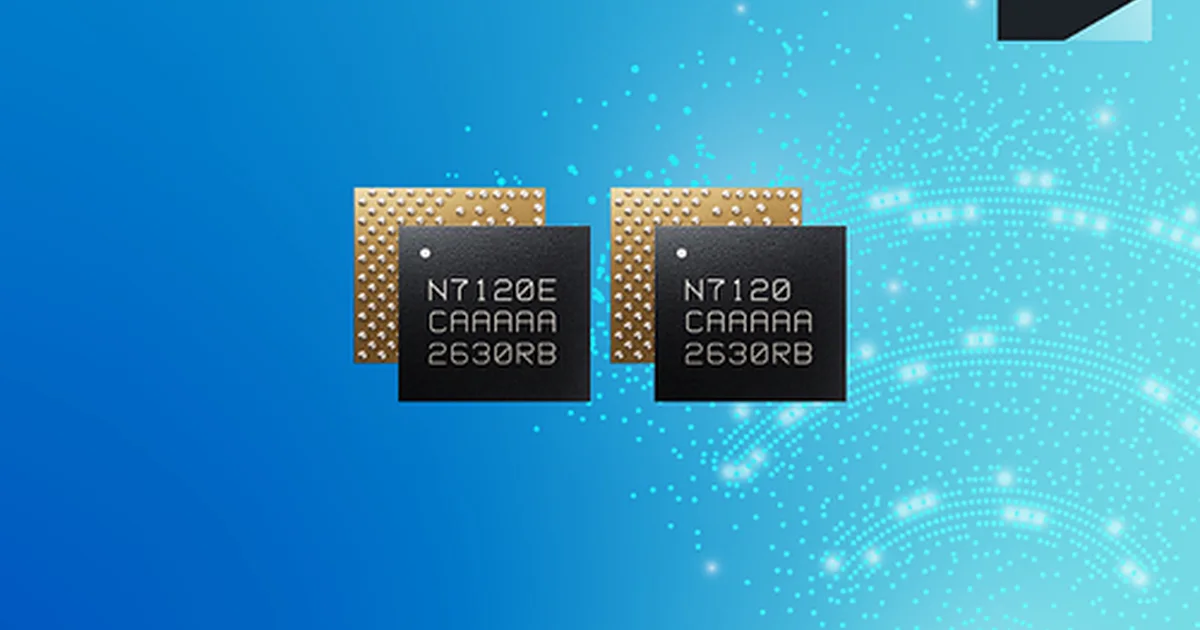
Nordic Semiconductor announced the nRF71 Series on November 3, 2026, a family of ultra-low-power systems-on-chip that puts Wi-Fi, Bluetooth Low Energy, Thread and edge AI on a single chip. The pitch is aimed squarely at the devices that have had to choose between staying connected and staying alive on a battery: smart locks, sensors, wearables and smart-home hubs. Nordic says the new series uses up to 20 times less standby power than its current-generation nRF70 Series Wi-Fi products.
“Edge AI will be part of every connected device, but for those that run on a battery, Wi-Fi has demanded a power budget they could not afford,” said Kjetil Holstad, Nordic’s executive vice president for Wi-Fi and power management, in the announcement. “With the nRF71 Series, Nordic removes that barrier.” The first two parts are the nRF7120 and the nRF7120E. Both are now sampling with selected customers; Nordic has not announced a date for general availability.
Two radios, one application processor
The nRF71 Series carries two independent radios with separate radio-frequency and processing blocks: a Wi-Fi radio and a 2.4 GHz multiprotocol radio borrowed from Nordic’s latest nRF54 Series. Because both radios can receive at the same time, a device can hold its Wi-Fi connection to the cloud while still listening for Bluetooth LE or Thread traffic, instead of making one protocol wait for the other. That is what lets a battery-powered smart-home hub, Matter bridge or Thread border router run Wi-Fi, Thread and Bluetooth LE on one chip.
It is also a full application processor, not just a radio companion. Both parts combine the radios with a host processor on the same device, removing the need for a separate host microcontroller. Unite.AI’s report, drawing on Nordic’s product pages, adds the silicon detail: a 256 MHz Arm Cortex-M33 application processor plus a second 256 MHz RISC-V coprocessor for real-time tasks, with 4 MB of on-chip non-volatile memory and 1 MB of user-accessible RAM. The chips support Matter and NFC and use the same nRF Connect SDK as Nordic’s nRF54 and nRF70 parts, so existing Nordic developers are not starting from a new toolchain.
The AI lives on the E variant
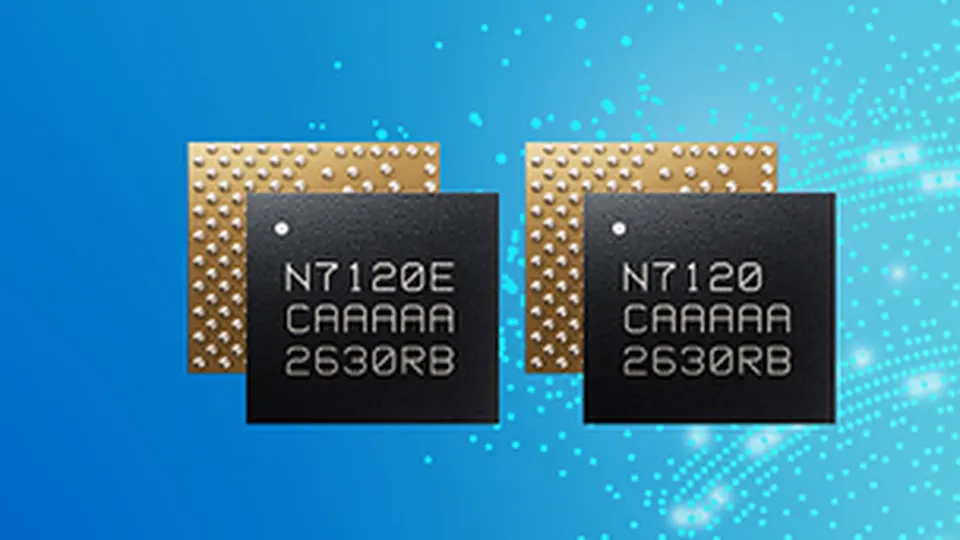
The two parts split on wireless bands and on AI. The nRF7120 offers dual-band Wi-Fi 6. The nRF7120E adds tri-band Wi-Fi 6E and the Axon neural processing unit for hardware-accelerated edge AI. With the Axon NPU, Nordic says, machine-learning models run 10 to 17 times faster than on the 256 MHz Cortex-M33 alone — enough to make keyword spotting, anomaly detection and image classification practical on battery-powered devices, with no external AI processor and fewer components. Processing locally also means a device can send just the inference result over Wi-Fi instead of a stream of raw sensor data.
The base nRF7120 is not left without an AI route. Nordic says the series can also run ultra-small models that developers build from their own data with its Neuton software, which suits running edge AI on the application processor alone. And models are not frozen at the factory: Nordic points to over-the-air model updates through nRF Cloud, so a shipped device can receive a new or retrained model after deployment.
Standby power is the headline number
The 20-times figure is a standby-power claim, and it is the number the whole announcement hangs on: up to 20 times lower standby power usage than current-generation nRF70 Series Wi-Fi products. Nordic lists average connected current at DTIM 10 of 14 microamps at 2.4 GHz and 8 microamps at 5 GHz for both parts, according to Unite.AI’s report, with Target Wake Time and Wi-Fi power save — plus a dedicated low-power receiver — enabled by default in the SDK. The operating pattern is a device that stays on the network between transmissions while consuming very little current in between, rather than waking, reconnecting and burning its budget on housekeeping.
Read the claim for what it is: a vendor figure for standby, not a promise about battery life in a finished product. Real-world life will depend on how often the device transmits, how much inference it runs, and how the application is written. What the number does establish is Nordic’s target — Wi-Fi devices that can stay connected for years on a battery, a combination that has previously forced designers toward Bluetooth-only designs or mains power.
Sampling now; the module is still earning its certifications
Nordic is targeting battery-powered smart-home hubs, Matter bridges, Thread border routers, Matter-enabled smart locks, security panels, wearables and industrial sensors. It will show the series, including a Nordic-branded module, at Electronica in Hall C6, booth 159. The module packages either SoC in a 10 × 14 mm package, and Unite.AI notes its pin-compatible variants let a board move between dual-band Wi-Fi 6 and tri-band Wi-Fi 6E with Axon acceleration without a redesign — though FCC, CE and Japan certifications for the module are planned, not yet completed.
The honest summary is a strong architecture with limited initial availability. The radios, processor and optional accelerator are integrated and specified; the proof now sits with the selected customers sampling the parts, whose finished products will show whether the standby-power and on-device inference claims survive contact with real batteries, real networks and real workloads. If they do, the nRF71 removes a long-standing excuse for keeping intelligence in the cloud: the chip in the lock, the sensor or the hub will be able to decide for itself, and still last.
Frequently asked questions
What did Nordic announce on November 3, 2026?
The nRF71 Series of ultra-low-power systems-on-chip, combining Wi-Fi, Bluetooth Low Energy, Thread and edge AI on a single chip. The first parts are the nRF7120 and nRF7120E, now sampling with selected customers.
Which nRF71 chip has the AI accelerator?
Only the nRF7120E, which adds tri-band Wi-Fi 6E and the Axon neural processing unit. Nordic says the Axon NPU runs machine-learning models 10 to 17 times faster than the 256 MHz Arm Cortex-M33 alone. The base nRF7120 has dual-band Wi-Fi 6 and no dedicated accelerator, but can run ultra-small models built with Nordic's Neuton software on its application processor.
Can developers buy the nRF71 Series now?
Not generally. The series is sampling with selected customers, and developers are directed to contact their local Nordic sales representative for availability. Nordic has not announced a general-availability date, and certifications for the Nordic-branded module are still planned.