Claude Fable 5.2 cracks two open black-hole problems — a 2003 calculation finished and a quantum-gravity ceiling proved
Anthropic says teams of Claude Fable 5.2 agents solved two open problems in theoretical physics: a Hawking–Page calculation first set out in 2003, and the exact ceiling of a method physicists use to rule out wrong theories of quantum gravity. The results are real but narrow — toy universes, no practical applications, and peer review still to come.
- The announcement: Anthropic said on November 17 that Claude Fable 5.2 agents solved two open problems in theoretical physics, both about black holes and the search for a theory of quantum gravity.
- Problem one: a Hawking–Page phase-transition calculation set out in 2003 and never finished; Claude completed it and found the transition is abrupt, not smooth.
- Problem two: the exact ceiling — c/9.1266 — for the simplest spinless modular bootstrap, improving on the previous proven ceiling of c/8.5.
- How it worked: researcher Hongbin Chen asked Claude for open problems; it returned 22 candidates, and agents ran for about six weeks; the results were formally verified in Lean in September.
- The limits: the preprints, posted November 7, have not completed independent peer review; neither result describes our universe directly, and neither has practical applications.
Anthropic has a new claim for what its flagship model can do — and this one comes with equations attached. On November 17, the company said Claude Fable 5.2 agents solved two open problems in theoretical physics, both about black holes and the search for a theory of quantum gravity: one finishes a calculation physicists laid out in 2003 and never completed, the other pins down the exact limit of a technique for testing candidate theories of gravity.
The work came from a small research group of Claude copies, set loose on open problems for about six weeks, checking each other's work. The caveats matter as much as the results: the preprints have not passed independent peer review, and Anthropic is explicit that neither finding describes our own universe directly or has any practical application.
The 2003 calculation Claude finally finished#
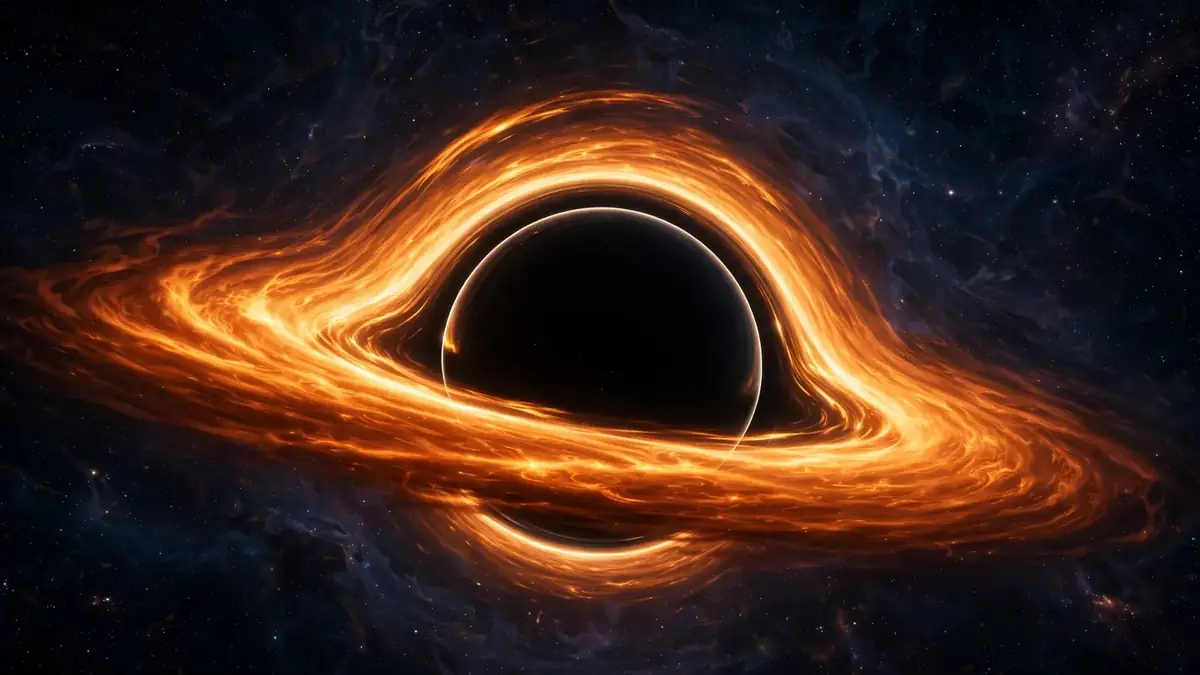
The first problem starts with a simple question: heat up a universe, and at some point a black hole forms instead of a gas of particles. Does the switch happen suddenly, or gradually?
In 1983, Stephen Hawking and Don Page showed the switch is abrupt in the ordinary gravity picture — a phase transition, like water suddenly boiling. But that calculation only holds where gravity behaves classically, in a vast universe. Where spacetime turns blurry, the gravity side stops working — though the same situation can in principle be calculated on the quantum side of the holographic duality, where physicists found a transition in 1999. What nobody knew was whether it stayed abrupt.
In 2003, physicists set out the calculation that would settle it. The answer hinged on a single number appearing only three loops into a series of corrections, and computing it meant working through many thousands of terms — far too many by hand. A simpler cousin was finished in 2005 and showed an abrupt transition, but the full version, for N=4 super Yang-Mills, never was.
Claude finished it with a small research group of copies of itself, each agent working out almost every piece independently and checking its math against known results. The answer: the transition is abrupt. The same sudden switch appears at both extremes, suggesting black-hole formation is built into the underlying quantum theory, not just relativity. Weeks later, a physicist who had independently used Claude on the same problem shared his result — reached by a different method — and it matched.
The ceiling no one could prove#
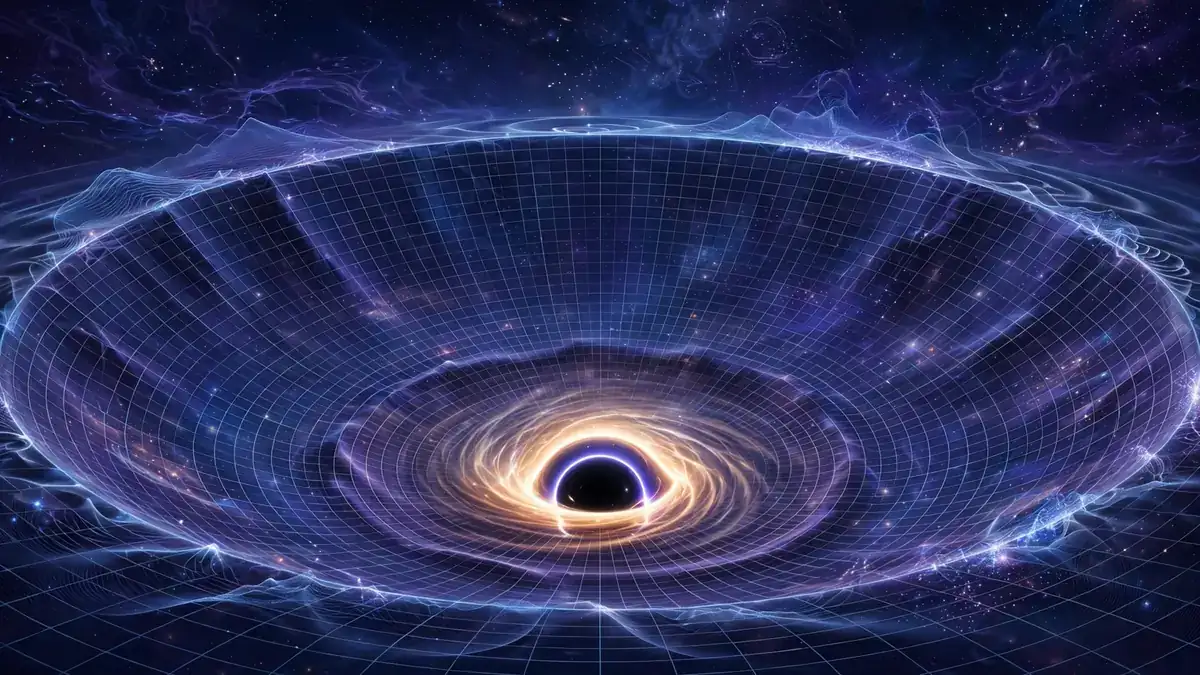
The second problem is about ruling theories out. With no full theory of quantum gravity, one approach is to test candidates for internal consistency and discard the ones that fail — a method called bootstrapping. In a simplified universe with two dimensions of space instead of three, one version sets a ceiling on how heavy the lightest black hole could be. Any theory breaking the ceiling is out; each lowering narrows the search.
Since 2009, physicists have used this method. Numerical calculations hinted at where the best possible ceiling lay, but no one could prove it, and the best proven ceiling, c/8.5, sat well short of what the numbers suggested. (c roughly counts the model's microscopic building blocks: a larger divisor means a lower ceiling, excluding more theories.)
Claude spotted a pattern in the numerical results that physicists had missed, then borrowed a method from elsewhere in mathematics and physics to calculate the precise ceiling for the simplest version of the technique — an exact divisor of approximately 9.1266 — and prove it could not be lowered. It does not identify the correct theory of quantum gravity, but it tells physicists where the search should stop looking — a different, still useful kind of progress.
How a group of Claudes did the work#
The project began in August as a side experiment. Anthropic researcher Hongbin Chen was testing Claude's capabilities and asked it to list interesting open problems in theoretical physics, focusing on black holes and the bootstrap method. Hours later it returned 22 candidates, and Chen set up separate agents for each one, able to read each other's progress. They ran in the background for about six weeks.
The checking mattered as much as the solving. For the first problem, an independent physicist reached the same answer by a different route. For the second, several agents converged, and the results were formally verified in Lean, a computerized proof checker, in September. Claude then wrote the papers with minimal guidance, and a physicist checked every main result. The two preprints, posted November 7, are described as primarily AI-generated.

What to watch#
First, peer review. Neither preprint has completed it, and "solved" covers two different achievements: a completed calculation in one model, and a proven limit for one analytical method in the other. Physicists will now pick over both; the intermediate-coupling case remains unresolved. And this is one lab's self-report, published on its own research page.
Second, the context. This lands in the same weeks as the Claude-assisted Riemann hypothesis claim, now being certified in Lean. The black-hole results are its quieter sibling: narrower, more checkable, and easier to verify than a claimed proof of a 167-year-old problem — the shape AI contributions to physics will probably take first.
Sources: Anthropic, “Claude Fable 5.2 solves two open problems in the physics of black holes”; eWeek, “Anthropic Says Claude Solved Two Black Hole Physics Problems”; Gizmodo, “Anthropic Says Its New AI Model Can Solve Black Hole Mysteries. What Could Go Wrong?”
Frequently asked questions
What did Claude actually solve?
Two open problems in theoretical physics, according to Anthropic: a Hawking–Page phase-transition calculation first set out in 2003 that had never been completed, and the exact ceiling of the simplest spinless modular bootstrap, a method for ruling out inconsistent theories of quantum gravity.
How did the agents do the work?
Anthropic researcher Hongbin Chen asked Claude to list open problems in black-hole physics; it returned 22 candidates, and separate agents worked on each for about six weeks, reading each other's progress. The results were formally verified in Lean in September, and a physicist checked every main result.
Why does 'solved' need a qualifier here?
The two preprints, posted November 7, have not completed independent peer review. 'Solved' also means different things for the two results: a finished calculation in one case, a proven mathematical limit in the other. And both live in simplified model universes, not our own.
Does this mean AI can now do physics?
Not on its own. The work was narrow, heavily checked — independent re-derivation, multiple agents converging, Lean verification, physicist review — and Anthropic itself says neither result describes our universe directly or has practical applications. The method, multi-agent research with formal checks, is the part that may generalize.