Fleet Tau 3.8: AI world model trained on 10 million synthetic Earths cuts copper-grade error by 38%
Fleet Space Technologies launched Tau 3.8 in the United States and Canada on November 10, 2026 — an AI “world model” for mineral systems trained on ten million synthetic geological worlds. At a copper-gold project in Chile, it predicted copper grades with 38% less error than the conventional method, on drillholes it had never seen.
What we checked: Fleet’s own announcement on PR Newswire, published November 10, 2026 at 11:15 a.m. ET, cross-checked against CoinDesk’s same-day report on the launch.
- What: Tau 3.8, an AI “world model” for mineral systems from Fleet Space Technologies.
- When: launched November 10, 2026 in the United States and Canada.
- Training: ten million synthetic geological worlds; combines 3D seismic, drilling, geology, geophysics and mineralogy data.
- Proof point: at ATEX Resources’ Valeriano copper-gold project in Chile, 38% less error than conventional kriging on held-back drillholes; up to 67% less on the deepest step-out holes.
- Why it matters: S&P Global forecasts data-center copper demand more than doubling, from 1.1 million metric tons in 2025 to 2.5 million by 2040, with AI training accounting for 58% of that demand by 2030.
- Built with: Nvidia on accelerated computing; the team includes geoscientists with more than 200 years of combined experience across 400-plus programs, and machine-learning leaders from Caltech and the University of Oxford.
How Tau 3.8 works#
World models — AI systems that learn how the physical world behaves rather than predicting the next word — have become one of the most closely watched frontiers in AI. Most of the attention has gone to robotics, video and self-driving cars. Fleet has pointed the approach at an environment far harder to observe than any road or factory floor: the rock kilometres beneath your feet. Here is the mechanism, step by step.
Step 1: build ten million fake Earths. Fleet’s team generated 10 million simulated geological environments — plausible underground worlds with different rock layers, fault lines and ore bodies. It is the same trick behind synthetic training data for physical AI: when real examples are scarce and expensive, you manufacture the training set.
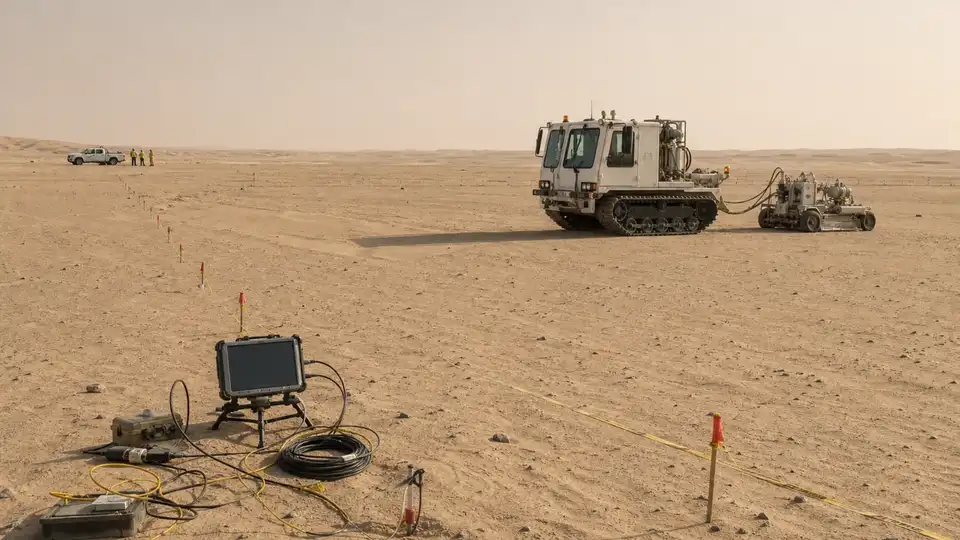
Step 2: simulate what the sensors would see. For each synthetic world, the team modelled what Fleet’s seismic sensors and drillholes would detect in it — the sparse, partial signals a real survey actually produces. A drillhole samples a needle of rock; everything between holes is guesswork.
Step 3: train Tau to infer the rest. Tau learns to reconstruct the hidden geology from those partial measurements. “Mineral systems are three-dimensional, buried and understood through observations that are sparse and costly to acquire,” said Fleet Chief Scientific Officer Dr. Gerrit Olivier. “Fleet’s approach was to build ten million simulated geological environments, model what seismic sensors and drillholes would detect in each, and train Tau to infer the geology between those partial measurements.”
Step 4: let seismic narrow the guesses. AI can generate millions of plausible versions of what lies underground, and many of them will fit the same sparse data. Seismic provides the physical evidence to tell them apart, constraining the depth, geometry, orientation and continuity of structures in the vast volumes between drillholes.
Step 5: rank the targets, recommend the next measurement. Tau reconstructs hidden geology, ranks targets for resource expansion, and identifies which new measurement would most reduce uncertainty — so a mining company can decide where to drill next with far more confidence. Fleet calls this loop Agentic Geoscience. “Tau does not remove the geologist from the decision,” said Fleet co-founder and CEO Flavia Tata Nardini. “It gives them a quantified view of uncertainty before the drill bit provides the answer.”
The worked example: Valeriano#
The concrete test happened at ATEX Resources’ Valeriano copper-gold project in Chile. Tau combined Fleet’s ambient noise tomography (ANT) and magnetotelluric (MT) surveys with Comet and machine learning, then predicted copper grades on drillholes it had never seen. The results, against a conventional geostatistical estimate (kriging) built from the same drilling:
| Test | Tau 3.8 vs conventional kriging |
|---|---|
| Held-back drillholes, overall | 38% less error |
| Deepest step-out holes | Up to 67% less error |
That matters because drilling is typically the largest cost in mineral exploration, and a single deep diamond drillhole can cost hundreds of thousands of dollars. Predicting grades more accurately from the drilling already in hand means fewer holes ending in barren ground — and resources defined and expanded with less drilling, in less time, at lower cost. One footnote worth keeping: Fleet says the conventional estimate was an independent exercise, not related to the project’s 2025 SRK Mineral Resource Estimate.
What launched today#
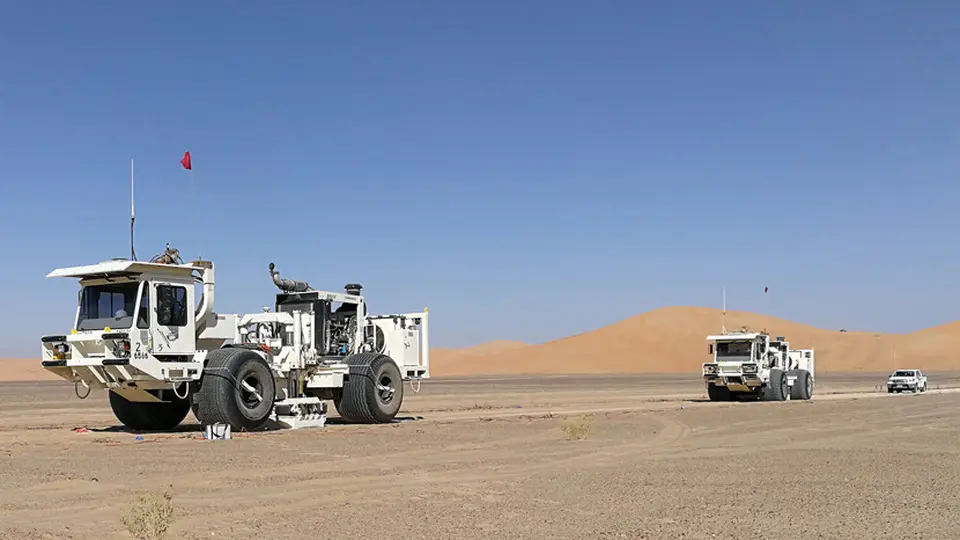
Tau 3.8 launched on November 10, 2026 in the United States and Canada, extending Fleet’s flagship ExoSphere platform — a satellite network, rapid 3D seismic data acquisition and AI that images mineral systems in near real time — into what the company calls Agentic Geoscience. Fleet is already working in the field, from Barrick’s Reko Diq copper-gold project in Pakistan to Lundin Gold’s Fruta del Norte gold mine in Ecuador, Fermi Exploration’s Perch River project in Canada’s Athabasca Basin, Southern Cross Gold’s Sunday Creek project in Victoria, Australia, and Alkane Resources’ Boda-Kaiser project in New South Wales. Its wider customer base includes Gold Fields, Rio Tinto, Ma’aden, Standard Uranium, IsoEnergy, Q2 Metals and France’s geological survey, BRGM.
Fleet is backed by In-Q-Tel, Blackbird and Teachers’ Venture Growth, the late-stage venture arm of the Ontario Teachers’ Pension Plan. It is also working with Nvidia on the accelerated computing infrastructure needed to train the next generation of high-resolution subsurface models, and it is an industrial affiliate of Stanford University’s Mineral-X program, which connects researchers and industry on AI, geoscience and decision-making under uncertainty. Tata Nardini serves on the Mineral-X Advisory Council.
Why copper, why now#
Most of the debate about AI’s limits has focused on chips and power. Fleet argues the deeper constraint is discovery: every data center, transmission line and grid upgrade needs copper, and finding the deposits to supply it is still slow, expensive and uncertain. The numbers in its announcement:
| Figure | Value | Source |
|---|---|---|
| Data-center copper demand, 2025 | 1.1 million metric tons | S&P Global |
| Data-center copper demand, 2040 | 2.5 million metric tons | S&P Global forecast |
| AI training share of that demand by 2030 | 58% | S&P Global |
| Canadian copper production, 2014–2023 | Fell by nearly 25% | Natural Resources Canada |
| US reliance on copper imports | 57%, up from 45% a year earlier | US Geological Survey |
“North America is building an AI economy on a mineral base it hasn’t yet found,” Tata Nardini said. “Hyperscalers can order more GPUs and sign new power deals, but they can’t order a copper deposit into existence. The gap between what these economies need and what the industry can bring online is widening and mineral discovery has become a constraint on growth itself.” Copper is one of six priority minerals in Canada’s Critical Minerals Strategy.
What to watch#
The honest caveat is that the 38% figure is Fleet’s own test, on holes it held back itself — not an independent benchmark. The mechanism is sound and the Valeriano result is concrete, but one deposit’s geology is not every deposit’s geology. The announcement also gives no pricing and no detail on how Tau is sold or deployed beyond the US and Canada launch.
What to watch: whether a second operator publishes its own Tau results, which is when this stops being a vendor claim; whether the model holds up on different rock types and at other projects in Fleet’s pipeline; and how fast the Nvidia-backed training pipeline produces a higher-resolution successor. If the numbers replicate, exploration budgets get a lot sharper — and the AI build-out’s least-discussed bottleneck gets a real tool.
Frequently asked questions
What is Fleet’s Tau 3.8?
An AI “world model” for mineral systems, launched on November 10, 2026 in the United States and Canada. It was trained on ten million synthetic geological worlds and combines 3D seismic, drilling, geology, geophysics and mineralogy data to reconstruct hidden geology, rank targets for resource expansion, and recommend the next measurement that would most reduce uncertainty.
How much better was Tau 3.8 than conventional methods at Valeriano?
At ATEX Resources’ Valeriano copper-gold project in Chile, Tau predicted copper grades on drillholes held back from it with 38% less error than a conventional geostatistical estimate (kriging) built from the same drilling — and up to 67% less error on the deepest step-out holes. Fleet notes the conventional estimate was an independent exercise, unrelated to the project’s 2025 SRK Mineral Resource Estimate.
Why does copper matter for AI?
S&P Global forecasts data-center copper demand more than doubling, from 1.1 million metric tons in 2025 to 2.5 million by 2040, with AI training accounting for 58% of that demand by 2030. Meanwhile Canadian copper production fell by nearly 25% between 2014 and 2023, and the US now relies on imports for 57% of the copper it consumes.