NVIDIA’s GR00T 2 teaches robots dexterous skills by watching human video
The hardest thing to teach a robot is not walking across a room — it is picking up a cable and plugging it in. At the Conference on Robot Learning in Austin on Monday, NVIDIA unveiled a model for exactly that problem: GR00T 2, a robot foundation model trained largely on video of humans doing manual work, which can take on a new dexterous task after watching a person do it once — and, by NVIDIA’s own measurements, gets it right 95% of the time after five demonstrations.
What we checked: NVIDIA’s CoRL blog post “Practice Makes Precise,” published November 9, 2026, cross-checked against The Robot Report’s November 9 coverage and MLQ’s report. Performance figures are NVIDIA’s own test results; no independent replication has been published.
- What: GR00T 2, an open frontier world action model for robots built on NVIDIA Cosmos, plus Isaac Lab 3.0, an open-source robot-learning framework.
- When: unveiled Monday, November 9, 2026, at the Conference on Robot Learning (CoRL) in Austin, Texas.
- The headline numbers: 40 of 50 tasks completed with no demonstrations; 71% average success with one demonstration per task; 95% with five — NVIDIA’s own tests, not independently verified.
- Training data: 402,730 hours of first-person human video in the pretraining mix, per NVIDIA’s research materials; 100,000 hours released openly as Human-1M-100K under a CC BY 4.0 licence.
- The asterisk: model code is due in December; NVIDIA has announced no release date or licence for the weights.
- Early users: Nexuni (laundry handling), Foxconn (server manufacturing), Siemens (industrial work) and MicroAGI (Ethernet cable swapping) — all testing or evaluating, none deployed.
Learning by watching#
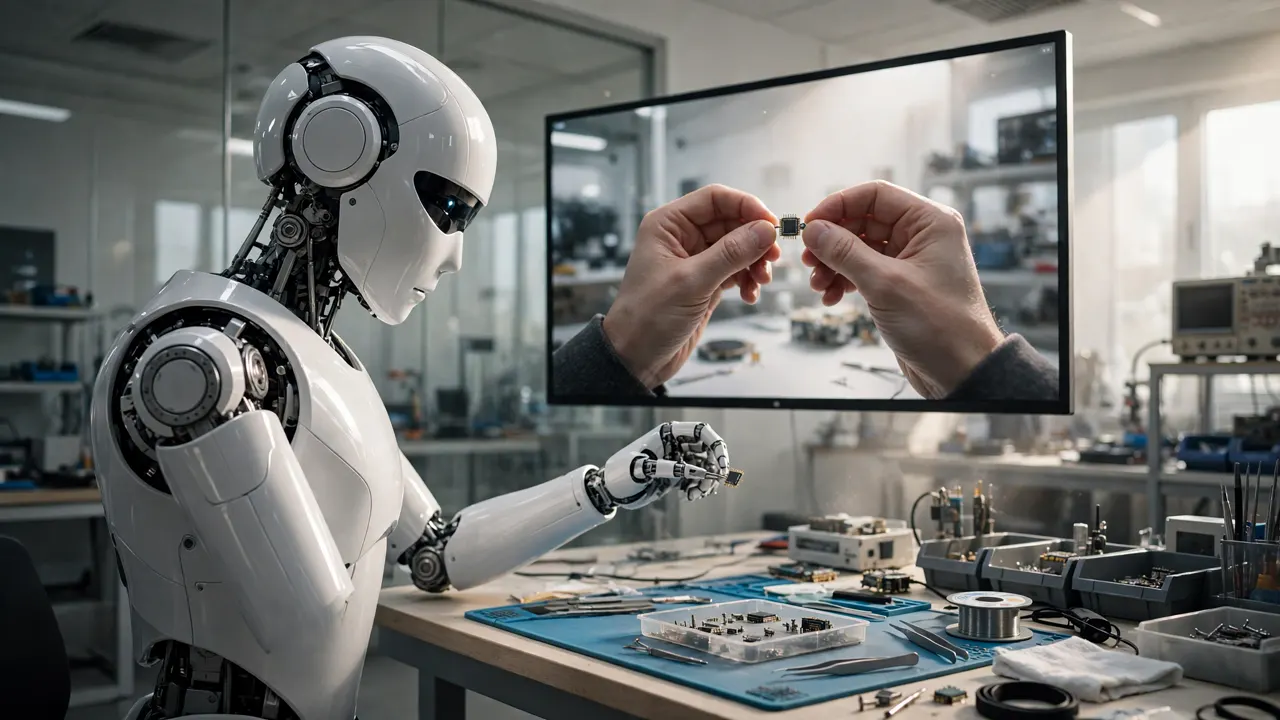
GR00T 2 is what NVIDIA calls a world action model. It is built on Cosmos, the company’s family of world models, and it does two things at once: it predicts what a scene will look like as a task unfolds and the robot actions that get it there. The idea is that a model which can imagine the future of a manipulation task is better at choosing the next move than one that only maps camera images to joint angles.
The training data is the interesting part. Alongside robot demonstrations, NVIDIA fed the model first-person video of humans at work. NVIDIA’s research materials put the pretraining mix at 402,730 hours of first-person human video; 100,000 of those hours are being released openly as a dataset called Human-1M-100K, under a Creative Commons licence that allows commercial use. The bet is that the cheapest way to teach a robot to handle objects is to show it how people already do.
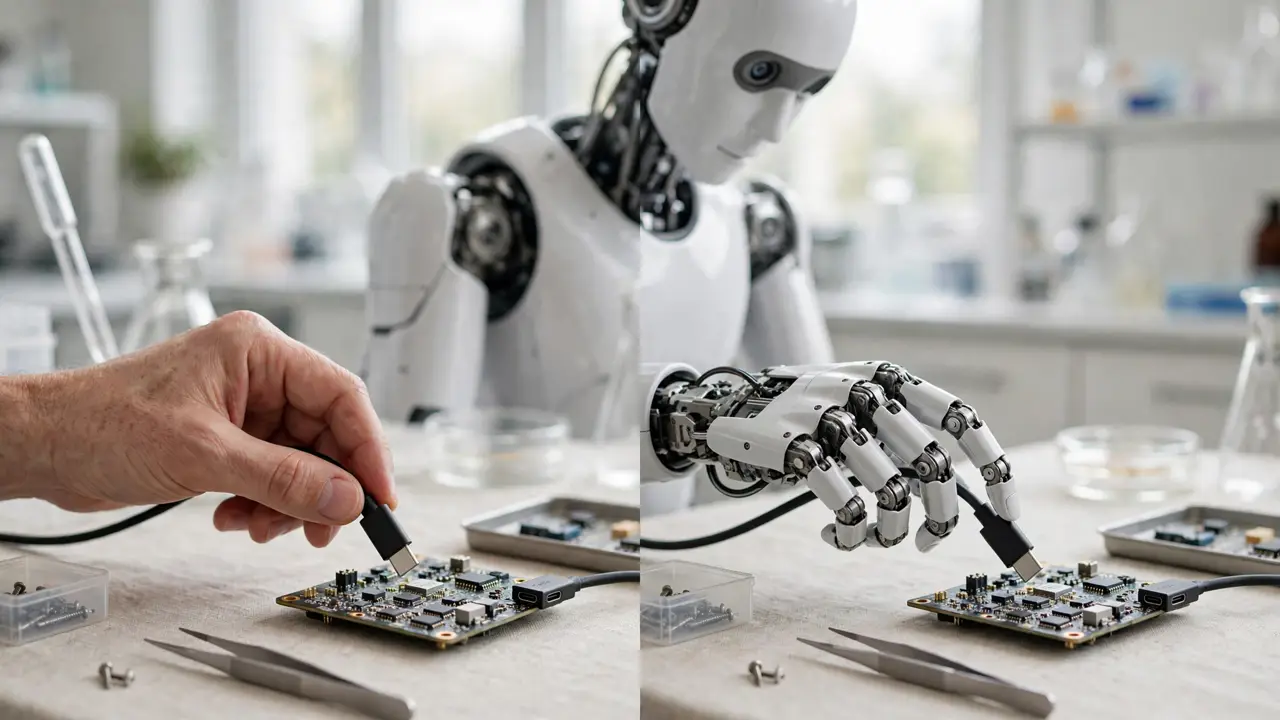
That bet shows up in the model’s most useful trick: skill transfer between robot bodies. GR00T 2 can learn a skill from human demonstrations and carry it to a different robot without new robot demonstrations — useful because collecting robot data is slow and expensive, while human video is everywhere.
The numbers NVIDIA is claiming#
NVIDIA tested GR00T 2 on 50 manipulation tasks. With no task-specific demonstrations at all, the model completed 40 of the 50 tasks at least once. With one demonstration per task, average success reached 71%. With five, it hit 95%. The company also says the model ranks among the top three in its categories across four benchmarks — RoboCasa365, RoboLab, RoboDojo and MolmoSpaces — with several leaderboard wins.
Treat those figures as the vendor’s, not the field’s: they come from NVIDIA’s own evaluation, with no independent replication published. What makes them worth noting anyway is the shape of the curve: the jump from zero demonstrations to one is the steep part, and that is the part that matters for deployment. A robot that needs five examples of a new job is a robot a factory can actually train.
There is also an agent layer. AI agents can call GR00T 2’s programming interface to chain skills together and recover when a step fails — the difference between a demo that works once and a system that keeps working when a part slips.
Open, with an asterisk#
NVIDIA calls GR00T 2 an open frontier model, but the word is doing heavy lifting. The 100,000-hour dataset is genuinely open, under a Creative Commons licence. The model itself is not downloadable yet: the code arrives in December, and NVIDIA has announced no release date or licence for the weights. Until then, “open” describes the research direction, not something you can run.
The early users are real companies, not just labs — all four testing or evaluating, none deployed:
- Nexuni — robotic laundry handling (testing)
- Foxconn — server manufacturing (applying it to factory automation)
- Siemens — industrial use cases (evaluating)
- MicroAGI — Ethernet cable swapping with a YAM robotic arm, using a version post-trained with reinforcement learning
Simulation does the heavy lifting#
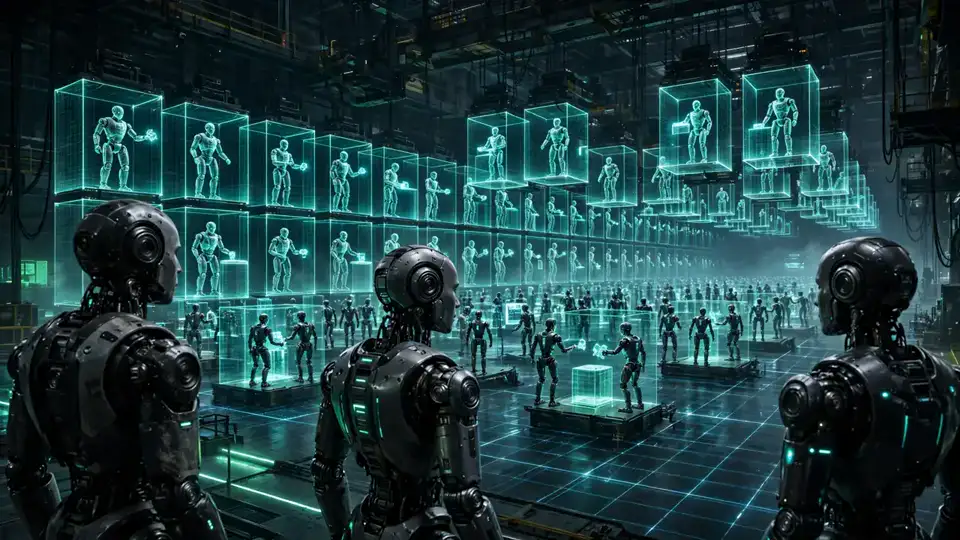
The model is only half of what NVIDIA brought to Austin. The other half is Isaac Lab 3.0, the open-source framework where robot skills are trained in simulation before they touch hardware. Its new release lets AI agents set up training environments, switch between the PhysX and Newton physics solvers, and apply a reinforcement-learning post-training library to models like GR00T 2.
The Newton engine models deformable objects — cables, cloth — and robotic hands with many interacting joints, the exact things that used to break the jump from simulation to the real robot. On a vision-based dexterous manipulation benchmark, NVIDIA says Isaac Lab 3.0 with Newton trains up to 2.5 times faster than Isaac Lab 2.3 with PhysX.
Two new benchmarks arrive alongside it: DexBench, built by RLWRLD with NVIDIA, testing dexterity across 15 tasks in retail, logistics, manufacturing and hospitality; and VABAR, from UC Berkeley and NVIDIA, scoring robots on six industrial tasks with standardised difficulty tiers. And in a line that will be quoted back at the company, UC Berkeley robotics professor Ken Goldberg called agentic robotics “the most exciting technological development since the internet in 1995.”
What to watch#
Three things decide whether GR00T 2 is a milestone or a demo reel. First, December: the code release, and whether the weights follow — and under what licence. A model behind an API is a product; a model with open weights is infrastructure, and the field will treat it very differently.
Second, independent numbers. NVIDIA’s 40-of-50 and 95% figures need replication on someone else’s hardware before they are more than a claim. The DexBench and VABAR benchmarks give the field a way to do that checking in public.
Third, the factory floor. If Foxconn or Siemens moves from evaluating to deploying GR00T 2 on a production line, “learn by watching” stops being a research story and becomes an industrial one. CoRL runs through Thursday, and the conference’s best-paper awards — two NVIDIA papers are among the six finalists — will say something about how the field itself judges the work.
Sources#
- NVIDIA Blog: Practice Makes Precise — At CoRL, NVIDIA and Partners Reveal How Robots Rehearse Delicate Work in Simulation (November 9, 2026)
- The Robot Report: NVIDIA launches GR00T 2 and Isaac Lab 3.0 at CoRL (November 9, 2026)
- MLQ: Nvidia launches GR00T 2, a robot model that learns new skills from human video, and Isaac Lab 3 at CoRL (November 9, 2026)