GIGABYTE AI TOP AERO: a 1-litre RTX Spark desktop that runs AI models locally on Windows 11
GIGABYTE launched the AI TOP AERO today, a one-litre desktop built on NVIDIA’s RTX Spark platform that runs large AI models locally on Windows 11 — no cloud, no subscription, no data leaving the desk. It is the Windows answer to GIGABYTE’s own Linux-based AI TOP ATOM, and the comparison between the two says a lot about where local AI is heading.
What we checked: GIGABYTE’s launch announcement on PR Newswire (dated today, November 10, 2026) and AAP News’ syndication of the same release, plus our own AI TOP ATOM coverage and published reviews of the ATOM and DGX Spark for the comparison specs.
- Who: GIGABYTE, building on NVIDIA’s RTX Spark platform.
- What: AI TOP AERO, a “Personal AI Studio” desktop for local AI, content creation and gaming.
- When: Launched Tuesday, November 10, 2026; pricing and regional availability not yet announced.
- Chip: NVIDIA RTX Spark N1X Superchip — a 20-core Grace CPU plus a Blackwell RTX GPU.
- Memory and storage: Up to 128GB of LPDDR5x unified memory and up to a 4TB PCIe Gen5 SSD.
- Size and connectivity: About one litre; USB Type-C, 10GbE Ethernet and Wi-Fi 7; runs Windows 11.
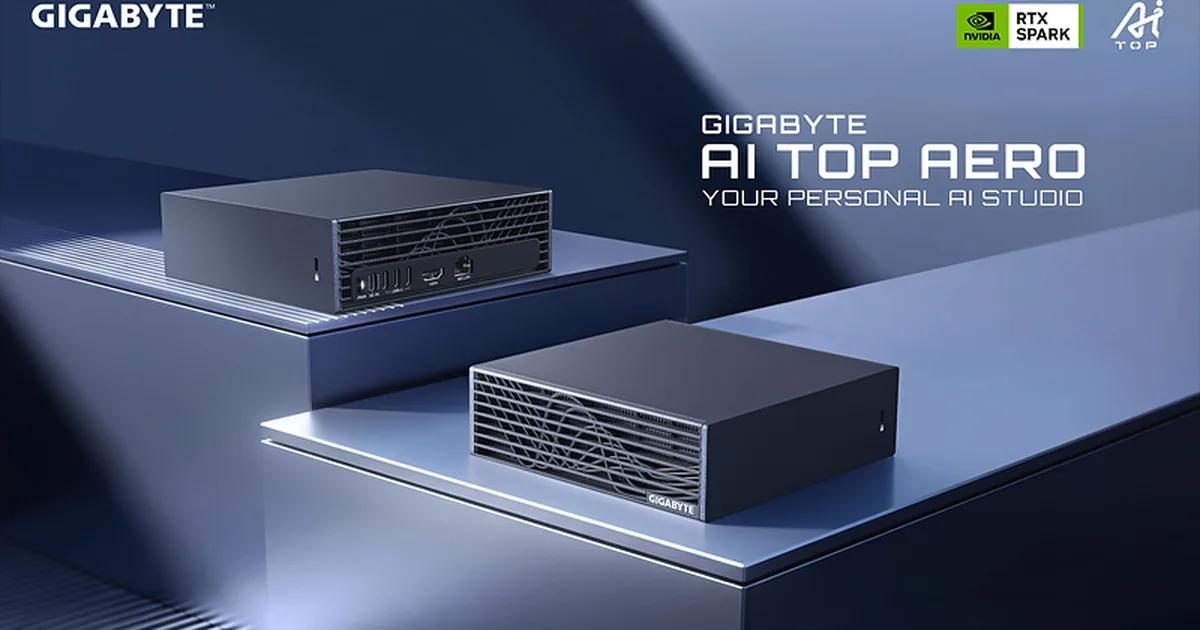
The pitch is a simple one: the cloud is optional now. GIGABYTE’s new box puts the model, the memory and the compute on your desk, in a chassis of about one litre — roughly the size of a lunchbox — and runs it under plain Windows 11. No data-center bill, no round trip to a server, no sending your documents to someone else’s computer to get an answer.
Three boxes, one idea#
Local AI desktops have converged on one formula: a Grace CPU stitched to a Blackwell GPU, 128GB of unified memory, a one-litre box. The differences are the operating system, the chip variant and the price. Here is the field as it stands today.
| AI TOP AERO (new) | AI TOP ATOM | DGX Spark Founders Edition | |
|---|---|---|---|
| Superchip | NVIDIA RTX Spark N1X | NVIDIA GB10 Grace Blackwell | NVIDIA GB10 Grace Blackwell |
| CPU | 20-core NVIDIA Grace | 20-core Arm (10× Cortex-X925 + 10× Cortex-A725) | 20-core Arm |
| Unified memory | Up to 128GB LPDDR5x | 128GB LPDDR5x | 128GB LPDDR5x |
| Operating system | Windows 11 | DGX OS (Ubuntu Linux) | DGX OS (Ubuntu Linux) |
| Price | Not announced | 128GB 2TB model listed at $7,499 | $6,950 (128GB, reported) |
| Best for | Windows users who want local AI plus creation and gaming | Linux developers running always-on agents | The reference design, straight from NVIDIA |
AI TOP AERO: the Windows one#
The AERO’s trick is the same one that makes the whole category work: unified memory. The 20-core Grace CPU and the Blackwell GPU share a single pool of up to 128GB of LPDDR5x, so a model that fits in memory runs without shuttling weights back and forth between system RAM and graphics memory. GIGABYTE pairs that with up to a 4TB PCIe Gen5 SSD and its own cooling design in the one-litre chassis, built to hold up under inference and generation workloads that keep a machine busy for hours.
The software stack is where the Windows choice pays off. Developers can build, prototype, fine-tune and run open models locally with NVIDIA’s Nemotron models and CUDA-accelerated tools, or reach for familiar apps like LM Studio and Ollama. GIGABYTE also points to NVIDIA PAIR (Personal AI Router), which spreads inference jobs across devices on a local network, and to the same RTX Spark tooling we covered when NVIDIA declared the platform “all systems go” last month. Creators get ComfyUI for generative workflows plus NVIDIA Broadcast and RTX Video; gamers get a Blackwell GPU with DLSS 5. One box, three jobs.
AI TOP ATOM: the Linux one#
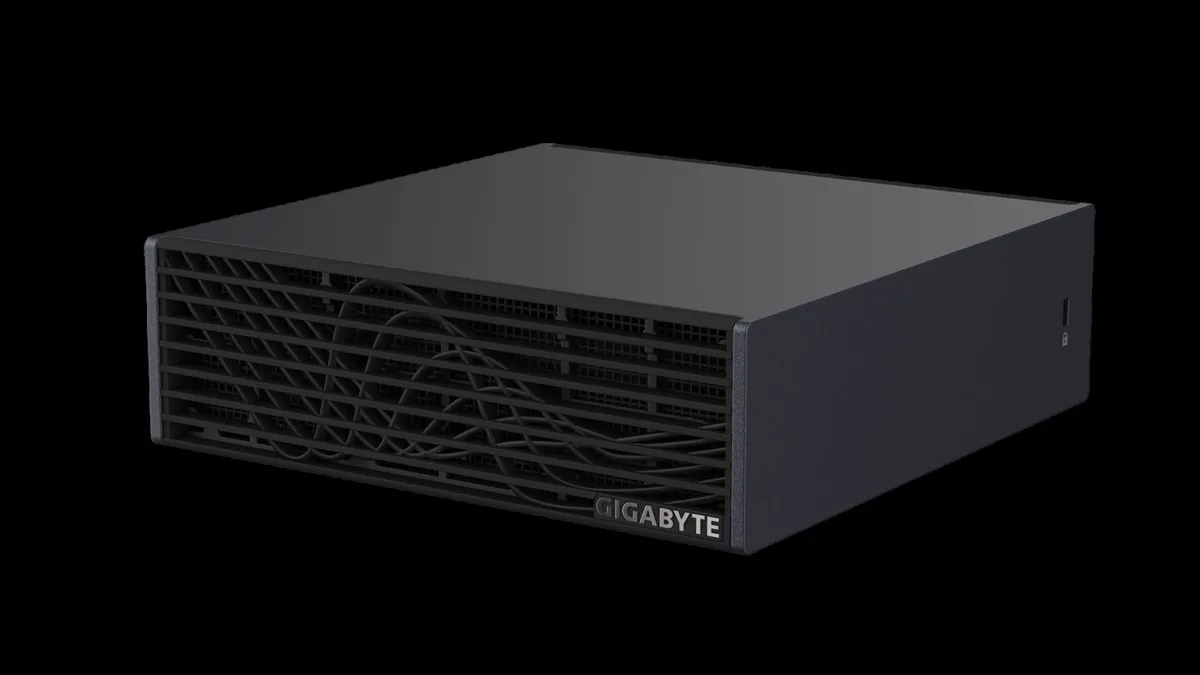
The ATOM is the machine the AERO has to live up to. GIGABYTE’s take on NVIDIA’s DGX Spark runs the GB10 Grace Blackwell superchip — the same 20-core Arm CPU and Blackwell GPU, with 6,144 CUDA cores and up to 1 petaflop of sparse FP4 performance — under DGX OS, NVIDIA’s Ubuntu-based system. Independent testing found it can run roughly 200-billion-parameter models in FP4 on a single unit, while drawing around 50 watts at the wall under load. GIGABYTE added a 64GB ATOM in October, and up to four of those can be clustered into a 256GB memory pool.
The ATOM is a developer’s machine through and through: Linux, a terminal, agents that stay running around the clock. Its weakness was never the silicon — it was the audience. Plenty of people who want local AI live in Windows, and they were never going to switch operating systems for it. That is the gap the AERO is built to fill.

DGX Spark: NVIDIA’s own#
The third box in the table is the reference everything else is measured against. NVIDIA’s own DGX Spark Founders Edition carries the same GB10 chip and 128GB of memory as the ATOM, under the same DGX OS. NVIDIA’s updated price for the 128GB Founders Edition is a reported $6,950, and a 64GB version starts at a reported $4,999 — the price floor for this class of machine. RTX Spark laptops start lower, at $2,599, but they are laptops, with laptop thermals and laptop compromises.
The verdict#
If you live in Windows, the AERO is the box to wait for; if you live in Linux, the ATOM is already on shelves and reviewed. The real question is the one GIGABYTE hasn’t answered: price. This class of machine starts at roughly $5,000 and runs past $7,000, so the AERO is a serious workstation purchase, not an impulse buy — and until GIGABYTE names a number, the value case is unfinished. The other open question is speed: the N1X is a new chip variant and no independent benchmarks exist yet, so the ATOM’s measured performance is the only hard evidence in the family. Buy the idea, but wait for the price tag and the first benchmarks before buying the box.
Sources: GIGABYTE, “GIGABYTE Expands Its Local AI Portfolio with the Launch of AI TOP AERO Powered by NVIDIA RTX SPARK™” (November 10, 2026), here; AAP News, syndication of the same release, here; ATOM and DGX Spark specifications and pricing from Back2Gaming’s ATOM review and Prof. Peter Falkingham’s ATOM review.