Google Cloud's A5X brings NVIDIA Vera Rubin to the cloud: GA in November, 960,000 GPUs in the pipeline
- Who: NVIDIA and Google Cloud, announcing jointly at GTC Berlin on October 21, 2026.
- What: A5X cloud instances powered by NVIDIA Vera Rubin NVL72; general availability next month (November 2026), with expansion to Europe planned.
- Hardware: Vera Rubin NVL72 rack systems plus NVIDIA ConnectX-9 SuperNICs, the Google Cloud Virgo Network, and fourth-generation liquid cooling.
- Scale: Google Cloud plans to run as many as 960,000 Rubin GPUs across multiple sites.
- First customer: Ineffable Intelligence, the London company founded by AlphaGo creator David Silver, for large-scale reinforcement learning.
- Proof point: WPP ran multistep creative-agent workflows on a single A5X instance — jobs that previously needed a multi-node cluster.
- Security: NVIDIA Confidential Computing at rack scale on bare-metal A4X Max (GB300 NVL72); GA on G4 VMs with RTX PRO 6000 Blackwell GPUs.
Google Cloud's first Vera Rubin instances are about to go public. NVIDIA and Google Cloud announced on October 21, 2026, at GTC Berlin, that A5X instances — powered by NVIDIA's Vera Rubin NVL72 rack systems — will reach general availability next month, with availability expanding to Europe afterward. Google Cloud also said it plans to scale its Vera Rubin infrastructure to as many as 960,000 GPUs across multiple sites, one of the largest single-generation AI infrastructure build-outs ever announced by a cloud provider.
The announcement matters because Rubin is the architecture the next wave of AI training and inference is being planned around — and until now, access has mostly meant waiting lists and private previews. A5X puts the platform on a cloud bill.
Inside the A5X
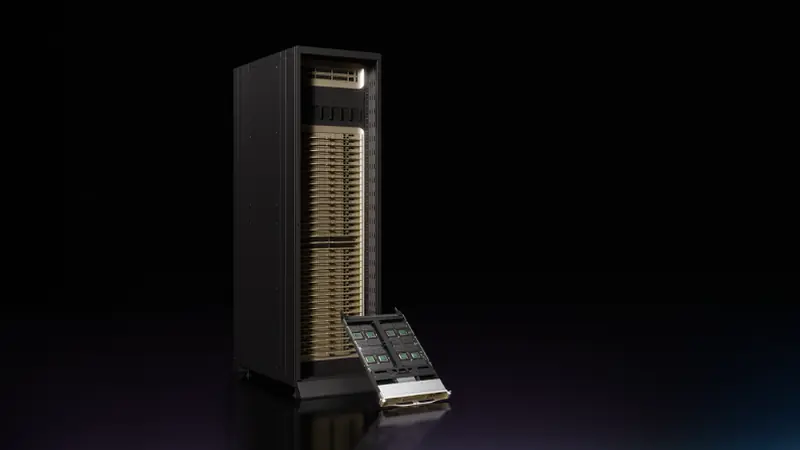
Each A5X instance combines NVIDIA Vera Rubin NVL72, NVIDIA ConnectX-9 SuperNICs, the Google Cloud Virgo Network, and Google Cloud's fourth-generation liquid-cooling technology. The combination targets two workloads that are hard to serve at once: agentic inference, where response quality depends on fast multi-step reasoning, and large-scale reinforcement learning, where the bottleneck is the continuous loop between generating experience and training on it.
A5X folds Vera Rubin into Google Cloud's AI Hypercomputer as an integrated system, tying compute, networking and storage together to support what the companies call experience-driven learning — a continuous cycle of generating experience, evaluating outcomes and updating models. And scale is the headline: Google Cloud plans to run as many as 960,000 Rubin GPUs across multiple sites.
First through the door
The first customer is Ineffable Intelligence, the London-based technology company founded by AlphaGo creator David Silver, which is using A5X for large-scale reinforcement learning research aimed at “superlearner” systems that learn continuously from experience. “We're building superlearners that continually improve through their own experience,” said Silver. “That demands both substantial compute and a tight connection between generating experience and training on it, so each improvement in the agent can quickly shape its next experience.” Vera Rubin's combination of compute performance and high-bandwidth connectivity — between the Vera CPU and Rubin GPUs, and between the Rubin GPUs within the rack — lets the company “push the scale and ambition” of its reinforcement learning research further, he said.
Marketing giant WPP, also London-based, demonstrated its creative agent reference architecture on A5X, built on NVIDIA Nemotron models and NVIDIA OpenShell — part of NVIDIA's OpenShell Reference Architecture for running AI agents with safety guardrails. The agents turn conversational requests into multistep creative workflows — video generation, upscaling, restyling — with human approval required before execution, while OpenShell's governed sandboxes control access to sensitive brand assets and creative tools. In WPP's initial tests, workloads that typically required a multi-node cluster ran on a single A5X instance.
Confidential computing goes rack-scale
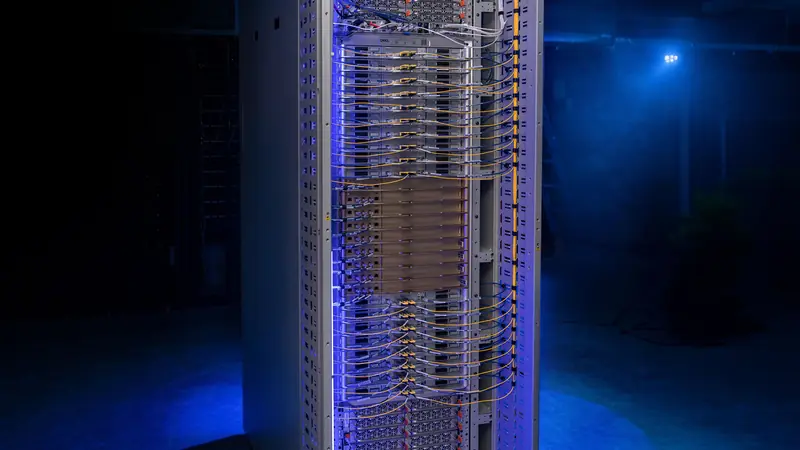
Security is the other half of the announcement. Google Cloud will be among the first cloud providers to offer NVIDIA Confidential Computing at rack scale on bare-metal instances such as A4X Max, powered by NVIDIA GB300 NVL72 — hardware-backed protection for proprietary models and sensitive data running on infrastructure the customer doesn't own. Confidential Computing is also generally available on G4 VMs powered by NVIDIA RTX PRO 6000 Blackwell Server Edition GPUs, a flexible option for confidential inference and fine-tuning already in use by Vertebrae, Polaris Cloud and Confidential Core AI for conversational privacy, verifiable agent execution and policy-governed enterprise intelligence.
Efficiency is the quiet footnote: the two companies are exploring NVIDIA DSX MaxLPS for Vera Rubin-based infrastructure to optimize performance per watt and fit more capacity within available data-center power budgets — the practical limit on how fast any of these builds can scale.
The Rubin era is arriving as a rental, not a purchase. For most AI teams, the question was never whether Vera Rubin would be fast — it is whether the cloud stack around it can keep nearly a million GPUs fed, networked and cool. Google Cloud's answer lands next month with the A5X.
Frequently asked questions
When will Google Cloud's Vera Rubin A5X instances be available?
General availability is coming next month (November 2026), the companies announced on October 21, 2026 at GTC Berlin, with a planned expansion of availability to Europe.
What hardware powers an A5X instance?
Each A5X instance combines NVIDIA Vera Rubin NVL72 rack systems with NVIDIA ConnectX-9 SuperNICs, the Google Cloud Virgo Network, and Google Cloud's fourth-generation liquid-cooling technology, integrated into Google Cloud's AI Hypercomputer for training, inference and large-scale reinforcement learning.
Who is already using A5X?
Ineffable Intelligence, the London-based technology company founded by AlphaGo creator David Silver, was the first customer to access A5X, using it for large-scale reinforcement learning. Marketing company WPP has also demonstrated its creative agent reference architecture on A5X, using NVIDIA Nemotron models and NVIDIA OpenShell.