GPT-6 Astra helped a Stanford physicist write a quantum-gravity paper — the preprint is real, the ‘physics solved’ hype is not
Venkatesa Chandrasekaran’s 54-page preprint proposes a new algebraic quantization of vacuum gravity — built over months with GPT-6 Astra, some 400 million tokens of it. Reddit called it physics’ holy grail. The paper itself is more careful than that.
- The paper: “An algebraic quantization of gravity from the null cone,” Venkatesa Chandrasekaran (Stanford), arXiv:2611.34924, submitted November 25, 2026, 18:58 UTC; 54 pages plus appendices.
- The AI role: the acknowledgements say several calculations and proofs were developed “through detailed, back and forth collaboration with GPT-6 Astra over the course of many months, amounting to ~400M total tokens spent”; OpenAI provided the compute.
- The reaction: two r/singularity threads, November 26, 1:27 and 1:32 a.m. ET, drew about 560 and 850 upvotes; the top comments call the author legitimate and the work serious — and correct the framing.
- What’s missing: no peer review, no experimental test, no OpenAI authorship — Chandrasekaran is the sole author.
On Tuesday afternoon, Stanford physicist Venkatesa Chandrasekaran posted a 54-page preprint to arXiv with a striking claim: a new algebraic quantization of vacuum gravity, built from the physics of light cones. By early Wednesday morning, two Reddit threads sharing it had collected more than 1,400 upvotes and 460 comments, and the titles had already outrun the paper — “physics’ holy grail,” “uniting Einstein and quantum mechanics.” The paper itself is real, serious, and hours old. It is also unreviewed, untested, and — as the top comments in those same threads point out — not what the headlines say it is.
What the paper actually claims#
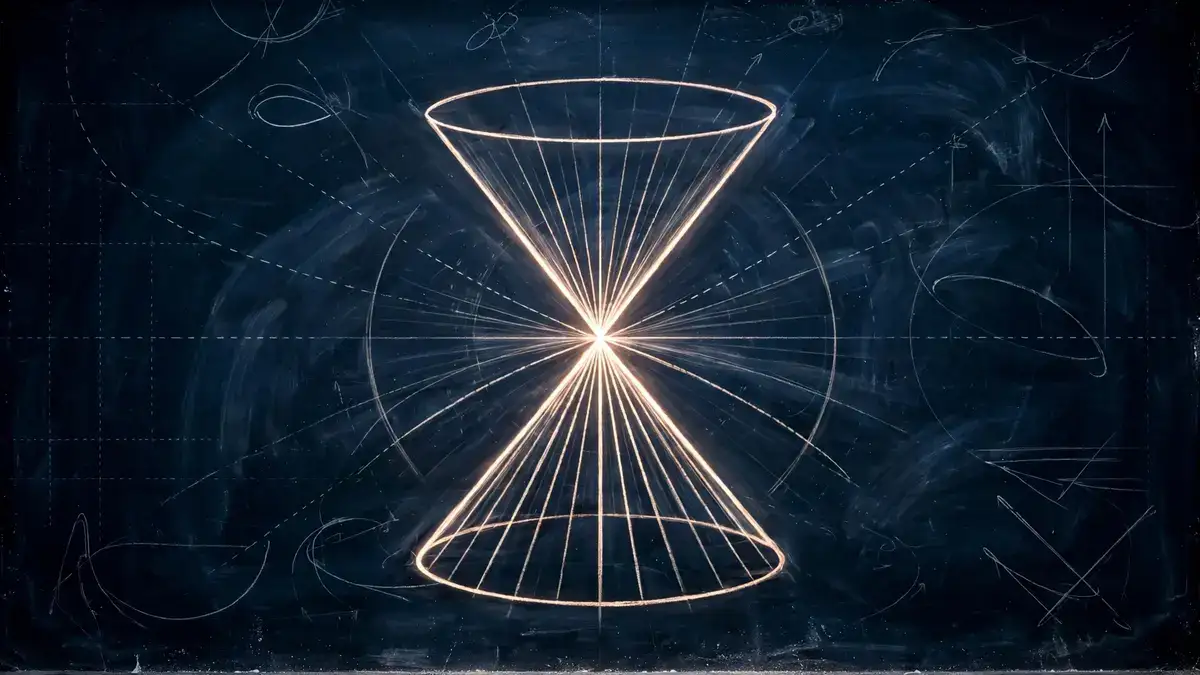
The paper, “An algebraic quantization of gravity from the null cone,” starts from first-order gravity and solves the gravitational constraints on intersecting null cones — the surfaces traced by light rays — inside a region of spacetime. From that reduced phase space, Chandrasekaran promotes the classical Poisson brackets to commutation relations, defines an algebra of observables, and uses Gaussian wavefunctions to build a nonperturbative Hilbert space in which that algebra generates a type I factor. The construction yields a Lorentzian path integral in which every sum over intermediate states converges absolutely — a property most approaches to quantum gravity can only dream of.
Then come the checks. The paper computes a finite, closed-form amplitude for graviton pair creation and annihilation on a null cone, even though expanding first in Newton’s constant gives a logarithmic divergence. It shows a macroscopic causal diamond — a region of spacetime bounded by light cones — has a finite-dimensional Hilbert space. From the Lorentzian trace it recovers the Bekenstein–Hawking entropy for marginally trapped surfaces, including the logarithmic correction for large Schwarzschild black holes that Ashoke Sen derived by Euclidean methods. And it derives the semiclassical Einstein equations, to one loop, as the theory’s low-energy limit.
Note what those checks are: consistency with results physics already knows. Recovering Einstein’s equations and black-hole entropy is a demanding bar for any new framework — and the reason the paper is being taken seriously — but it is not a new prediction, and it is not proof the framework is right.
How GPT-6 Astra fits in#
The AI angle is documented in the paper’s acknowledgements, on page 54: “Several of the calculations and proofs in this paper were developed through detailed, back and forth collaboration with GPT-6 Astra over the course of many months, amounting to ~400M total tokens spent; I thank OpenAI for providing this compute.” Chandrasekaran also thanks Sam Altman, Sebastien Bubeck, and his OpenAI colleagues for encouragement.
That is a different kind of AI contribution from the ones that have dominated the last two weeks. The Riemann hypothesis and matrix-multiplication claims arrived as Lean-checked proofs, with the model doing the formal work. Here the model was a collaborator on a human-led theory paper — months of back-and-forth on calculations and proofs, with a credentialed physicist as sole author. OpenAI provided the compute; it did not author the paper, and nothing on the arXiv page lists an OpenAI affiliation. OpenAI president Greg Brockman reposted the paper on X with the line “towards more deeply understanding the universe,” which is how many readers first saw it.
The distinction matters, and Reddit’s top commenters drew it immediately. “This was a human led work and he used AI,” wrote one highly upvoted reply. “This is not OpenAI/Astra the same way GRH was through Claude.”
Where the hype overreaches#
Set against the paper, the viral framing overstates the case in three ways. First, authorship: the threads titled it an OpenAI paper. It is not — Chandrasekaran is the sole author, and the “by OpenAI” reading was corrected in-thread within hours. Second, status: a proposal is not a working theory. As one commenter put it, “a proposal for a theory is neither ‘Mega breakthrough’ nor ‘working theory’” — testable predictions would have to be tested first. Theories of quantized gravity, another noted, “are a dime a dozen,” and this one must still survive scrutiny from physicists who can actually follow its 54 pages; the top comment on one thread was a physicist saying the paper was his graduate topic and he still did not understand it.
Third, verification: physics is not mathematics. A Lean proof can be checked by a machine in minutes; a theory of quantum gravity needs predictions that can be tested, and the effects it describes live at the Planck scale, far beyond any collider. One detailed reader’s analysis noted the paper’s checks reproduce known results, with no new testable physics yet. Even the venue question is unsettled: commenters report that r/Physics removed discussion of the paper under its rule against AI-assisted physics claims, so the debate is happening everywhere except the physics community’s main forum.
Why it still matters#
None of that makes the paper uninteresting — it makes it interesting in the right way. Chandrasekaran is a serious physicist, known for work on quantum gravity and black-hole entropy, including papers with Edward Witten on the algebra of observables in black holes. A framework that recovers Einstein’s equations and Bekenstein–Hawking entropy from a new starting point has cleared a bar most proposals never reach. And the scale of the AI collaboration — 400 million tokens over months, not a single prompt — is a different phenomenon from the one-prompt paper drops of the last two weeks: a frontier model as a sustained research partner on a hard theory problem.
The community response is part of the story too. Within hours, the same threads that hyped the paper had also corrected it — on authorship, on the difference from the Lean proofs, on what “quantizing gravity” does and does not mean. That fast, informed skepticism is the immune system working, and it is why the signal here is worth more than the headline.
What to watch#
Four things. First, whether physicists find errors or gaps in the 54 pages in the coming days — the paper has been public for less than a day, and no independent check has been reported. Second, whether Chandrasekaran responds to the “no new predictions” criticism, or whether follow-up work supplies one. Third, whether OpenAI says anything about the Astra collaboration or the compute behind it. And fourth, whether this becomes a pattern: AI-assisted theory papers as a regular arXiv genre, with the model in the acknowledgements rather than on the author line. Until then, the fair summary is narrower than the viral version: a respected physicist has proposed a new way to quantize gravity, built with months of help from GPT-6 Astra — and the physics community has not yet had time to say whether it works.
Sources: arXiv:2611.34924, “An algebraic quantization of gravity from the null cone” (November 25, 2026); arXiv PDF, acknowledgements p. 54; r/singularity, “GPT-6 (Astra) physics breakthrough” (November 26, 2026); r/singularity, “Stanford Physicist Venkatesa Chandrasekaran reacts to GPT-6 (Astra 6)” (November 26, 2026); r/accelerate, “Mega breakthrough: We have working theory of quantum gravity?!” (November 26, 2026); Greg Brockman (@gdb) on X, November 26, 2026