Hugging Face's Carbon-X lets you 'chat with DNA': a 14.8B open model that reads raw genomes and answers in plain English
- Who: Hugging Face (HuggingFaceBio), with the Zhongguancun Academy in China and the Telethon Institute of Genetics and Medicine at the University of Naples Federico II in Italy.
- What: Carbon-X — a 14.8B-parameter open language model for DNA understanding that takes raw sequences in a chat conversation and answers in English (Apache 2.0).
- When: Released October 22, 2026 (model card published on the Hugging Face Hub).
- How it reads DNA: a hybrid tokenizer adds 5,515 DNA tokens to the text vocabulary, encoding DNA as non-overlapping 6-mers in one shared token stream. Built from Qwen3-14B, mid-trained on 302B tokens (55% raw DNA), then supervised fine-tuning and reinforcement learning with verifiable rewards.
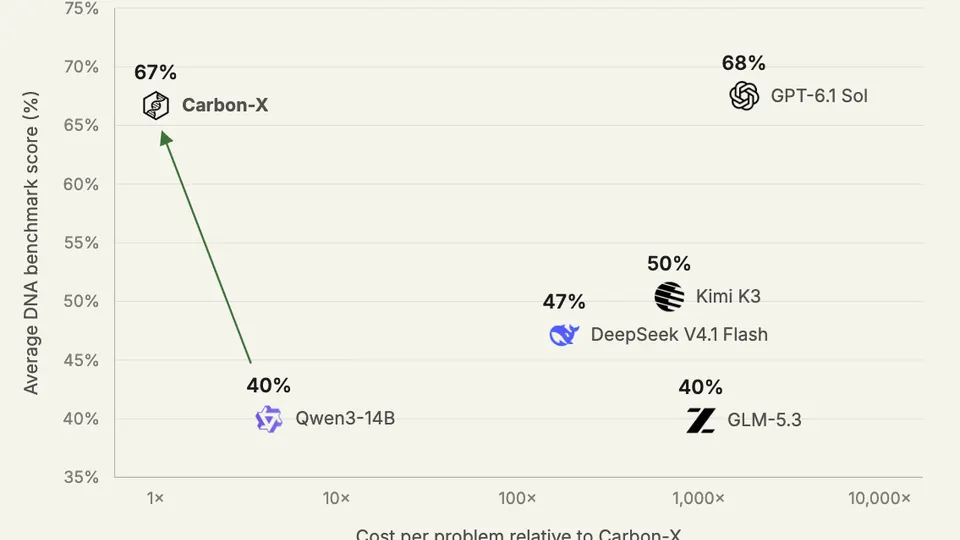
- Benchmarks: 66.7% average across five DNA benchmarks vs 67.5% for GPT-6.1 Sol at ~1/1,800 the cost per problem; leads every model tested on BioReason Coding (74.9) and NextBase (39.4); 79.3% prompt-level strict accuracy on IFEval.
- Safety: viruses infecting animals, plants and other complex life were deliberately excluded from training data; the model card states Carbon-X is not clinically validated, has not been tested in a wet lab, and should not be used for medical decisions.
Hugging Face released Carbon-X today, an open language model built to do something no mainstream model was designed for: read raw DNA as if it were another language. Paste in a genetic sequence, ask whether a mutation looks benign or pathogenic, and it answers in plain English with its reasoning attached.
The 14.8-billion-parameter model comes out of HuggingFaceBio, Hugging Face's biology effort, built with the Zhongguancun Academy in China and the Telethon Institute of Genetics and Medicine at the University of Naples Federico II in Italy. The weights are free to download under the Apache 2.0 license, and the model fits on a single 80GB GPU — so a lab can run it locally instead of sending unpublished sequences to someone else's cloud.
"We've unlocked a new capability in language models, which is fundamentally about being able to chat with DNA," Lewis Tunstall, a senior research scientist at Hugging Face, told Wired. The pitch is that it could help researchers design drugs and genetic therapies — for example, by judging whether a mutation is harmless or causes disease.
DNA as another language
Most language models treat a DNA sequence as gibberish text. Carbon-X gives DNA its own vocabulary: a hybrid tokenizer keeps the usual text vocabulary and adds 5,515 DNA tokens, encoding DNA as non-overlapping 6-mers so DNA and text flow through one shared token stream, with no separate DNA encoder in the picture.
Under the hood it starts from Alibaba's Qwen3-14B, then learns the genetic tongue: 302 billion tokens of mid-training — 55% of it raw DNA from mammals, other vertebrates, invertebrates, plants, fungi and protozoa, plus mRNA — followed by supervised fine-tuning and reinforcement learning with verifiable rewards on DNA tasks.
Feed it a sequence and it can predict whether mutations are benign or pathogenic, flag regions that control gene activity, classify sequences by organism group, predict the next bases of a sequence, and explain itself. It also stays a capable assistant: 79.3% prompt-level strict accuracy on IFEval.
Near-frontier scores, at a fraction of the cost
Across five DNA benchmarks — variant-effect prediction, sequence understanding, next-base prediction — Carbon-X averages 66.7%, 27 points above the Qwen3-14B it starts from and ahead of every other open model Hugging Face tested. It lands just behind OpenAI's GPT-6.1 Sol (67.5%) at what Hugging Face puts at about 1/1,800 of the cost per problem. It leads every model tested on coding-variant effects (74.9 on BioReason Coding) and next-base prediction (39.4). The usual caveats apply: Hugging Face built two of the five benchmarks itself, and none of this has been checked in a real lab yet.
The cost math is the headline for research budgets. Hugging Face estimates that analyzing the 2.4 million variants of uncertain significance in ClinVar would cost about $300 with Carbon-X, compared with $32,000 to $4 million with the frontier models it evaluated.
One detail buried in the release notes says a lot about why an open model matters here: closed models often refuse legitimate genetics questions. Hugging Face reports that Claude Opus 5.5's next-base score collapses as it refuses more, and Gemini 4 Argon's mutation accuracy drops from 58% to 38% as reasoning effort — and refusal rates — rise.
Viruses left out on purpose
The team deliberately excluded viruses that infect animals, plants and other complex life from the training data, Tunstall said, to avoid the model being useful for dangerous work. Tests on DNA-editing tasks that could be misused found Carbon-X unreliable and no better than ordinary software — though Hugging Face says more research is needed.
The model card is equally blunt about what it cannot do: Carbon-X has not been clinically validated, has not been tested in a wet lab, and should not be used for medical decisions. It can miscount bases, confuse coordinates, and invent what a sequence does when given too little context. And it reads and explains DNA — it wasn't trained to design new sequences. Training sequences ran up to about 49,000 DNA letters, so you can't drop in a whole human genome.

Why it matters
Carbon-X is the latest in a busy month for AI in biology — and a bet that the winning interface for genomic work is conversation, not dashboards. A 14.8B-parameter model that fits on one GPU means sensitive or unpublished sequences never have to leave a researcher's own infrastructure, which is exactly what matters for patient data. The release also ships with a ready-made skill so coding agents like Claude Code and Codex CLI can call it as a tool.
The honest version of the pitch: a near-frontier genetics assistant, free and local, whose answers still need to survive contact with a real lab. The predictions are a hypothesis engine for now — rigorous experimental validation remains the test that hasn't been run.
Frequently asked questions
What does “chatting with DNA” actually mean here?
A researcher pastes a raw DNA sequence into the chat and asks a question in plain English — for example, whether a variant looks benign or pathogenic — and Carbon-X answers in English with its reasoning. There is no separate DNA encoder: DNA is tokenized as non-overlapping 6-mers inside the same token stream as the text.
How accurate is Carbon-X — can it be used for medical decisions?
It averages 66.7% across Hugging Face’s five DNA benchmarks, close to GPT-6.1 Sol’s 67.5%, but the model card states it has not been clinically validated and has not been tested in a wet lab, and it should not be used for medical decisions. It can miscount bases, confuse coordinates, and invent a sequence’s function from too little context.
What does it cost to run?
The weights fit on a single 80GB GPU in bfloat16, so labs can run it on their own infrastructure instead of sending sequences to a cloud provider. Hugging Face estimates that analyzing the 2.4 million variants of uncertain significance in ClinVar would cost about $300 with Carbon-X, versus $32,000 to $4 million with the frontier models it compared against.