A local world model you can steer with WASD just landed on Hugging Face — and it runs on an RTX 3060
The video is four and a half minutes of a man in a brown jacket walking across a grassy field, steered by a keyboard. It looks unremarkable until you realise nothing in it was filmed or rendered in advance: every frame is being generated on the fly, one at a time, by a 630-million-parameter model built to run on a graphics card you can buy at retail. On Wednesday, the independent developer behind LucidML released it — weights, inference code, and a playable demo included.
- The release: posted to r/LocalLLaMA on November 11 by u/lucidml_lover — 227 upvotes and 31 comments by Thursday morning, with a 4-minute-29-second demo video.
- The model: a 630M-parameter transformer called Summaryformer, trained from scratch on GG800, an 800-hour dataset of GTA V footage.
- The trick: older frames are stored as 96 summary tokens each instead of full resolution — 6,528 keys of memory for 24 frames of history, versus 26,208 if every frame were kept whole.
- The hardware: built for consumer GPUs — an RTX 3060, 4060, or anything above — with a live demo at lucidml.ai and open weights under Apache-2.0.
- The verdict: the top comment calls it “neural GTA before GTA 6”; the pushback is the wobble — floppy feet, dreamlike drift, and low resolution in the demo.
- The context: lab world models like Google’s Project Genie need datacenter hardware. LucidML’s bet is that playable worlds belong on the machine in front of you.
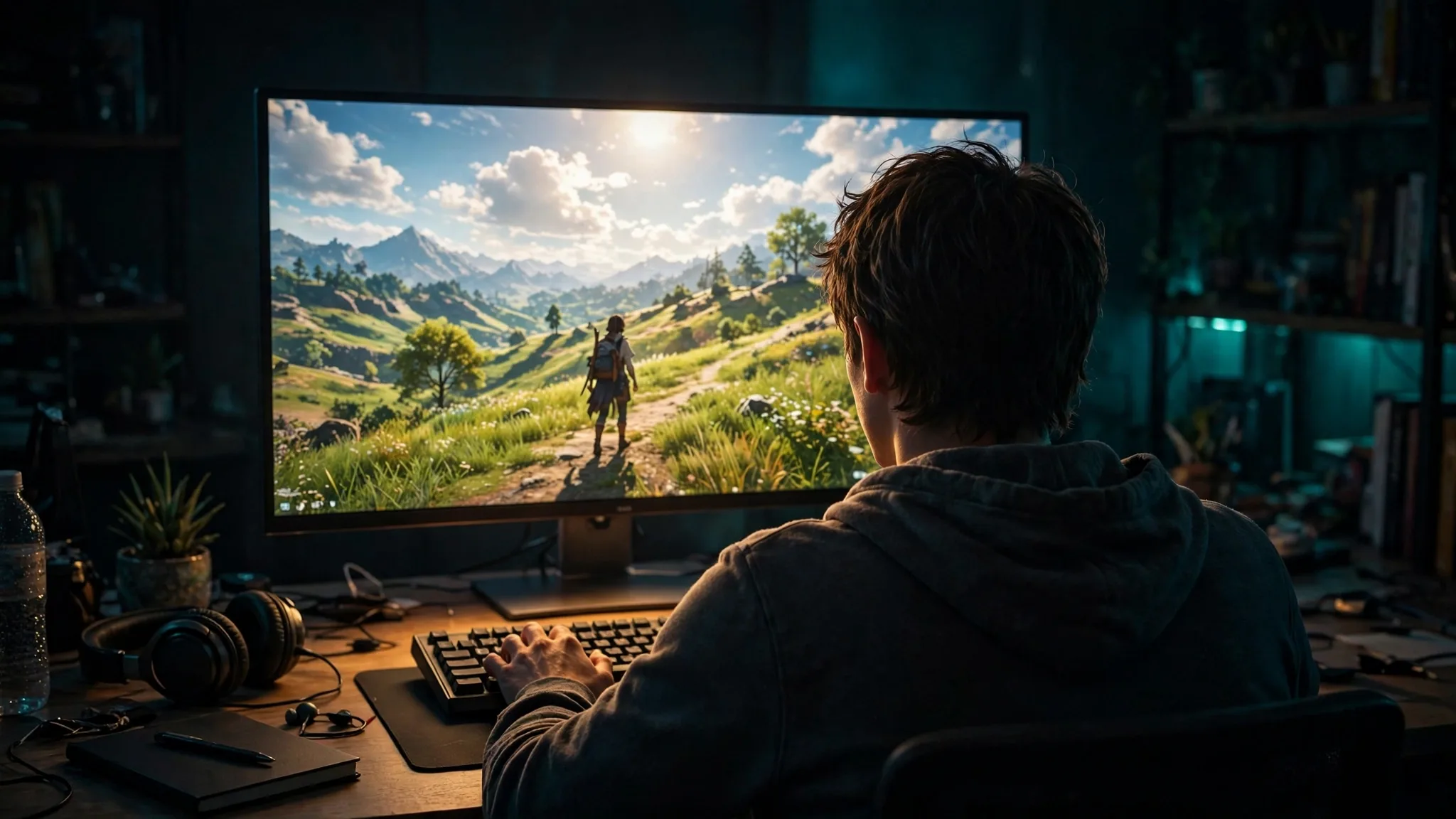
World models have spent the last year as a lab luxury. Google’s Project Genie can turn a picture into a playable scene, but it lives behind a research demo; other open efforts need server-class hardware to run at all. The LucidML release flips the premise: a world model small enough to sit on the same card as your games, fast enough to keep up with your keyboard, and open enough to download today.
The developer is candid about the scale of the thing. This is the first model they have ever released, they wrote in the post, and “it’s a bit scary for me.” The thread answered with the highest praise a demo can get on r/LocalLLaMA: the top comment, at 40 upvotes, reads “Omg we got neural GTA before GTA 6.”
What the demo shows#
The video is a screen recording of the LucidML dashboard, not a trailer. A generated clip shows a man in a brown jacket walking across grassy land, seen from behind as if in a third-person game, while the player steers him with WASD. Around the video sit the controls: an INIT IMAGE panel where the starting picture goes in, a SCENE PROMPT box, a Stop Stream button, and — tellingly — a button that reads “I want this Open Source.”
That is the whole pitch in one screen: give it one start image, hold keys, and it generates the video that follows, one frame at a time, streaming it to a browser while you play. The live demo at lucidml.ai works the same way, no sign-in required — one consumer GPU per player, a short session each, and a queue when every machine is taken. The site also shows a live prompt-switching demo running on a single RTX 5090, where the prompt is edited three times mid-rollout — a pond appears, the man’s jacket turns red, the desert becomes ice — and the stream never cuts.
How it remembers: Summaryformer in plain English#
The reason a world model this small can keep a scene coherent is the memory design, and it is the part the developer most wants people to read. A generated video has a memory problem: a frame from a second ago matters in pixel-perfect detail, because the next frame has to continue its motion exactly; a frame from ten seconds ago matters only in outline — what was there, roughly where. Keep every frame at full resolution and the attention budget explodes. Keep only a short window and the model forgets the scene.
Summaryformer, the architecture in the release, stores every frame twice. The start image and the two newest frames are kept whole. The 22 older frames in the window are kept only as 96 summary tokens each — compact descriptions the model writes itself as a by-product of generating the frame, with no separate summarizer network. The result: 6,528 keys of memory covering 24 frames of history, where keeping every frame whole would take 26,208. The start image is never evicted, so the scene stays anchored to the picture you gave it.
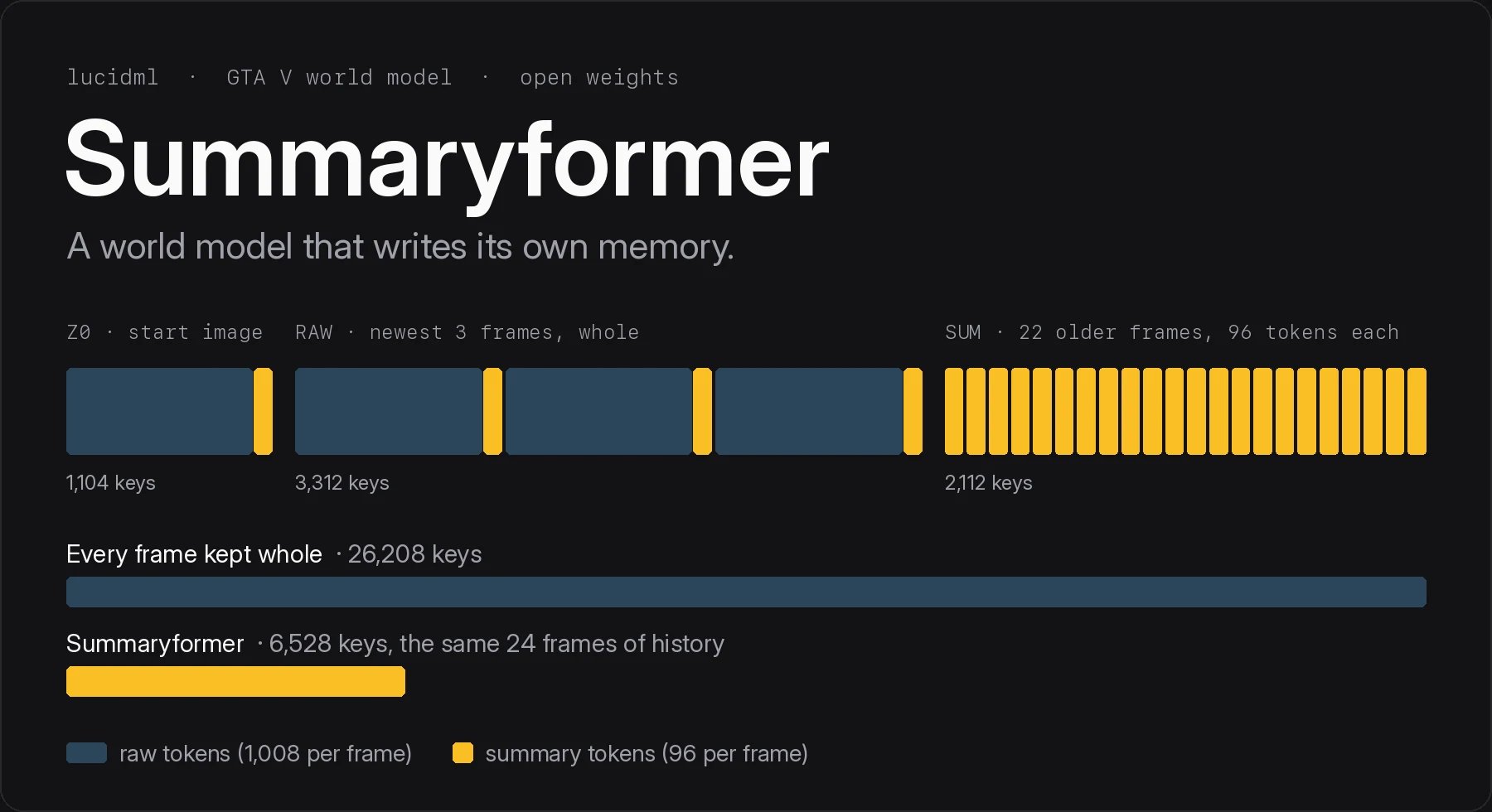
Two more details from the model card are worth noting. The model is 630,205,008 parameters — 28 transformer blocks, no text conditioning at all; the player’s key presses, the frame rate, and the grid shape are the only controls. And it was trained from scratch on GG800, an 800-hour dataset of GTA V footage the developer built for the project, which is why the demo world looks the way it does: the model thinks in Grand Theft Auto.
Why a consumer GPU is the point#
The headline spec is the hardware floor: an RTX 3060, a 4060, or anything above. The repository on Hugging Face holds the weights and the complete inference runtime — the model, its memory, the sampler, and the streaming server — under an Apache-2.0 license, with the training code held back. The credits are careful: the KV-cached inference technique was learned from the Self-Forcing project, the rotary positions adapted from Wan2.1, and the noise schedule drawn from the literature. What is new, the developer argues, is the memory design itself.
That distinction is also the thread’s sharpest debate. One commenter noted that world models have existed for a few years and linked Google’s Project Genie; another compared LucidML to LingBot-World 2.0. The developer’s reply drew the line plainly: that model distills a huge model and needs server-class hardware. LucidML’s claim is not that world models are new — it is that a playable one now fits on a laptop. As the site puts it: “A world you can step into shouldn’t need a cluster behind it. It should run on the machine in front of you, and it does.”

The rough edges are the point, too#
The demo is not polished, and nobody in the thread pretends otherwise. “The feet are floopy,” one commenter wrote, and the developer agreed: the video was trained at very poor latent resolutions — 21 by 12 in the clip shown. Others called it “psychedelic and dreamlike” and “a fever dream. Quite cool nonetheless.” The developer’s own framing is the same: consistency and quality improvements are still needed.
The limits are concrete, not just cosmetic. Sessions on the hosted demo run about three minutes. The model is CUDA-only, one GPU process serves one player at a time, and the current checkpoint only knows the world of GTA V — a general world model is the stated next step, not a shipped one. None of that stopped the thread’s verdict: one commenter wrote that they thought consumer world models were “a few years off,” and called the release “incredible.”
What to watch#
Three things decide whether this is a curiosity or a milestone. First, whether the general world model ships — the GTA checkpoint proves the architecture, but a model that can start from any image is the real product. Second, whether other people can reproduce the consumer-GPU claim on their own cards, now that the weights and runtime are public. And third, whether the rough edges close fast: the history of generated video is a history of artifacts that looked fatal for about a year and then vanished. The developer trained this one at tiny latent resolutions on consumer hardware; the obvious next experiment is what happens with more of both.
For now, the demo is live, the weights are downloadable, and the queue on the hosted demo is the honest measure of demand. A world model you can play is no longer a lab demo. It is a download.
Sources: the original post by u/lucidml_lover on r/LocalLLaMA; the model card and weights on Hugging Face; and the live demo at lucidml.ai. Commenter claims are reported as thread claims, not independently verified. The Summaryformer diagram is from the LucidML repository (Apache-2.0); the cover and GPU illustrations are AI-generated.