MIT FLEX teaches robots to read between the lines — ‘don't spill on the laptop’ means avoid all electronics
MIT announced FLEX on November 9, 2026, a pipeline that lets a robot read the intent behind a spoken correction instead of just obeying the words. Tell a coffee-carrying arm ‘don't spill on the laptop,’ and it works out that you mean all electronics — no extra instructions needed.
What we checked: MIT News’ November 9, 2026 announcement and the FLEX project page and paper, cross-checked against Unite.AI’s same-day coverage.
- What: FLEX (Flexible Feature Editing Pipeline), a three-step method that updates a robot’s motion-planning features from natural-language corrections.
- Who: MIT CSAIL’s CLEAR Lab, led by Andreea Bobu, with New York University; co-authors Audrey Lee, Nathan Dennler and Ilia Sucholutsky.
- When: Announced November 9, 2026 by MIT News; to be presented at the Conference on Robot Learning (CoRL) this month.
- How: Add → Generalize → Mask, using GPT-4o; the full three-step loop takes about five seconds.
- Results: Highest normalized reward in all seven 2D navigation scenarios; 0.99 vs 0.69 (ALGAE), 0.83 (MFE) and 0.78 (unscaffolded baseline) when all three operations are needed; intent-understanding rating 6.3 out of 7, vs 5.0 and 4.5.
- Tested on: Three simulated Franka arm tasks — serving coffee, moving a lit candle, carrying a bowling ball — plus 9×9 navigation grids, and a 12-person user study.
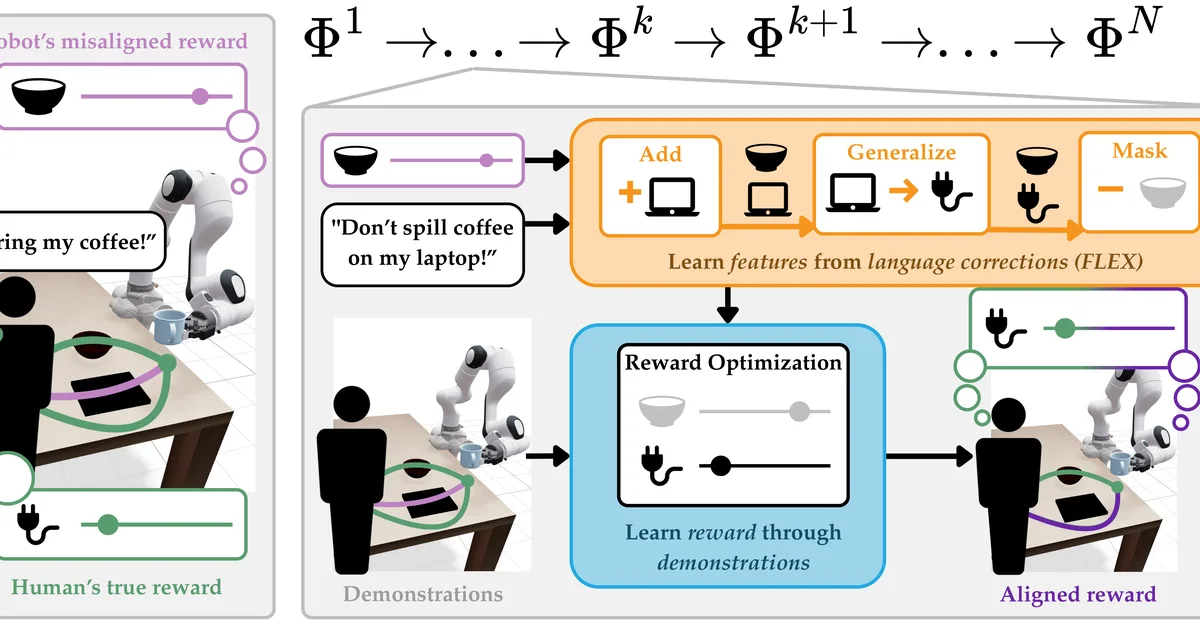
Picture the scene MIT’s researchers set up: a simulated robot arm carries a cup of coffee across a cluttered table, past a laptop and a phone. You watch it drift too close and type, “Don’t spill on the laptop!”
That sentence is the whole problem FLEX exists to solve. A robot that only hears the literal words will add “laptop” to its list of things to avoid and carry on. A person hearing the same sentence understands something bigger: keep hot liquid away from electronics. FLEX, announced by MIT on November 9, 2026, is a pipeline that gives the robot the second hearing.
How it works: three edits in about five seconds
FLEX — the Flexible Feature Editing Pipeline — treats a robot’s motion plan as a list of features: the things in the scene that matter for the task. Every correction you type runs through three operations, in order, in about five seconds.
Step 1: Add. The robot adds the thing you named to its feature list. “Don’t spill on the laptop” puts the laptop on the list, and the arm re-plans its path around it. This is where earlier methods stopped — and where their trouble started. “The problem happens when your feature list becomes super long, and some features are no longer relevant because your environment may have changed,” says study author Nathan Dennler, a postdoc in MIT’s Computer Science and Artificial Intelligence Laboratory (CSAIL).
Step 2: Generalize. This is FLEX’s new contribution. GPT-4o looks at the features you have named so far and searches its training for what they have in common. A laptop becomes “electronic devices”; a mug becomes “fragile things”; a lit candle becomes “flammable objects.” The robot re-plans around the whole class, not the single item. “LLMs have seen so many texts from the internet,” Dennler says. “People might have written about, ‘Oh, my phone dropped in the water and now it doesn’t work,’ or ‘I spilled coffee on my computer and now it doesn’t work.’ So LLMs pick up on the idea that liquids plus devices leads to things not working.”
Step 3: Mask. The robot’s standard computer-vision system scans the scene and drops features for objects that are no longer there. Mask runs last deliberately, so it judges features in their final, generalized form — not the narrow version from step one.
| Step | What FLEX does | Coffee-table example |
|---|---|---|
| Add | Adds the named object to the features the robot plans around | Laptop joins the avoid list |
| Generalize | GPT-4o finds what the named features have in common and broadens the rule | Laptop → all electronics |
| Mask | Vision checks the scene and drops features for objects that left | A phone that left the table leaves the list |
The three operations run in this order on every correction; the full loop takes about five seconds, according to MIT.
Under the hood, FLEX splits the job in two. Language corrections decide which features matter; demonstrations — examples of the motion you wanted — decide how much each one matters. The robot models its reward as a weighted combination of features and learns the weights from demonstrations. That split is what lets one sentence change the plan, instead of requiring a fresh demonstration for every rule. “The idea is that there is some higher-level intention behind the words that you say,” Dennler says. “FLEX gives you an interface of communication with a robot to say, ‘When people say this, they mean that.’”
The announcement
MIT News published the announcement on November 9, 2026. The paper behind it, “Flexible Language-Guided Representation Editing for Adaptive Robot Behavior,” is on arXiv, and the team will present it at the Conference on Robot Learning (CoRL) this month. The work was led by Andreea Bobu, assistant professor of aeronautics and astronautics at MIT and head of the Collaborative Learning and Autonomy Research (CLEAR) Lab. Co-authors are Audrey Lee, Nathan Dennler, and Ilia Sucholutsky of New York University. Support came from the MIT Generative AI Impact Consortium and the MIT Schwarzman College of Computing’s Social and Ethical Responsibilities of Computing program.
MIT News announced a second machine-intelligence result the same day: WorldParticle, a single model that simulates sand, cloth, fluids and folding proteins. FLEX is the more practical of the two — it is about the robot in the kitchen, not the physics in the simulator.
What the tests showed
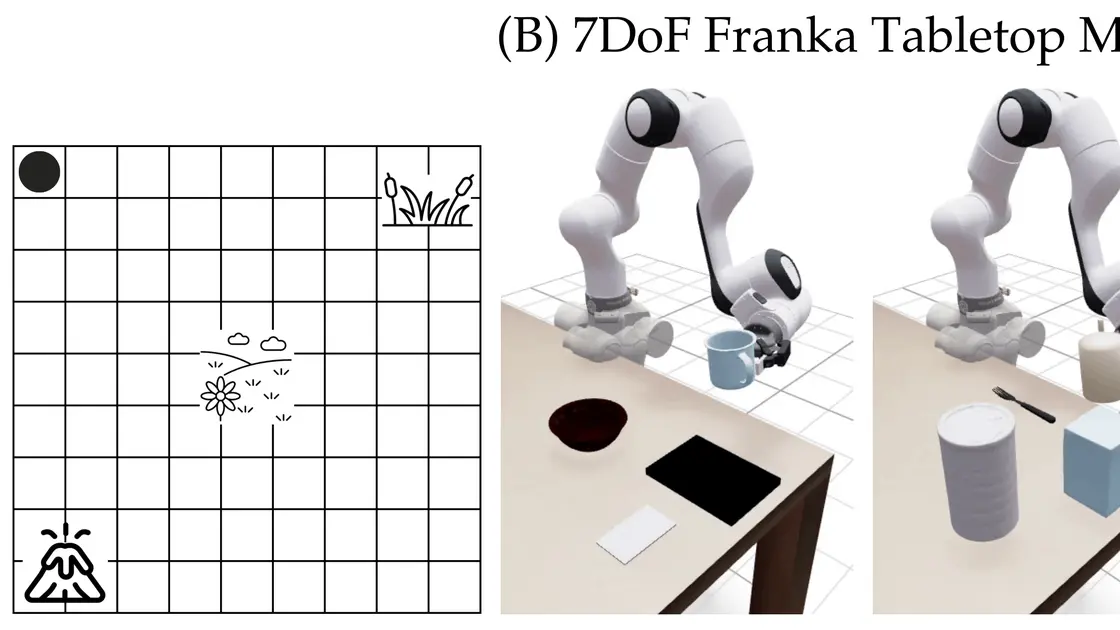
The team ran FLEX through seven 2D navigation scenarios on 9×9 grids, each testing a different combination of the three operations, and it achieved the highest normalized reward in all seven. In the hardest scenario — the one needing all three operations — the gap was wide: FLEX scored 0.99, against 0.69 for ALGAE (add-only), 0.83 for MFE (mask-only) and 0.78 for an unscaffolded baseline that asks a language model once, with no operation breakdown.
| Method | Normalized reward, all three operations needed |
|---|---|
| FLEX | 0.99 |
| MFE (mask-only) | 0.83 |
| Unscaffolded baseline | 0.78 |
| ALGAE (add-only) | 0.69 |
Normalized reward of 1.0 is optimal behavior; figures from the FLEX paper, as reported by Unite.AI.
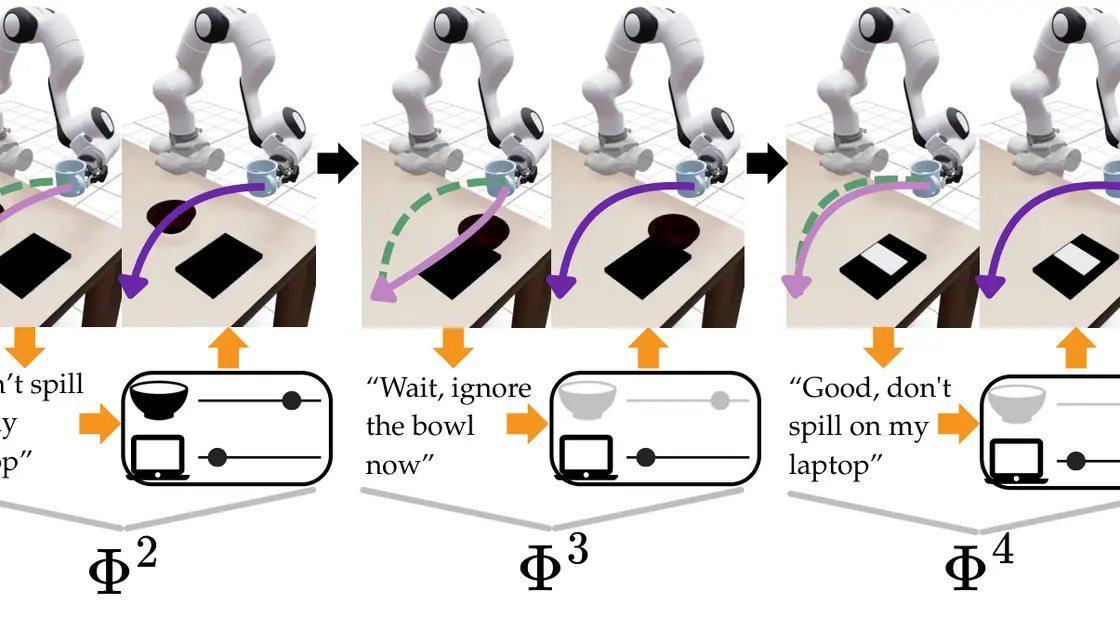
The Franka arm tests told the same story over longer sequences. In five-stage correction sequences across the coffee, candle and bowling-ball tasks, FLEX learned the user’s reward after one or two corrections and held its performance as stages changed. The baselines needed more corrections and degraded as spurious features piled up. In a user study, 12 participants typed corrections across three five-stage blocks; they rated FLEX highest on all five dimensions measured, including intent understanding — 6.3 out of 7, against 5.0 for ALGAE and 4.5 for MFE.
What it can’t do yet
Every result so far comes from simulation. The human study had participants watch simulated trajectories rather than a live arm, because some baseline methods produced erratic motions. Expert demonstrations were collected on a physical Franka arm, but only for offline learning — the full loop has not run closed-loop on hardware.
The scope is narrow, too: slow, quasi-static manipulation of rigid objects whose relevant properties can be put into words. Dynamic tasks and deformable objects will need more than language. And the commonsense FLEX borrows from GPT-4o is the average internet’s commonsense — it can miss personal or counterintuitive preferences. “Everyone’s homes are different, and everyone cares about different things, so no robot comes out of the box knowing what matters to you,” Bobu says. “What excites me about FLEX is that it can pick that up from a sentence or two instead of asking you to spell out every rule — and that’s the difference between a robot people put up with and one they actually want in their home.”
Robotics is converging on the same problem from the hardware side: NXP’s new unified robotics platform promises a flying drone 30 minutes out of the box, and NVIDIA’s Cosmos 3 world models, opened the same day, give robots simulated worlds to practice in. FLEX is the software half of that bargain — the part that lets the machine take correction like a person would. The code and dataset are listed as coming soon on the project page; the CoRL presentation is the next evidence to watch.