Nothing's first AI-native device ships in December: a screenless work tool with no new display
Nothing CEO Carl Pei confirmed on November 4 that the company’s first AI-native product ships in December: a screenless work tool built as dedicated hardware, not an app. No name, price, or specifications yet.
- Who and when: Nothing CEO Carl Pei, in an X post titled “Toolmakers” published on November 4, 2026.
- What is confirmed: A first AI-native product shipping in December 2026; a tool with no new screen that “couldn’t have been an app.”
- What is not revealed: The product’s name, price, exact shipping date, and specifications; Nothing has not confirmed whether it records or captures its surroundings.
- The argument: AI will prove itself at work first, as PCs and the iPhone did; AI value concentrates in coding, IT, customer support, and legal work. Pei calls the missing piece the “context gap.”
- Background: Nothing raised $200 million in September 2025 in a Series C led by Tiger Global at a $1.3 billion valuation, when Pei said the first AI-native device would launch in 2026.
- Separate project: AI smart glasses are reportedly targeted for the first half of 2027, per Bloomberg’s Mark Gurman as reported by Gizbot.

Nothing will ship its first AI-native product next month, CEO Carl Pei confirmed on November 4 in a post on X titled “Toolmakers.” The product is a tool, Pei wrote, built with the personality and care of a Nothing product — and it breaks with the phone in two deliberate ways: “It has no new screen, and it couldn’t have been an app.”
That is nearly everything Nothing has said. The company has not revealed the product’s name, price, exact shipping date, or specifications, and the teaser image that accompanied the announcement shows only a matte dark form with rounded corners marked “NOTHING (R)” and “COMING SOON,” as Fone Arena reports. What Pei did publish is an argument: about why AI hardware should start at work, what today’s models are missing, and why a device with no display might be the right shape for it.
Work first, consumer second
Pei’s central claim is historical. Personal computers became popular as office machines long before people used them for music or games, and the iPhone arrived at the end of a 30-year journey that began with pagers and car phones used by doctors and businesspeople, Gizbot reports from the post. AI, in Pei’s telling, will follow the same route: it proves itself at work first, and the industry’s rush to find AI’s version of the iPhone — a pendant, a pin, glasses, a companion device — is premature.
The spending pattern backs the work-first bet, as Pei presents it. Coding takes the biggest share of what companies spend on job-specific AI tools, followed by IT, customer support, and legal work. That is where AI value concentrates today, and it is the audience Nothing says it is building for: not a lifestyle gadget, but a productivity tool. Fone Arena’s reading of the announcement puts it the same way, framing the device as a productivity-focused tool rather than an attempt at a standalone consumer breakthrough.
The context gap
The problem Pei says the device addresses is not intelligence but awareness. Models are extremely capable, he argues, yet they know very little about your day. People paste emails, screenshots, and background details into a chat box to get a useful answer, while the most valuable context — an idea mentioned over coffee, a throwaway comment that unblocks a week — never reaches the model at all, because by the time the phone comes out, the moment has moved on.
That example is doing a lot of work in the coverage. 9to5Google notes that the rest of Pei’s post “really seems to imply” an ambient recorder of some kind, and Gizbot says the example “hints at a device that can capture what happens around you during the workday.” Both are careful to say Nothing has not confirmed that. The screenless design narrows the possibilities — 9to5Google observes that “couldn’t have been an app” is a familiar line for dedicated recorders — but narrowing is not confirming. Until Nothing says what the hardware does, the honest description is the one Pei gave: a screenless tool, not an app, shipping in December.

Design is the argument, too
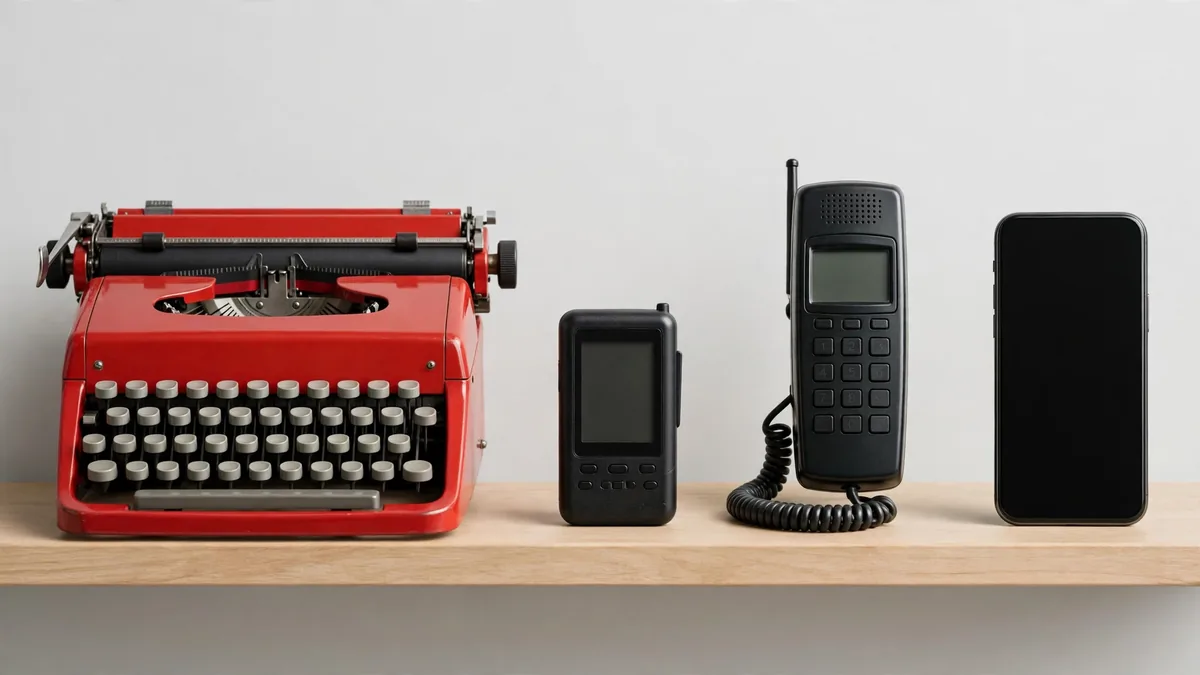
Pei also used the post to say something about what work tools should look like. He criticised how boring office equipment looks, contrasting the conference-room speakerphone with Ettore Sottsass’s bright red Olivetti Valentine typewriter from 1969, and argued that utilitarian tools deserve intentional industrial design. Nothing builds its hardware and software in-house, Pei noted, and already has tens of millions of devices in people’s pockets and ears — the ecosystem the new device will integrate with, according to Fone Arena. The teaser’s matte dark exterior and rounded corners are, for now, the only visual evidence of what that design language produces in a screenless form.
A promise kept, and a separate glasses project
The December date delivers on a promise made in September 2025, when Nothing raised $200 million in a Series C round led by Tiger Global, valuing the London-based company at $1.3 billion, with Zerodha co-founder Nikhil Kamath and Qualcomm Ventures joining as new investors. Pei said at the time that Nothing’s first AI-native device would launch in 2026. Shipping in December lands that commitment with weeks to spare.
The new device appears to be separate from the AI smart glasses Nothing is reportedly working on. Bloomberg’s Mark Gurman has reported that the glasses are targeted for release in the first half of 2027, Gizbot notes. The distinction matters because the glasses and the screenless tool answer different versions of the same question: where AI should live when it is not on a phone. Pei’s answer for December is the more modest one — a tool for work, with no new screen to look at.
The cautionary tales are recent. Gizbot points to the Humane Ai Pin and the Rabbit R1, earlier AI gadgets that struggled after launch, and reads Pei’s work-tool framing as expectation-setting before the reveal. Nothing’s version of that lesson is visible in what it chose not to claim: no “iPhone moment,” no consumer revolution, no specifications to overpromise on. Just a ship date, a shape, and an argument about context. The device itself — its name, its price, what it actually does all day — is still to come. December is weeks away, and this time the wait has a date on it.
Nothing is not the first company to bet that AI belongs on the body rather than in the pocket. Amazon’s Bee wearables turn everyday conversation into summaries and to-dos, Alloop’s Trio builds a wearable around a conversational health agent, and Nordic’s nRF71 chip puts edge AI on hardware built to run for years on a battery. Nothing’s entry differs in one respect the company has already stated: it is aimed at work first.
Frequently asked questions
What did Nothing actually confirm about its first AI-native device?
That it ships in December, that it is a tool built with Nothing's design approach, that it has no new screen, and that it could not have been an app. Nothing has not named the product or given a price, an exact date, or specifications.
Does the device record conversations or capture what happens around you?
Nothing has not said so. Coverage of Pei's post notes that his 'context gap' example points that way, but that reading is the outlets' interpretation, not a confirmation from Nothing.
Why is Nothing aiming at work first instead of a mass-market consumer gadget?
Pei argues transformative technologies prove themselves at work before going mainstream, citing personal computers and the iPhone's 30-year path from pagers and car phones. He says AI value today concentrates in coding, IT, customer support, and legal work, and that chasing a consumer 'iPhone moment' now is premature.