China has its own Stargate: Envision built 120MW of AI compute in Inner Mongolia in a year, at a fifth of US cost
America's AI buildout has a symbol: the Stargate campus in Abilene, Texas, a gigawatt-scale site built for OpenAI. China now has an answer on the same scale — and researchers who walked the site say it went up faster and cheaper than anything comparable in the US. SemiAnalysis, a research firm that tracks data-center construction worldwide, toured the Galaxy campus in Ulanqab, Inner Mongolia, in September and published its findings on November 7: a site planned for up to 800 megawatts of IT capacity, whose first 120-megawatt phase was commissioned in August 2026, less than a year after work began.
What we checked: SemiAnalysis's November 7 site-visit report on the Galaxy campus, cross-checked against Gadget Review's and PakTechStan's coverage of the same report, plus SemiAnalysis's figures for the Stargate Abilene campus.
- What: Galaxy, an AI data-center campus in Ulanqab, Inner Mongolia, owned by Envision Group.
- Scale: up to 800MW of IT capacity across four phases; the full campus is due by the end of 2027.
- Speed: the first 120MW phase was delivered within a year and commissioned in August 2026.
- Cost: under $3M per megawatt, about a fifth of a comparable US build, per SemiAnalysis's estimate.
- Power: 420MW of dedicated wind, four-hour battery storage, and a target of more than 60% of the first two phases' power from Envision's own wind farms; all-in power about $0.055/kWh.
- Tech note: a 5MW hall runs 800V DC straight to the racks via solid-state transformers — an architecture still on the US roadmap.
- Comparison: Stargate Abilene's core is about 820MW of critical IT capacity; Crusoe describes the site as 1.2GW of power.
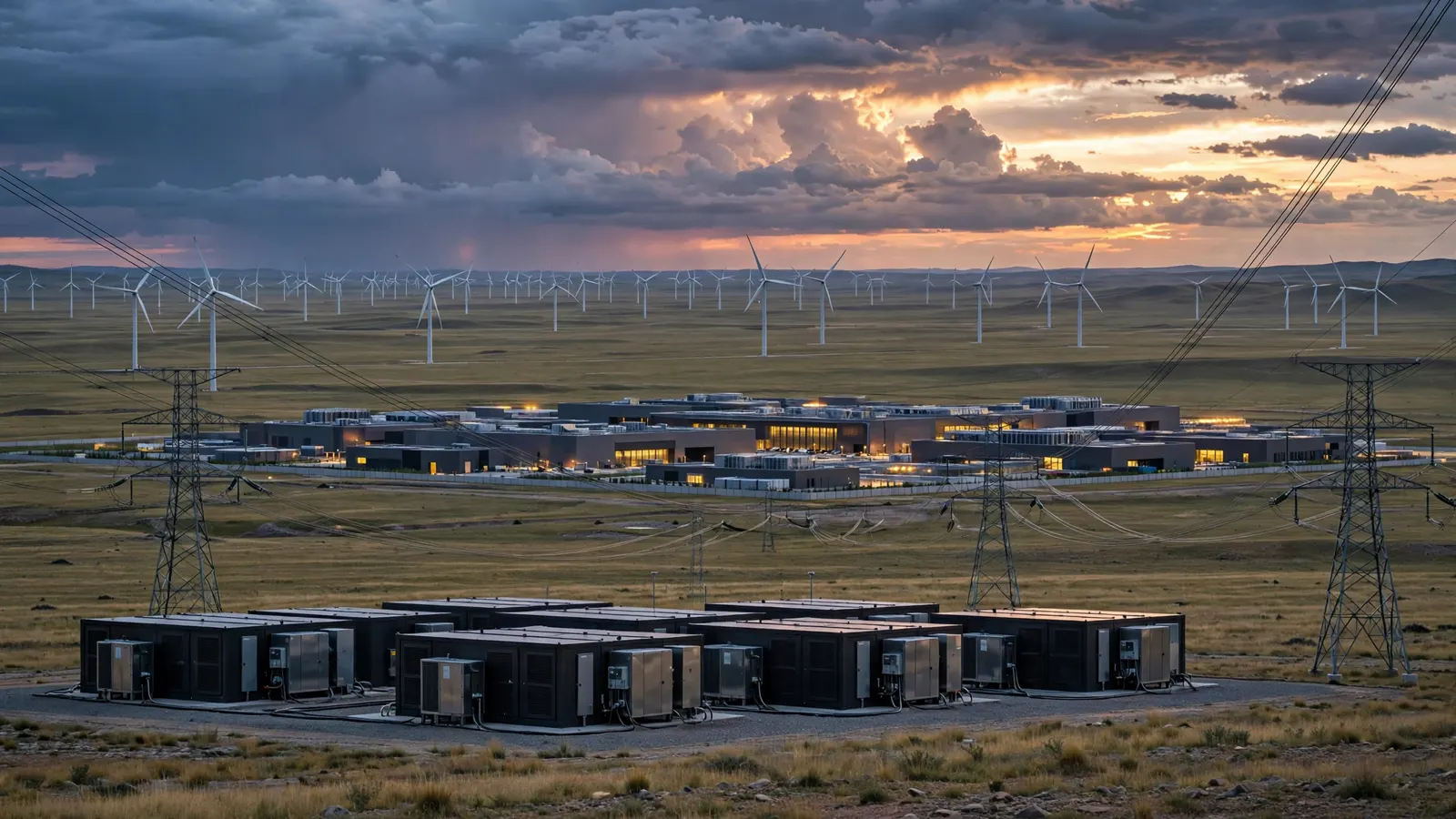
China's answer to Stargate is not a press release — it is a construction site. The campus is owned by Envision Group, a renewable-energy company with more than 100 gigawatts of wind turbines installed around the world. SemiAnalysis's verdict, after walking the site: a build on the scale of America's flagship AI campus, delivered faster and far cheaper.
The build: 120 megawatts in a year#
Galaxy is planned for up to 800 megawatts of IT capacity across four phases, with the full campus expected to be finished by the end of 2027. Its first phase — a 120,000-square-metre AI supercomputing building — was commissioned in August 2026, within about a year of work starting. The surrounding Chahar High-tech Zone had nearly 30,000 construction workers on site across 22 data-center projects when SemiAnalysis visited, according to a local report. All four Galaxy phases are built-to-suit for two internet giants, which the report does not name.
The scale invites the obvious comparison. Stargate's flagship campus in Abilene, Texas — built by Crusoe, leased to Oracle and run for OpenAI — is described as 1.2 gigawatts of power, which SemiAnalysis puts at about 820 megawatts of critical IT capacity. Galaxy's planned 800 megawatts sits essentially on par with that core. Abilene has room to grow further — an expansion phase powered behind the meter would take it to 1.5 gigawatts of IT capacity — and Galaxy has room too: converting the wind-turbine factory next door could take it to about a gigawatt.
The cost gap — and the caveats#
The number that will travel furthest is the cost. SemiAnalysis estimates Galaxy's construction at under $3 million per megawatt — roughly a fifth of a comparable US build. Rents in China's data-center market have roughly halved over five years, to about $40 per kilowatt per month before power, and all-in electricity in Inner Mongolia runs about $0.055 per kilowatt-hour, among the cheapest power SemiAnalysis cites anywhere.
Three caveats belong next to that figure. It is SemiAnalysis's estimate, not an audited like-for-like comparison. The report does not say which chips Galaxy will hold — the hardware is the one part of the campus the visit could not verify. And Envision's own public descriptions of the project have varied, with some references reaching 2 or 3 gigawatts; those figures appear to describe different project boundaries or expansion stages, not the 800-megawatt IT capacity SemiAnalysis measured.
A wind company that builds its own power#
What sets Galaxy apart is not the size but who is building it. Envision came to data centers from energy management, and it is unusually vertically integrated: it builds its own wind farms and a dedicated power line, manufactures the battery storage that smooths the load, designed the low-voltage power modules and the 800-volt system inside the campus, and co-designed the prefabricated substation. Its blade factory sits just across the road from the campus, with finished blades stacked in the yard.
The power arrangement has a name in China: source-grid-load-storage, or SGLS — one project builds its own wind or solar farm, battery storage and data center, linked by a dedicated line instead of the public grid. Two wind farms with 420 megawatts of combined capacity, sited about 80 kilometres apart so they rarely go calm at the same time, plus a four-hour battery system, are meant to supply more than 60% of the first two phases' power. Inner Mongolia holds about 57% of China's usable wind resources, and Ulanqab's sites run at a 35–40% capacity factor.
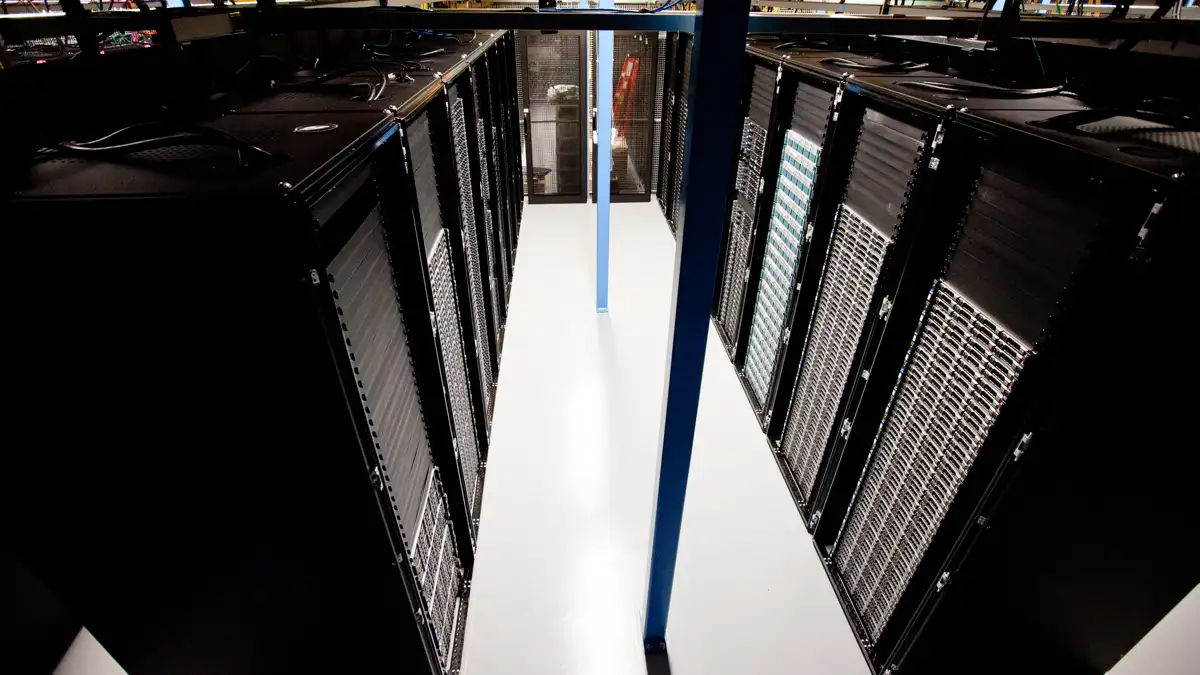
Inside the halls, Galaxy is also running hardware the US is still planning. In one 5-megawatt hall, solid-state transformers convert 10-kilovolt grid power straight to 800-volt DC for the racks, removing the low-voltage transformer, UPS and rectifier stages in between. China has run data centers on DC power for nearly two decades; roughly a quarter of Chinese data centers built in the past decade run on DC, against about 97% of US sites still on AC UPS. Galaxy also drops the central chiller plant — liquid- and air-cooled servers share one water loop, a design already running at scale in northern China.
Why it matters beyond China#
Galaxy is a single campus, and SemiAnalysis is careful not to overclaim: vertical integration alone does not win hyperscaler orders, which still go mainly on resources and track record. But two trends point its way. First, access to power is becoming central to data-center development everywhere — in the US, developers bridge the gap with on-site gas turbines, fuel cells and batteries; in Southeast Asia, governments are pushing developers to bring their own power; in China, approvals increasingly favour projects that pair compute with green power. Second, the power architecture from the grid connection to the rack is being redesigned, with higher-voltage DC and battery backup taking over roles the UPS used to hold.
Envision is not alone on this path. Its Inner Mongolia data-center plans add up to 3 gigawatts, and the region has about 25 gigawatts of announced data-center projects. The closest parallel is the tie-up between VNET, CATL and Zhongheng Electric: CATL, the world's largest EV battery maker, became VNET's largest shareholder in 2026 and agreed with it to jointly develop gigawatt-scale campuses. The pattern is familiar from China's EV market, where players like BYD make much of what goes into their cars — and it is now arriving in AI infrastructure.
What to watch#
Three things to track. First, the chips: until someone confirms what accelerators Galaxy will run, the campus is a building story, not yet a compute story. Second, the next SemiAnalysis report, which promises a wider view of Inner Mongolia's market — including what actually limits development there, from power to land and water. The region is often pictured as empty data-center halls; SemiAnalysis says its data tells a different story. And third, whether the model travels: Envision's cost edge rests on cheap wind, abundant labour and a regulatory environment that welcomes the build — conditions that do not copy-paste to Texas or Virginia.
For now, the fact that stands is simple. A Chinese wind company built 120 megawatts of AI compute in about a year, at a price American developers would struggle to match — and it has 680 megawatts more to go.