Nvidia, IBM and Fermilab launch quantum codesign platform — new decoder cuts error-correction research from 12 weeks to 45 minutes
Nvidia, IBM and Fermilab unveiled a quantum-classical codesign platform and a decoder that runs error-correction research up to 13,000 times faster — but the viral “12 weeks to 45 minutes” line needs its qualifier.
- The announcement: Nvidia, IBM and Fermilab will build a modular quantum-classical codesign platform, pairing Nvidia DGX B200 systems with IBM quantum computers — including IBM Quantum Nighthawk, which runs circuits of up to 7,500 two-qubit operations on 120 qubits.
- The 13,000x number: Nvidia’s TCBP-JOBS decoding algorithm, part of CUDA-Q, speeds up quantum error-correction research by up to 13,000x — cutting the compute time for researching new quantum designs from 12 weeks to 45 minutes.
- The qualifier that matters: that is decoding time for error-correction research. It is not a quantum computer running a 12-week job in 45 minutes, and nobody involved claims a useful quantum computer exists yet.
- The chemistry result: IBM and RIKEN used quantum-classical workflows to model molecular complexes of up to 12,635 atoms — more than 40 times the previous 303-atom benchmark — with 79 times better accuracy than earlier runs of the same experiment.
- The plumbing: Slurm, the scheduler behind many of the world’s biggest supercomputers, is gaining a native quantum interface, so quantum processors can be scheduled like CPUs and GPUs.

A screenshot of an X post did the rounds on Reddit this weekend with a punchy claim: Nvidia had cut a 12-week computing task to 45 minutes. The number is real — but it is not what the viral version suggests. What Nvidia actually announced on Monday, alongside IBM and Fermilab, is a new quantum-classical codesign platform plus a decoding algorithm that makes one specific, grinding part of quantum research dramatically faster.
The distinction matters more than the headline. Quantum computers are still held back by errors: the machines are so noisy that useful calculations need error correction, and error correction itself is a heavy classical computing problem. Speeding up the research into error correction is genuinely valuable — it just is not the same as a quantum computer finishing a 12-week job in under an hour.
What Nvidia, IBM and Fermilab actually announced#
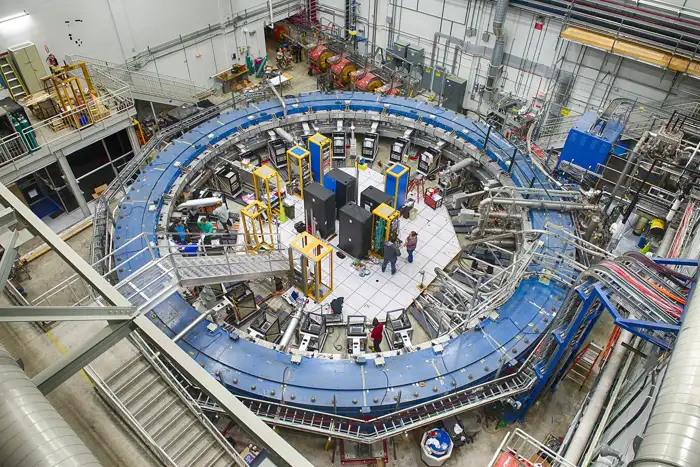
The three are building a modular quantum computing codesign platform that puts Nvidia DGX B200 systems next to IBM quantum computers, including machines powered by IBM Quantum Nighthawk — the most powerful quantum processor IBM has built, running circuits of up to 7,500 two-qubit operations on 120 qubits. Researchers will use it to develop and test error-correction codes, decoding algorithms and quantum-classical applications, with Fermilab's SQMS Center steering the work toward high-energy and nuclear physics problems classical machines cannot reach.
The framing from all three partners is consistent: quantum processors and accelerated computing have to evolve together. "Making quantum computers useful for science requires advances in error correction, applications and the systems that bring quantum processors and accelerated computing together," said Krysta Svore, Nvidia's vice president of applied research for quantum computing. Fermilab's Anna Grassellino put the ambition more plainly, calling it a step toward "quantum computers built for discovery."
The 13,000x number, explained#
Quantum error correction works by spreading one logical qubit across many physical ones, and a classical algorithm called a decoder has to interpret measurement data fast enough to spot likely errors. That decoding step is computationally brutal, and it is the bottleneck Nvidia's new algorithm attacks. TCBP-JOBS, part of the CUDA-Q platform and available now in the CUDA-Q QEC 0.9.0 library, accelerates the intensive parts of error-correction research by up to 13,000 times — which Nvidia says cuts the computation time for researching new quantum designs from 12 weeks to 45 minutes.
Note the wording: the time saved is in researching designs, not in running a quantum program. A faster decoder lets scientists test more error-correction codes and decoder configurations, and measure which designs use physical qubits most efficiently. That shortens the path to fault-tolerant machines. It does not make today's noisy machines useful on its own — a point the Reddit thread itself made, with top replies noting that current quantum computers are "extremely noisy" and "not even remotely close to having a useful quantum computer."

The chemistry result that got less attention#
The second half of the announcement barely featured in the viral posts, and it is arguably the more concrete result. IBM, RIKEN and Nvidia showed quantum-classical workflows modelling an iron-sulfur cluster, Fe4S4, found inside the proteins of living cells — a molecule whose interacting electrons make it notoriously hard to simulate. The team ran circuits of up to 4,000 two-qubit operations on 72 qubits, collected 5 million samples, and reached 79 times better accuracy than earlier runs of the same experiment, landing within 4.3 millihartree of the accuracy of density-matrix renormalization group, a leading classical method.
Separately, the same collaboration calculated binding energies for two protein-ligand complexes relevant to drug discovery, modelling systems of up to 12,635 atoms — more than 40 times the size of the previous 303-atom quantum-classical benchmark.
What the crowd got right — and wrong#
The story surfaced on r/accelerate as a screenshot of a Polymarket Money post on X, which framed it as "BREAKING: Nvidia unveils a quantum computing breakthrough that cuts a 12-week computing task to just 45 minutes." The post drew hundreds of upvotes and a split reaction: excitement about the pace of progress, and pushback noting the missing context — that no useful quantum computer is near, and that AI itself runs on classical algorithms anyway.
Both the excitement and the skepticism have a point. A 13,000x faster decoder is a real, measurable advance in the least glamorous part of the quantum stack, and the chemistry numbers show hybrid quantum-classical workflows inching toward classical-grade accuracy on genuinely hard molecules. But the viral framing collapses three different things — decoding research, error-correction research, and quantum computation — into one misleading sentence. The honest version is less spectacular and more interesting: the tools for building fault-tolerant quantum computers are getting faster, and the physics problems they will eventually tackle are already being scoped.
What to watch#
Three things will tell whether this is a turning point or a press-release bundle. First, whether the codesign platform produces published error-correction results that other groups can reproduce. Second, whether TCBP-JOBS holds its speedup across different codes and decoder configurations, or only on the workloads Nvidia benchmarked. And third, whether Slurm's new quantum interface — built with IBM's vendor-agnostic Quantum Resource Management Interface — actually gets adopted at supercomputing centers. If those three land, the 45-minute figure will look like a footnote to something bigger. If they don't, it will stay a viral screenshot.
Sources: NVIDIA Newsroom — NVIDIA Announces Collaboration With IBM and Fermi National Accelerator Laboratory to Launch Quantum-Classical Codesign Platform, Plus Error-Correction Breakthrough (Nov. 16, 2026); IBM Newsroom — IBM, Fermilab, and NVIDIA Announce Plans for New Co-Design Platform (Nov. 16, 2026); r/accelerate — Acceleration in Quantum computing (Nov. 16, 2026).