NVIDIA launches Minerva: an AIOps platform that predicts AI-factory failures before they kill your training run
- Who: NVIDIA — announced October 22, 2026 (unveiled at GTC Berlin, per coverage).
- What: Minerva, an AIOps platform for end-to-end AI-factory observability: one view across GPUs, networking, storage, schedulers and AI workloads, with purpose-built AI models turning raw telemetry into actionable insight.
- How it works: a dynamic knowledge graph maps GPUs, SuperNICs, switches, cables and the jobs running on them; Minerva analyzes billions of data points per hour with supervised and unsupervised machine learning — learning normal behavior, spotting unseen anomalies, predicting emerging failures, and grouping event storms into one incident with a likely root cause.
- Interface: a native AI assistant plus hooks to external agentic AI tools, so operators query cluster health in natural language and get recommended remediation — with a human in the loop or wired to automation through infrastructure APIs.
- Who’s in: IREN is already using Minerva; Aolani, Bitdeer AI, IBM, Jio, Lambda, Quake AI and Tesla plan to deploy. Dell Technologies, Lenovo and Supermicro will sell it as part of their AI factory operations portfolios.
- The metric: “AI factory yield” — the useful work infrastructure produces, tracked through GPU hours, goodput, cluster uptime and token production. NVIDIA frames the outcomes as longer time between interruptions, faster time to repair, and greater insight.
NVIDIA wants to sell you fewer alarms. The company unveiled Minerva on October 22, an AIOps platform that watches over its AI factories end to end — from the GPUs to the job scheduler to the training workloads themselves — and uses machine learning to flag problems before they eat your compute.
The problem it names is real. AI factories are among the most complex operations in the world, and at that scale a single degraded component can slow an entire job. The warning signs are easy to miss: a GPU running hotter than its peers, or an NVMe drive quietly losing performance under load. Minerva's pitch is to catch those signs early enough to matter.
One live map of everything
Traditional monitoring splits the data center into separate views — networking, compute, site reliability and machine-learning teams each see a different part of the operation. Minerva connects those signals across NVIDIA GPUs, networking, storage, schedulers and workloads, building a dynamic knowledge graph that logically maps the infrastructure — GPUs, SuperNICs, switches, cables — and the jobs running on top of it.
That context is what lets operators trace a slow training job back to the component affecting it, even across a factory with hundreds of thousands of GPUs. Instead of chasing symptoms across four dashboards, they get one map with the job and the hardware it runs on.
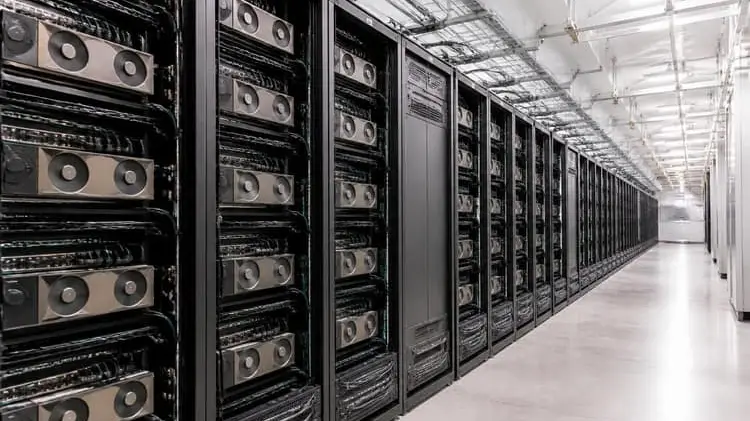
Billions of data points an hour
On top of that map, Minerva runs supervised and unsupervised machine learning over billions of data points per hour. It learns what normal looks like, detects previously unseen anomalies, predicts emerging failures, and correlates related events based on the factory's topology. Rather than firing every symptom at an operator, it can group an event storm into a focused incident with a likely root cause.
There is also a conversational layer: a native AI assistant, plus connections to external agentic AI tools, gives operators a natural-language interface grounded in live telemetry. Ask about cluster health, get recommended remediation. Teams can keep a person in the loop to implement fixes manually, or connect Minerva to automation through infrastructure APIs and external systems.
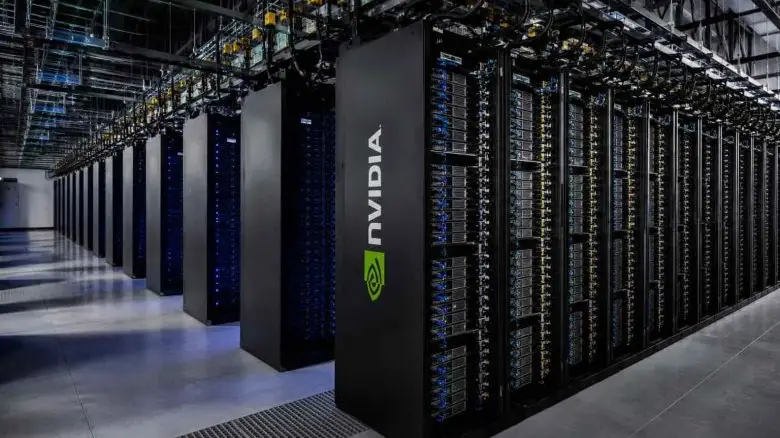
The customers are already lined up
IREN is among the first using Minerva to optimize its AI factories. "As we scale our AI factories, the key to providing the best service for our customers is maximizing the productivity of our GPUs," said Denis Skrinnikoff, chief technology officer of IREN. "NVIDIA Minerva gives our operations team one view across the network, the GPUs and the jobs running on them, so we focus more on proactive maintenance rather than troubleshooting."
Joining IREN, Aolani, Bitdeer AI, IBM, Jio, Lambda, Quake AI and Tesla plan to deploy Minerva, according to NVIDIA. Dell Technologies, Lenovo and Supermicro will offer it as part of their AI factory operations portfolios — the OEM channel that actually puts it into enterprise racks.
NVIDIA frames the goal as "AI factory yield": the useful work the infrastructure produces, measured through GPU hours, goodput, cluster uptime and token production. The promised outcomes are longer time between interruptions, faster time to repair, and greater insight. Pricing was not disclosed.
Why it matters
This is NVIDIA moving up the stack from silicon to software — observability is the margin layer on top of the GPU hardware it already dominates. For anyone renting compute at scale, the economics are unforgiving: every hour of stalled training is hundreds of thousands of GPUs burning dollars. The claim to watch is the predictive one. Correlating alerts is a solved problem; predicting failures accurately enough to act on, without a human double-checking, is where AIOps platforms usually fall apart.
One more caveat: Minerva's map is drawn around NVIDIA's own GPUs, networking and storage. Shops running mixed fleets will keep a second dashboard — which is exactly why the OEM partnerships matter more than the feature list.
Frequently asked questions
What exactly does NVIDIA Minerva do?
Minerva is an AIOps platform for end-to-end AI-factory observability. It pulls telemetry from infrastructure and AI workloads into one dynamic knowledge graph, applies machine learning to detect anomalies and predict failures, groups alert storms into single incidents with a likely root cause, and gives operators a natural-language assistant grounded in live telemetry.
What is "AI factory yield" — the metric Minerva is built around?
It is NVIDIA's measure of the useful work an AI factory's infrastructure produces: GPU hours, goodput, cluster uptime and token production. Minerva's stated outcomes are longer time between interruptions, faster time to repair, and greater insight into that yield.
Who is using Minerva, and how much does it cost?
IREN is already using Minerva in its AI factories. Aolani, Bitdeer AI, IBM, Jio, Lambda, Quake AI and Tesla plan to deploy it, and Dell Technologies, Lenovo and Supermicro will offer it in their AI factory operations portfolios. NVIDIA did not disclose pricing.