OpenAI Community Compact: AI campuses will pay their own power bills and stop asking officials to sign NDAs
OpenAI published a National Community Compact and a Compute Campus Policy Blueprint on November 5, 2026, pledging that every future AI campus it owns and operates will pay the full cost of its electricity and grid infrastructure, publish how much water and power each site uses, and stop asking public officials to sign nondisclosure agreements. The documents arrive two days after US midterm voters rejected data centers in 40 of 41 local ballot measures.
- Who and when: OpenAI published its National Community Compact and Compute Campus Policy Blueprint on November 5, 2026.
- What it covers: Every future AI campus OpenAI owns and operates gets its own local compact, shaped by residents, with a local point of contact and an annual public report.
- Power: OpenAI will pay the full cost of the electricity it uses and the infrastructure needed to serve its sites. Georgia Power can cut up to 1,000 megawatts to the Effingham County campus at peak demand, and Project Camellia contracts 3.2 gigawatts, delivered in phases from 2028 to 2032.
- Local investment: $80 million committed in Effingham County, Georgia — $4.8 million for free school meals for all 14,000 students and $2 million for a park. $40 million in Pike County, Ohio, including a $6 million childcare commitment with SB Energy. OpenAI expects 2,500 long-term jobs at $80,000 a year on average and 26,000 construction jobs.
- Disclosure: Site-level water and electricity use will be published, with independent noise studies before a campus opens and every year after. No NDAs with public officials, except narrow protections for security information, trade secrets, or competitively sensitive information.
- Context: Follows the January 20, 2026 Stargate Community commitments and the November 2 Grid Protectors launch — published two days after midterm voters rejected data centers in 40 of 41 local ballot measures.
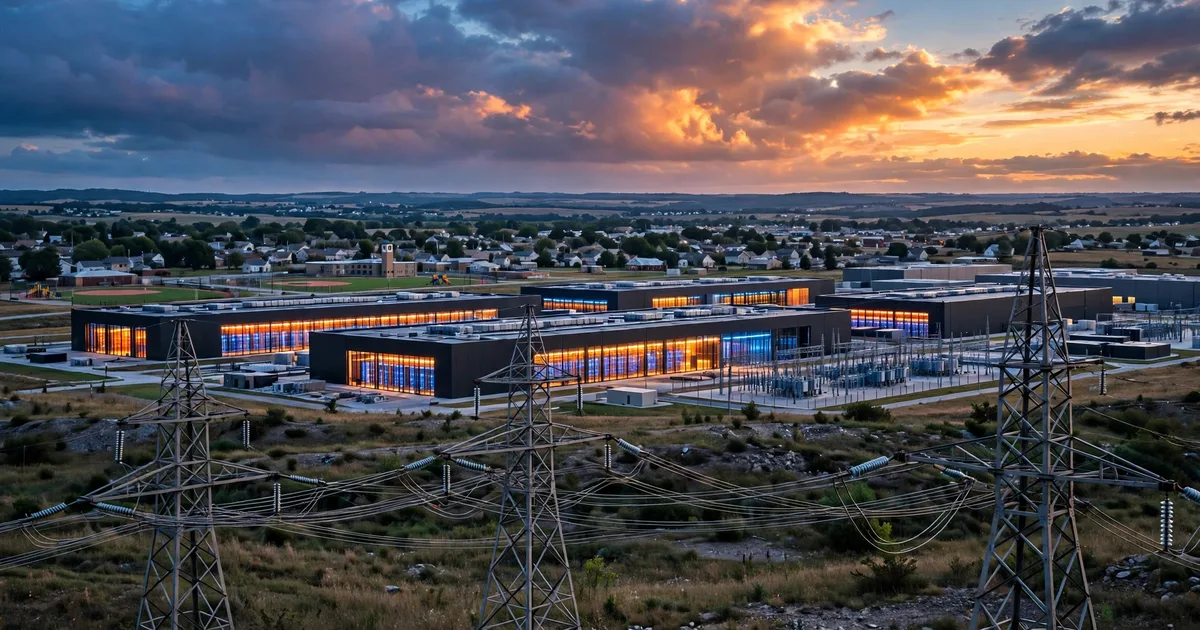
OpenAI published the two documents on Thursday under the title “Setting a new standard for responsible AI infrastructure.” The compact sets out what communities can expect from OpenAI at future campuses it owns and operates; the blueprint asks federal, state, and local policymakers to turn much of the same into law for the whole industry. The timing is deliberate: on November 1, OpenAI chief global affairs officer Chris Lehane told Axios the company would launch a policy push straight after the midterms, calling the election “a bit of a movie trailer” for the next presidential race. “AI is going to be the issue in 2028,” he said.
What OpenAI is promising
Every future campus OpenAI owns and operates will get its own local compact, shaped by residents, with a local point of contact for the life of the campus and a public report each year. The shared commitments start with money: OpenAI will pay “the full cost of the electricity we use” and the infrastructure needed to serve its sites, and will put up financial assurances before major spending begins so other customers are not left with the bill if a project is delayed, reduced, or canceled. The pledge tracks the White House’s Ratepayer Protection Pledge, which OpenAI has signed.
The compact also ends the secrecy deals that have shadowed data-center negotiations. OpenAI says it “will not require public officials to sign NDAs as a condition for discussion or negotiation,” keeping only narrow protections for legitimate security information, trade secrets, and competitively sensitive information. Its blueprint says it voided its own NDAs in Effingham County, Georgia, in July. A Senate inquiry found last month that Amazon, Google, Meta, and Microsoft still seek NDAs from public officials.
On disclosure, each campus gets a water plan that prioritizes closed-loop or low-water cooling, and OpenAI will publish site-level water and electricity use, construction plans covering traffic, noise, and lighting, and independent noise studies before a campus opens and every year after. Workforce plans will list the jobs each site expects to create, with annual reports on hiring and apprenticeships and local hiring targets where labor-market conditions allow.

Georgia and Ohio are the template
The compact points to two places where OpenAI says the model already works. In Effingham County, Georgia, near Savannah, OpenAI has committed $80 million to community priorities, including a $4.8 million grant providing free school meals for all 14,000 county students and $2 million to develop a local park. Its agreement with Georgia Power lets the utility reduce electricity deliveries to the campus by up to 1,000 megawatts during periods of high demand, and for Project Camellia OpenAI is contracting with Georgia Power for 3.2 gigawatts of power, delivered in phases between 2028 and 2032.
In Pike County, Ohio, OpenAI has committed $40 million, including a joint $6 million childcare commitment with SB Energy. OpenAI expects that campus to create 2,500 long-term jobs paying $80,000 a year on average, plus 26,000 construction jobs — the company’s own estimate.
What it wants from lawmakers
The blueprint argues that “voluntary measures alone don’t meet the scale of this moment.” It asks state utility commissions to create large-load tariffs requiring major electricity users to pay the incremental grid costs they create, and to back voluntary demand-flexibility programs with clear operating rules, including load curtailment and power from on-site generation or storage. From Congress it wants faster permitting for generation and transmission, clearer authority for the Federal Energy Regulatory Commission to expedite connections for ready-to-build projects, and reinstated and broadened technology-neutral clean-electricity tax incentives. Tax incentives, where offered, should have public terms, measurable commitments, and clawbacks if a developer falls short.
The blueprint also calls for public reporting on water, energy, noise, and hiring, and for narrow limits on when developers can require public officials to sign NDAs. And it proposes practical ways to keep more work local: developers share purchasing plans early enough for local suppliers to compete, and employers, building trades unions, and community colleges use hiring forecasts to train residents for jobs they know will be available.
The power question is not theoretical. Developers are racing to secure gigawatts for AI campuses, from a planned 1GW site at Drax Power Station to a 30MW AI data centre LG CNS just finished in Jakarta — and the communities hosting them are now pushing back at the ballot box.
What the compact does not do
The commitments are voluntary, and OpenAI will check them itself in its annual reports. The compact covers only campuses OpenAI owns and operates, and neither document says which current sites that includes. It also builds on earlier pledges rather than starting fresh: the January 20, 2026 Stargate Community commitments to pay its own energy costs, and the November 2 launch of Grid Protectors, a program for agreements that let future campuses reduce electricity demand during grid stress.
The test now is whether the local compacts and annual reports show OpenAI meeting its own standard — and whether lawmakers give residents the same protections when other developers build. OpenAI is building campuses in Georgia, Ohio, and Texas, three states where voters just turned against data centers, and pushing for binding rules lets it show newly elected officials it has already signed up — while holding its rivals to the same standard.
Sources: OpenAI’s blog post “Setting a new standard for responsible AI infrastructure”, Unite.AI’s coverage, MadRobot’s analysis, and Silicon Report.
Frequently asked questions
What is OpenAI's National Community Compact?
It is a set of commitments OpenAI published on November 5, 2026, for every future AI campus it owns and operates. Each campus gets its own local compact shaped by residents, and OpenAI will pay the full cost of the electricity and infrastructure its campuses use, publish site-level water and power use, and stop requiring public officials to sign NDAs.
What does the Compute Campus Policy Blueprint ask lawmakers to do?
It asks state utility commissions to make large electricity users pay the grid costs they create, Congress to speed up permitting and restore clean-electricity tax incentives, and all levels of government to require public reporting on water, energy, noise, and hiring — with public tax-incentive terms and clawbacks if a developer falls short.
Does the compact cover OpenAI's existing data centers?
No. It covers only future campuses OpenAI owns and operates, and the documents do not say which current sites that includes. The commitments are voluntary, and OpenAI reports on its own progress each year.