An open-source sky camera run by Claude Code caught 17 meteors in one night — and sorted them before sunrise
A 4K sky camera that runs around the clock, a Claude Code night workflow that reviews what it saw, and a Saturday-night haul of 17 meteors, sorted by morning. The open-source project behind the viral clip shows what an AI coding agent looks like as a night-shift colleague.
- Posted Monday, October 26, 2026 on r/ClaudeAI by u/Terrible_Award_2124: a 1:40 Reddit-hosted video, 1.3K upvotes and 76 comments within hours.
- The claim: Saturday night’s haul was 17 meteors, reviewed and sorted by morning, with the best detections texted to the owner.
- The rig: an EmpireTech IPC-Color4K-T camera, a YOLO26s detector trained by the creator, one-minute MP4s on the owner’s own disk, 40-day default retention.
- The agent layer: an MCP server with seven tools lets Claude Code browse footage, build and schedule detection workflows, and review detections — with a human still in the review seat.
- The caveats, from the creator’s own replies: detection uses no tokens, review is not fully hands-off, and birds — not meteors — dominate what the system tracks.

There is a particular pleasure in waking up to work that is already done. A new open-source project promises exactly that feeling for skywatchers: a camera that stares at the night sky around the clock, and a coding agent that sorts what it saw while its owner sleeps. On Monday, the project's creator posted a 100-second clip of the system in action, and the post took off on r/ClaudeAI, gathering 1.3K upvotes and 76 comments within hours.
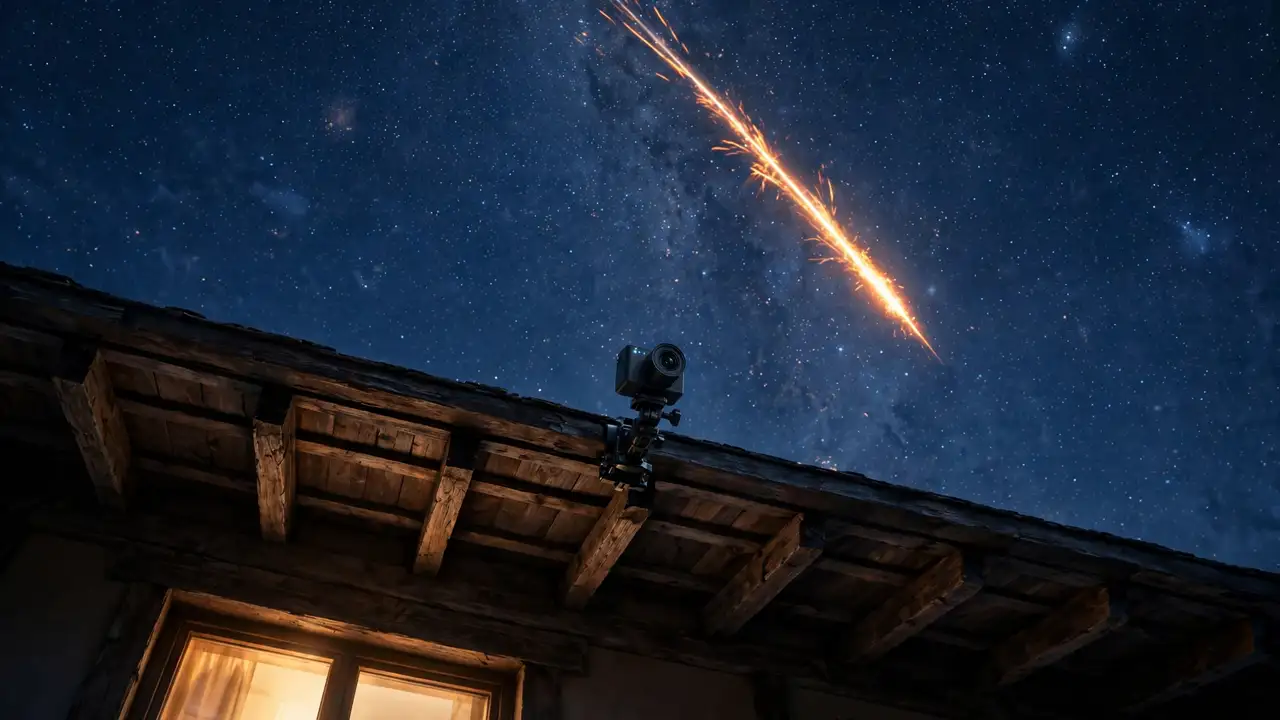
The hook was a single Saturday night. According to the post, the camera picked up 17 meteors in one night, and by morning the night's detections had been reviewed, sorted, and distilled into a short message about the best of them. The clip itself is unglamorous in the best way: a dark sky, a bright streak, and the quiet implication that nobody had to sit through hours of footage to find it.
The video: 17 meteors, sorted by sunrise#
The post comes from Reddit user u/Terrible_Award_2124, who describes the build as an open-source sky camera that Claude Code can actually run. The video, hosted on Reddit, runs 1 minute 40 seconds and shows the system's night-sky footage and the sorted results of its overnight review. It is not a rendered demo or a simulation: the footage is presented as the camera's own recordings, processed by the workflow the creator built around it.
What made the thread travel was not the meteor count alone. Commenters latched onto the shape of the thing: a hobbyist astronomy rig crossed with an AI coding agent, doing a job that used to mean either staying up late or scrubbing through recordings the next day. The top of the thread is mostly praise and technical questions — what camera, what model, how much of the pipeline the agent really handles — and the creator answered in the replies, which is where the more interesting details live.
How the rig works#
The project is called openskycam, and its public repository lays out a deliberately boring, self-hosted design. An IP camera pointed at the sky streams over RTSP to a small relay machine — a Raspberry Pi is enough — which slices the stream into one-minute MP4 files without re-encoding them. The files live on a disk the owner controls, catalogued by Cloudflare Workers, and are kept for 40 days by default. At roughly 43 gigabytes a day for a 4 Mbps stream, this is a project that takes storage seriously.
Detection runs on the owner's own machine. The repository ships a trained YOLO26s night detector, and its model card reports that on held-out nights it found 95% of planes and 90% of meteors, while flagging 7% of stars and fixed lights. Tracks are built by linking boxes of the same object across a recording, so the system can tell a moving aircraft from a streetlight that never moves. The camera in the viral post is an EmpireTech IPC-Color4K-T, according to the creator's replies, with a detection model trained by the creator.
What Claude Code actually does at night#
The agent part is the piece that separates this from a standard security camera with motion detection. The project exposes its whole website through an API and an MCP server with seven tools, so an agent can browse footage, grab a frame from any second of stored video, build and test detection workflows, schedule nightly runs, and review detections. The setup is designed to run unattended from a configuration file, and Claude Code connects to it as an MCP server.
In practice, the night workflow samples frames from the hours just recorded, runs detection, and routes each frame into buckets — meteors, planes, fixed lights — by class, score, and motion. Review is where the human loop closes: the creator corrects labels, and those corrections feed a dataset, which is how the system improved after stars were first misclassified. The morning message is the payoff — the good detections, texted to the owner, instead of a timeline to scrub through.
The creator is candid about the limits in the replies. Detection itself uses no tokens, the review is not fully hands-off, and much of what the system ends up tracking is birds rather than meteors. That honesty is part of why the thread reads as credible: this is a supervised workflow with an agent in the loop, not a claim that the machine runs itself.
What Reddit pushed back on#
No top comment in the thread debunked the 17-meteor claim, but the scepticism was not absent. One commenter said the footage looked fake, a charge that sits awkwardly against the project's open repository, public documentation, and the creator's willingness to answer detailed technical questions in the thread. The more substantive pushback was about framing: several commenters probed how much of the pipeline is genuinely agent-driven versus a well-built scheduled workflow with an agent-shaped interface, and the creator's answers — supervised review, token-free detection, birds dominating the buckets — give that question a fair hearing rather than a slogan.
That distinction matters for anyone tempted to copy the build. The impressive part is not that an AI watched the sky; it is that a hobbyist wired a camera, a disk, a detector, and an agent into a loop that produces a sorted answer every morning, and then published the whole thing under an MIT licence for anyone to run.

Why it matters, and what to watch#
The pattern here is bigger than astronomy. Coding agents are moving from chat windows into jobs with a physical footprint: a camera on a roof, a disk filling up in a closet, a message in the morning. The openskycam build shows what that looks like when it works — not a humanoid, not a demo on a stage, but a small loop of sense, decide, and report that runs while everyone sleeps. It also shows the failure modes honestly: misclassified stars, bird-dominated buckets, and a human still in the review seat.
Three things are worth watching from here:
- Whether the detector keeps improving in public. The dataset loop — review, correct, retrain — is the project's real engine, and its held-out numbers give future versions something to beat.
- Whether others replicate the Saturday-night result. The repository was published the same day as the post and had already gathered dozens of stars; independent builds will test whether 17 meteors is a good night or a typical one.
- Where the agent boundary settles. The interesting question the thread raised — scheduled workflow versus agent — will be answered by what owners actually ask the system to do next: new workflows, new cameras, new questions about old footage.
Sources: the original post by u/Terrible_Award_2124 on r/ClaudeAI; the openskycam project on GitHub and its documentation at docs.openskycam.org. The editorial illustrations are AI-generated.