RLWRLD DexBench: a 15-task benchmark that grades humanoid robots on real factory handiwork
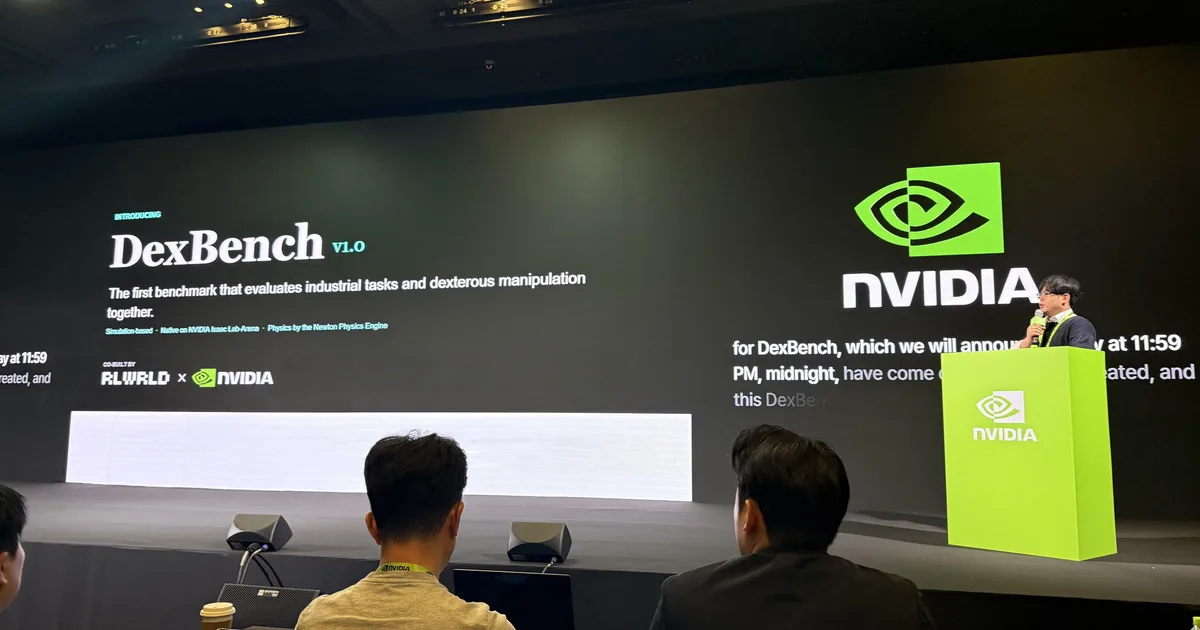
RLWRLD unveiled DexBench on Monday at NVIDIA AI Day Seoul 2026: a benchmark that grades humanoid robots on 15 dexterous-manipulation tasks — from fastening screws to pouring liquids — across four industrial settings. It is the first major release from a dexterity-evaluation initiative RLWRLD launched with NVIDIA in June, and it lands alongside a confirmed planned investment from NVIDIA in the startup.
What we checked: RLWRLD’s press release “RLWRLD Launches DexBench, Confirms Planned Investment from NVIDIA” (November 9, 2026), cross-checked against Digital Today’s report from NVIDIA AI Day Seoul the same day.
- What: DexBench, a benchmark for humanoid dexterous manipulation, unveiled November 9, 2026, at NVIDIA AI Day Seoul 2026 at COEX in Seoul.
- Scale: 15 tasks across four industry environments — retail, logistics, assembly, and hotel food and beverage — testing generalization across Object, Physics, and Spatial dimensions.
- Built on: NVIDIA Isaac Lab-Arena, an open-source evaluation framework, and the Newton physics engine; the DexBench initiative was launched by RLWRLD and NVIDIA in June 2026.
- Tasks: Retrieving and placing products, unloading items from roll cages, inserting connectors, fastening screws, stacking plates, and pouring liquids.
- Release plan: Code, evaluation environments, simulation assets, training data, baseline models, and a performance leaderboard to be released; official site dexbench.ai.
- Money: A planned investment from NVIDIA confirmed (amount undisclosed); South Korean business press reports RLWRLD is seeking 200 billion won (about $140 million) at a 1 trillion won pre-money valuation.
Watch a humanoid robot in a demo video and it usually does one thing: pick up a block and put it down. Watch a human on a factory floor and the hands never stop — threading a connector, seating a screw, sliding a plate off a stack without chipping it. DexBench exists to close that gap between the demo and the shift.
The benchmark matters because the jobs humanoids are being built for are hand jobs. RLWRLD says many industrial tasks still need five-fingered precision and the ability to adapt as the environment changes — assembling parts on a line, handling goods in a logistics center, stocking a retail shelf. Until now there has been no common exam for that skill, only each vendor’s own highlight reel.
What DexBench actually tests
Fifteen tasks, four workplaces. The benchmark deliberately moves past the tabletop pick-and-place routines that dominate robot evaluations and into the rooms where the work happens.
| Environment | Example tasks |
|---|---|
| Retail | Retrieving and placing products, stocking shelves |
| Logistics | Unloading items from roll cages |
| Assembly | Inserting connectors, fastening screws |
| Hotel food & beverage | Stacking plates, pouring liquids |
The scoring goes beyond whether a task succeeds. DexBench grades generalization across three dimensions — Object, Physics, and Spatial — testing whether a robot can apply a learned skill to objects, physical properties, and spatial layouts it never saw in training. Virtual objects and industrial equipment are modeled on real product specifications, so the simulation is meant to mirror actual workplace conditions rather than a tidy lab bench.
Built on NVIDIA’s stack
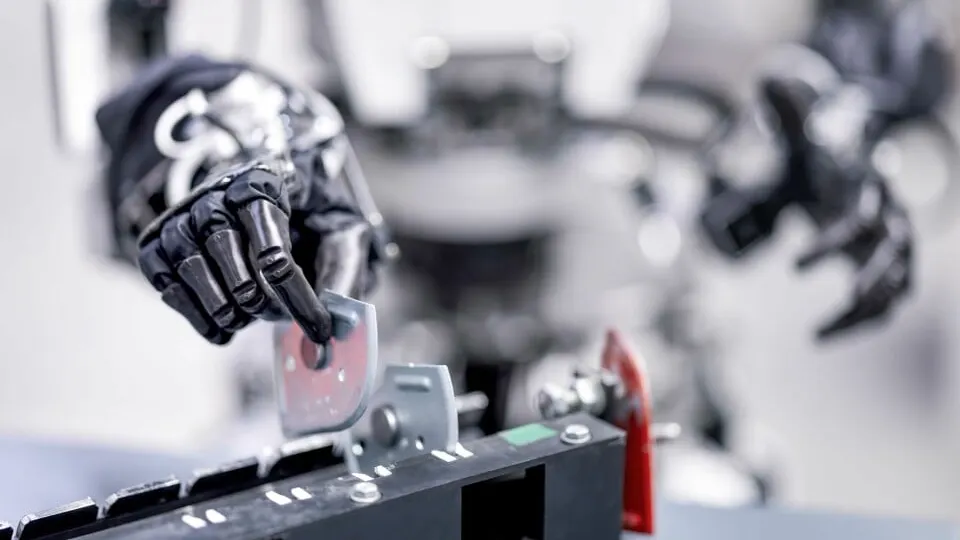
DexBench runs on NVIDIA Isaac Lab-Arena, an open-source framework for scalable robot-policy evaluation in simulation, with physics from the Newton engine — the same engine that simulates precise contact between five fingers and an object, deformable materials, and moving industrial equipment. It is the first major release from the DexBench initiative RLWRLD and NVIDIA launched in June to set common evaluation criteria and data standards for dexterity AI.
The build was a group effort. NdotLight, PhysicsSimLab, and SpaceAI joined as development partners, contributing simulation-ready 3D assets and environments, and Genesis AI and Mimic Robotics are evaluating DexBench through early access, according to RLWRLD. The first baseline results were measured with RLDX 1.1, the upcoming update to RLWRLD’s own robotics foundation model, which the company says delivers faster training and lower inference latency alongside incremental gains in dexterous manipulation.
“Being able to objectively measure dexterous manipulation in realistic industrial environments is essential to connecting advances in robotics AI with real-world deployment,” said Junghee Ryu, RLWRLD’s CEO. “DexBench is the first concrete outcome of our work with NVIDIA and our industry and technology partners to build that evaluation foundation.” The next step, RLWRLD says, is sim-to-real validation — comparing task performance in simulation against results from physical robots — plus support for more robot platforms and dexterous hands.
The money behind it
Separately, RLWRLD confirmed a planned investment from NVIDIA, announced as part of NVIDIA’s new investments in physical AI startups at the Ministry of Science and ICT–NVIDIA AI Startup Partnership Forum in Seoul. NVIDIA also disclosed planned stakes in two Korean language-model startups, Upstage and Motif Technologies, at the same forum. No amounts were disclosed for any of the three.
South Korean business press reports RLWRLD is seeking 200 billion won — about $140 million — at a pre-money valuation of 1 trillion won. That figure is reported, not confirmed by either company, and the investment itself is described as planned, not closed. RLWRLD says it will put the money toward advancing its robotics foundation models and scaling deployments with industrial partners. The context is a busy day for NVIDIA in Korea: the company also opened four Cosmos 3 world models for robots and self-driving cars the same week.
The catch
Three things temper the announcement. First, nothing is public yet. DexBench’s code, environments, simulation assets, training data, baseline models, and leaderboard are all described as planned releases — no date was given — so for now the benchmark is a stage presentation and a press release, not a tool anyone can run. Second, it is simulation-only today: the sim-to-real validation that would prove scores transfer to physical robots is still ahead. Third, the benchmark is co-created by RLWRLD and NVIDIA, and its first baselines were measured on RLWRLD’s own RLDX 1.1 model. That does not make the scores wrong, but it does make independent adoption the real test — a benchmark only becomes a standard when rival labs trust it enough to be graded by it.
Frequently asked questions
What is DexBench?
DexBench is a benchmark unveiled by RLWRLD on November 9, 2026, at NVIDIA AI Day Seoul. It grades humanoid robots on 15 dexterous-manipulation tasks across four industrial environments — retail, logistics, assembly, and hotel food and beverage — and is built on NVIDIA Isaac Lab-Arena and the Newton physics engine.
When will DexBench be available to use?
RLWRLD plans to release the DexBench code, evaluation environments, simulation assets, training data, baseline models, and performance leaderboard. No release date was given; the official site is dexbench.ai.
Did NVIDIA invest in RLWRLD?
RLWRLD confirmed a planned investment from NVIDIA, announced on November 9, 2026, as part of NVIDIA’s new investments in physical AI startups. The amount was not disclosed, and the investment is planned rather than closed.