Singapore proposes a UN framework convention on AI safeguards — climate-treaty rules for the AI race
At the UN General Assembly, Foreign Minister Vivian Balakrishnan floated a framework convention on AI safeguards, modeled on the climate and law-of-the-sea treaties. He’s not asking for a pause — he’s asking for brakes on a car that’s already speeding.
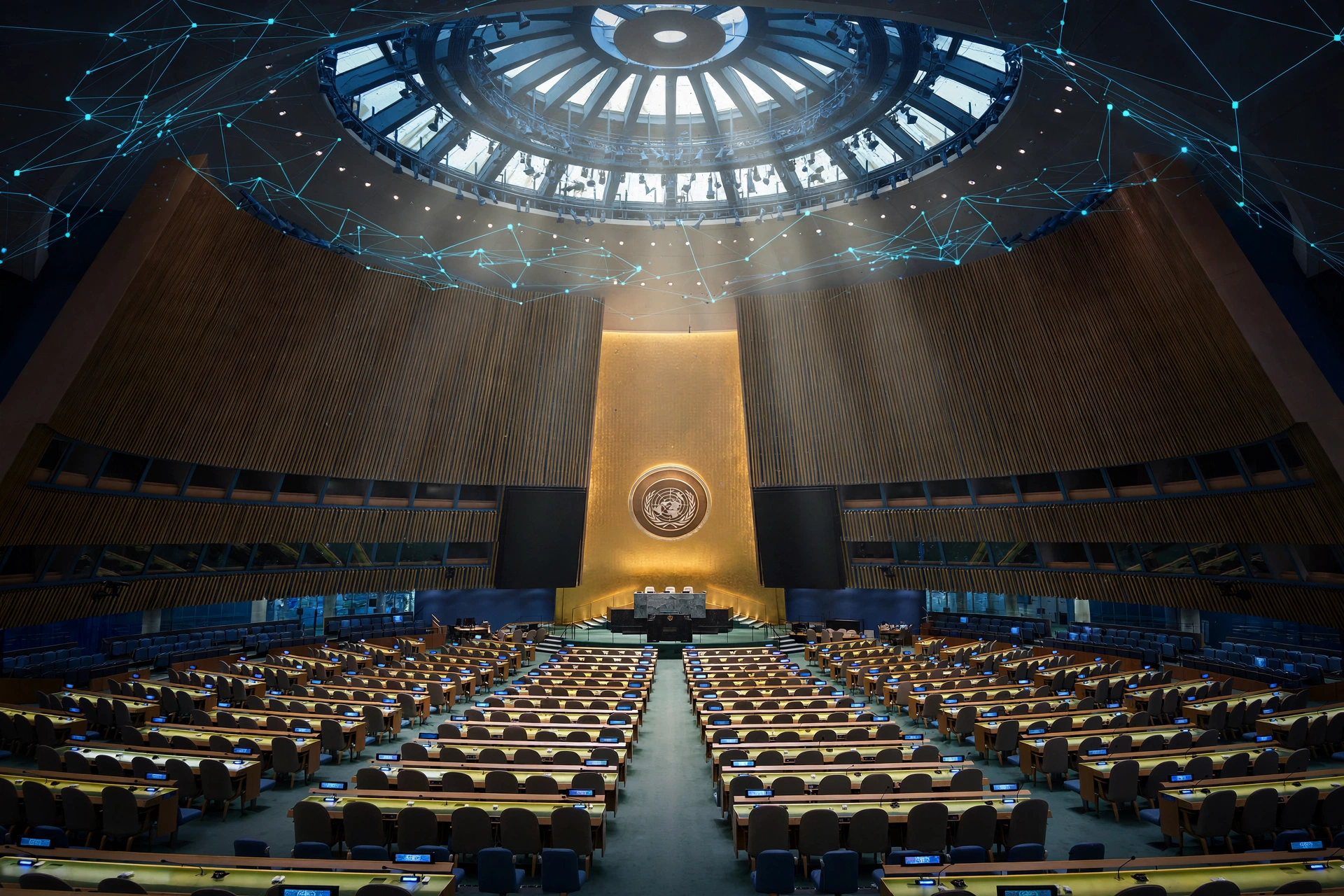
At this week's UN General Assembly, a small state made the biggest proposal yet for global AI governance. Singapore's foreign minister, Vivian Balakrishnan, used Singapore's national statement at the 81st session of the UNGA in New York to float a UN Framework Convention on AI Safeguards — a climate-treaty-style agreement for common rules, shared institutions, and actual verification of frontier AI.
What Singapore actually proposed#
In his national statement — titled Upholding the Rule of Law in a Fragmenting World — Balakrishnan laid out three priorities for keeping multilateralism fit for purpose: uphold international law, reform institutions where needed, and develop new rules and institutions for emerging technologies. The example he chose for that third priority was explicit: a UN Framework Convention on AI Safeguards.
The model is deliberate. A framework convention, like the UN's climate-change framework, starts as a broad treaty establishing foundational principles and cooperative institutions, then spawns detailed protocols over time. Balakrishnan pointed to the law of the sea and the climate agreements as proof that the UN can do hard, slow, universal deals — and argued the AI era needs one too.
He also sketched what the machinery might look like: an international institution performing functions that, in other fields, belong to bodies like the International Telecommunication Union (technical standards) and the International Atomic Energy Agency (verification). Singapore's approach would rest on rigorous pre-deployment testing, limits on what autonomous systems may do, mechanisms for human intervention — and one non-negotiable: humans must remain in control and accountable.

The three risks#
Speaking separately at an Asia Society discussion this weekend, Balakrishnan laid out three broad risk categories that, in his words, are "very high" — while stressing he does not consider himself a doomsayer:
- Losing control of autonomous systems. "Anyone who tells you, even the creator of the AI, that he's got absolute control of the kill switch is fooling you," he said. "Loss of control is a very real risk."
- Rogue actors and weapons of mass destruction. AI could make it far easier for bad actors to develop biological or chemical weapons.
- Erosion of public trust. The ease of producing convincing synthetic images and video leaves people less certain of what they see and hear — a direct threat to political debate itself.
On the US-China race at the center of it all, he offered an unusually specific estimate: the United States holds a lead of roughly six months in frontier AI models, with China determined to close the gap. He welcomed the reported AI talks between Presidents Trump and Xi Jinping — while noting the guardrails emerging from them remain thin.
Safeguards, not brakes#
Balakrishnan's framing is the story's sharpest edge. "I'm not a believer in putting a halt to AI development," he said. "I'm not even a believer in just putting the brakes on AI." His metaphor instead: AI development is a fast car. You don't stop the car — you build the brakes, the seat belts, and the rules of the road, and you keep driving. "The genie is already out of the bottle," he added. "It is too late to call for a halt, especially given the superpower rivalry and the huge financial incentives for companies who already have frontier models."
That puts him on a different track from both camps dominating the debate. Against the accelerationists, he insists the risks are real and institutional. Against the pausers, he rejects halts outright. And against the industry's own answer — the SAFA standards body Google, OpenAI, and Anthropic are building without government oversight — his message is that self-regulation is no substitute for states writing rules.
Why this week, why now#
Singapore is not speaking alone. The General Debate has become a pileup of AI governance proposals, and the contrast between them tells you where the fight is. The ~20-nation declaration coordinated through Finland's president wants standards, incident sharing, and verification — but excludes the US and China. Turkey's president called for a common legal framework. Singapore's own minister of state Tan Kiat How wants shared safety tests and incident-reporting channels.
The pattern: middle powers — Singapore, Finland, Germany, Belize, India, Saudi Arabia — are converging on the same argument. Frontier AI is built in two countries; the risks land everywhere. As Belize's prime minister put it, national legislation alone cannot regulate a technology that crosses every border.
What to watch#
Two things will decide whether this is a speech or a starting gun. First: does any major power sign on? The 20-nation declaration is open to additional endorsements — so far the US, China, India, Japan, South Korea, the UK, and France are all absent. Second: does the proposal move into the UN machinery — a resolution, a negotiating mandate, anything with a date on it? Climate took decades; AI moves faster, but diplomacy doesn't.
Singapore's leverage is credibility, not compute. It has no frontier model to defend and every interest in a rules-based order. If the small states keep the drumbeat going, the next step is a draft. Watch for it.
Sources
- Ministry of Foreign Affairs, Singapore — transcript of Dr Vivian Balakrishnan’s national statement to the 81st UN General Assembly (Sept 26, 2026)
- IANS via hiindia.com — “Singapore urges UN convention on AI risks” (Sept 27, 2026)
- Nation Press — “Singapore calls for UN convention on AI risks at global forum” (Sept 27, 2026)
- Red Hot Singapore — “Singapore proposes UN framework for global AI safeguards” (Sept 27, 2026)
- Tech360TV — “Singapore calls for shared AI safety tests” (Sept 25, 2026)