Springer retracts a peer-reviewed AI review over undeclared generative AI — the citations gave it away
A paper about how artificial intelligence is reshaping communication research has been retracted — because, the publisher concluded, it was itself written with artificial intelligence. Springer Nature's Discover Artificial Intelligence published the retraction note on October 3, 2026, withdrawing a 2024 review whose references, the publisher said, "appear to be contextually incorrect," a pattern that "may suggest generative AI was used in writing this manuscript."
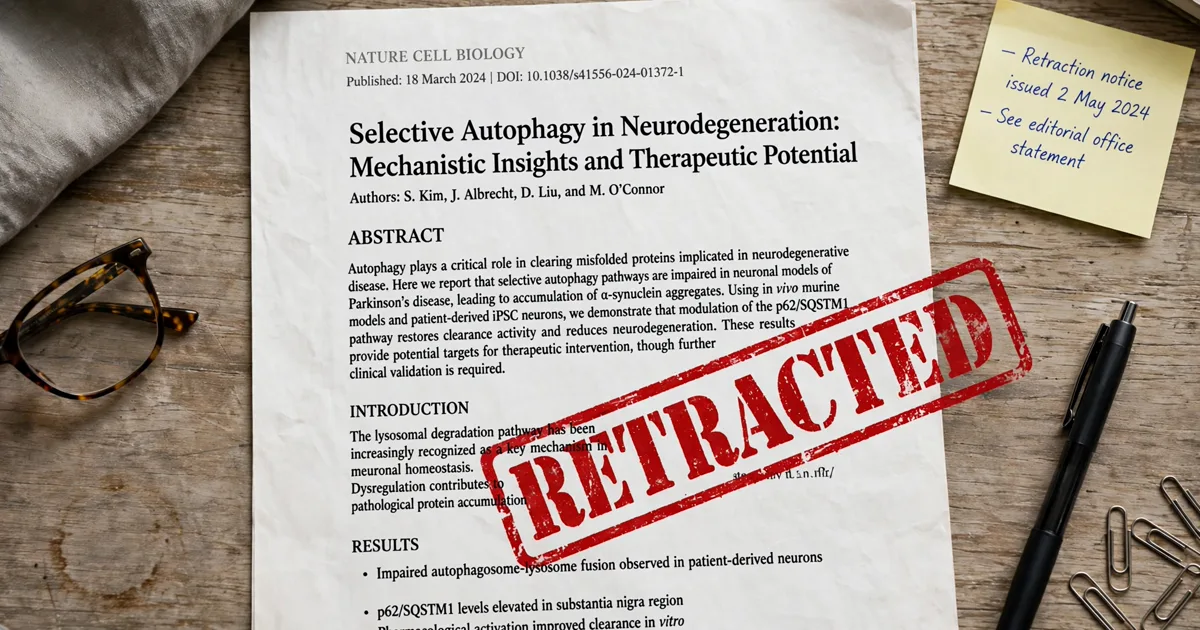
The retraction note, published on October 3, 2026, withdraws "Innovative application of artificial intelligence in a multi-dimensional communication research analysis: a critical review," a paper that appeared in Discover Artificial Intelligence on May 16, 2024 (volume 4, article 37). The authors — Muhammad Asif and Zhou Gouqing of the College of Journalism and Communication at Hunan Normal University in Changsha, China — did not, in the publisher's judgment, provide a satisfactory explanation when confronted. "The Publisher therefore no longer has confidence in the reliability of the contents of this article," the note states.
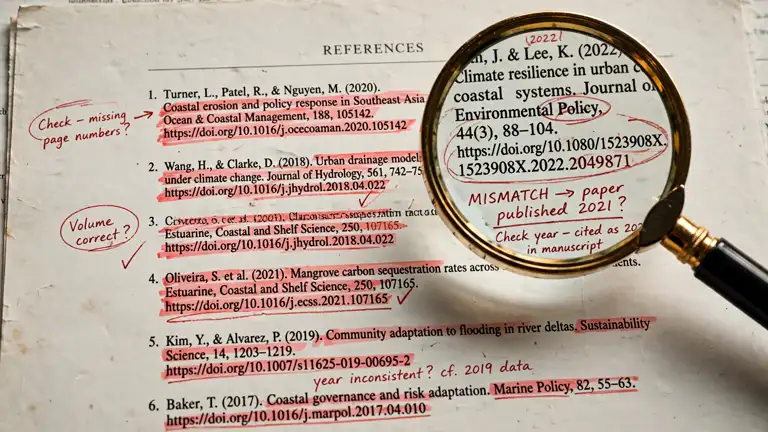
The trigger was the bibliography. A number of citations in the paper appeared contextually incorrect — one of the most recognizable fingerprints of machine-generated academic text. Language models, asked to produce scholarly prose, routinely generate references that look plausible, with real author names, real journal titles and realistic formatting, but that do not actually support, or in some cases do not correspond to, the claims they are attached to. In a critical review — a genre whose entire contribution is the accurate synthesis of prior work — corrupted references strike at the foundation.
The split#
The authors' responses diverged in a way integrity researchers will recognize. Muhammad Asif formally disagrees with the retraction, registering his objection in the published notice. Zhou Gouqing has not responded to the publisher's correspondence about the retraction at all. The split — one author contesting the decision while the other stays silent — leaves open questions about how the manuscript was produced and who was responsible for its citation record.
The case arrives amid a broader reckoning over generative AI in scholarly publishing. The consensus position among major publishers, Springer Nature included: AI tools may assist authors in limited ways, such as improving language and readability, but AI cannot be listed as an author, authors remain fully responsible for everything — including the accuracy of references — and any generative AI use must be transparently disclosed. The rationale is structural. Peer review is built on the assumption that named authors stand behind every claim; when a model has silently shaped the text, that chain of accountability breaks, and reviewers who believed they were evaluating human scholarship may instead have been evaluating synthetic prose.

The irony#
The irony has not been lost on observers: a review assessing the innovative application of AI in communication research, withdrawn over the suspected undeclared application of AI in its own writing. Communication scholars, of all researchers, might be expected to appreciate how generative systems reshape the production of text. The retraction suggests the pressures driving AI use — the volume of writing expected of academics, the speed at which AI topics move — cut across disciplines.
The two-year gap between the May 2024 publication and the October 2026 retraction also illustrates how long these investigations take. Publishers gather evidence, correspond with authors, weigh responses — retraction is deliberately a last resort because it carries serious professional consequences, but once lost, confidence in a paper's reliability is not restored by partial corrections.
The hard limit#
Detection remains an imperfect science. Unlike image duplication or text recycling, undeclared generative AI leaves no definitive signature; contextually wrong references are among the few reliable indicators precisely because they can be checked against the literature. Beyond that, publishers rely on reader reports, editorial vigilance and post-publication scrutiny.
The practical lessons are concrete. Authors who use generative AI should check every reference against the actual source, disclose the tool and the nature of its use per journal policy, and treat model output as a draft to be verified — never a finished product. Reviewers and editors, meanwhile, are being trained to scrutinize citation lists for the telltale signs of hallucinated scholarship: references that do not exist, papers that say something different from what is claimed, bibliographies that blend real venues with implausible content.
The retracted article remains visible online, as retracted papers typically do — now carrying the retraction note as a permanent marker, published as Discov Artif Intell 6, 1337 (2026). It joins a growing public ledger of AI-related retractions that is helping the research community calibrate its norms in real time. Whether that ledger grows or shrinks in the coming years will depend less on detection technology than on whether the norms of disclosure and verification take hold before the next generation of writing tools arrives.