Give your AI agent a PhD supervisor: a hands-on guide to Supervisor-Skills
HKUST's 10,100-star Supervisor-Skills distills a decade of PhD-advisor publishing experience into installable AI skills for research: idea evaluation, introduction drafting, literature surveys, and paper polishing. This guide installs the skills in your coding agent and walks the full idea-to-submission loop hands-on.
- What: Supervisor-Skills (HKUSTDial/Supervisor-Skills): 11 AI skills that model a PhD advisor’s moves across the paper lifecycle, from idea to pre-submission review.
- Who/when: built by Yuyu Luo, assistant professor at HKUST (Guangzhou); released 2026-04-19, 1,000 stars in 32 days, roughly 10,100 stars by 2026-10-19.
- License: CC BY-NC-SA 4.0 — non-commercial. Research and study use is fine; commercial adaptation needs permission.
- Install: paste “Help me install Supervisor-Skills from https://github.com/HKUSTDial/Supervisor-Skills with Skills.” into Claude Code, Cursor, or Codex; any other assistant works by copying a SKILL.md.
- Key skills: idea-evaluator (verdicts: Strong Accept / Accept with Revisions / Reject and Pivot), intro-drafter (six-paragraph flowchart), deep-research, paper-writer (evidence-gated), paper-polish, pre-submission-reviewer.
- Momentum: v2.1 on 2026-07-10; core research skill suite of Doubao Office Mode (2026-07-15); embedded in Baidu’s Kuku AI platform (2026-09-21).
Your advisor's office hours are over. Their feedback isn't. A PhD advisor with a decade of top-venue publishing experience — SIGMOD, VLDB, ICML, NeurIPS — has distilled how they mentor students into something you can install: Supervisor-Skills. Not a prompt library and not a framework, but eleven structured AI skills that plug into the coding agent you already use, each one modeling a concrete advisor move: scoring a half-formed idea, drafting an introduction, surveying a literature, polishing prose, and reviewing a draft like a top-venue reviewer.
The project comes from the Data Intelligence and Analytics Lab (DIAL) at HKUST (Guangzhou), led by assistant professor Yuyu Luo. Released in April 2026, it crossed 1,000 stars in 32 days and now sits at roughly 10,100 GitHub stars — plus real deployments: it's the core research skill suite of Doubao Office Mode and is embedded in Baidu's Kuku AI platform. One important caveat up front: it's licensed CC BY-NC-SA 4.0, which means non-commercial use. Fine for research and study; not for a commercial product.
This guide installs the skills and runs the full loop: idea → introduction → literature survey → polish → pre-submission review.
What you'll need
- An AI assistant that supports skills: Claude Code, Cursor, or Codex (any other assistant works too, with a manual step)
- A clone of
HKUSTDial/Supervisor-Skills— or just the URL - A research idea and some notes on it — half-formed is fine
- About 30 minutes; no new API keys beyond what your assistant already uses
Step 1 — Install the skills
Clone the repo and hand your assistant the install prompt from the README:
git clone https://github.com/HKUSTDial/Supervisor-Skills.git
cd Supervisor-Skills
Then paste this into Claude Code, Cursor, or Codex:
Help me install Supervisor-Skills from https://github.com/HKUSTDial/Supervisor-Skills with Skills.Using a different assistant? Copy the content of any SKILL.md straight into the chat — for example skills/idea-evaluator/SKILL.md. Skills are just structured prompt files; the "installation" is giving your agent the file.
Step 2 — Score your research idea
The idea-evaluator skill does what a good supervisor does with a hallway pitch: it scores your idea against a five-dimension framework — Higher, Faster, Stronger, Cheaper, Broader — matches the idea's lifecycle against your actual capability and weekly hours, probes for fatal flaws, and returns one of three verdicts: Strong Accept, Accept with Revisions, or Reject and Pivot.
Use the idea-evaluator skill. Here is my draft research idea:
<paste your idea here: the problem, your key insight, the setting>
Be honest about your resources in the prompt — the skill's capability-matching table only works if it knows what you can actually build. If it says "Reject and Pivot," that's the advisor saving you six months.
Step 3 — Draft the introduction
The intro-drafter skill turns your motivation into prose using a six-paragraph flowchart: background and running example → existing limitations → problem essence and goal → key challenges → solution overview → contributions. Reviewers decide whether to keep reading by the end of the introduction, so this structure is the whole game.
Use the intro-drafter skill with:
- Research area: <yours>
- Limitations of existing work: <from your deep-research notes>
- Key idea: <one sentence>
- Challenges: <why this is hard>
- Solution overview: <your approach>
- Optional references: <paper titles/URLs>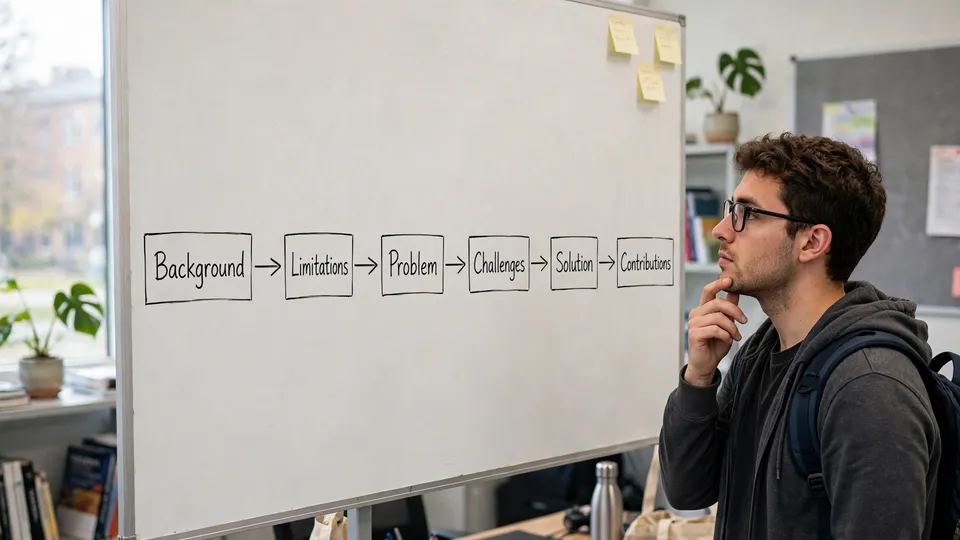
The skill outputs flowing prose by default (outline mode on request) and weaves in citations. Read it as a draft, not a verdict: if the throughline doesn't feel airtight, your challenge statements are probably vague.
Step 4 — Survey the literature
The deep-research skill runs a survey-grade literature investigation: multi-perspective search, per-citation verification, and MECE synthesis into a survey report that answers explicit research questions.
Use the deep-research skill. Answer these research questions:
1. What are the established methods for <your problem>, and what are their known limitations?
2. Which papers does my work most directly compete with or build on?
3. What evaluation setups are standard for this kind of claim?
Take the per-citation verification seriously: open the key citations yourself and confirm they say what the report says they say. The skill's paper-writer cousin is explicitly evidence-gated — every factual claim should trace to your materials or verified literature — but that gate is only as strong as your checking.
Step 5 — Polish, then face the reviewer
Run paper-polish on your draft for submission-quality language: grammar and flow repair, AI-tone removal, claim calibration against evidence strength, and Chinese-to-English rewriting if your draft started in Chinese. It flags meaning-risk edits for your confirmation and never fabricates data, citations, or claims.
Then sic pre-submission-reviewer on it. This skill adopts a top-venue reviewer's perspective, running your draft through the writing checklist and common English grammar pitfalls. Read the review like you'd read a real NeurIPS review: the painful points are the ones that would have killed the paper.
What you built
A working research co-advisor: eleven installable skills that took your half-formed idea through advisor-style evaluation, a six-paragraph introduction, a verified literature survey, submission-grade polishing, and a mock top-venue review. The same skills that power Doubao Office Mode's Research Evaluation and Academic Writing features — running in your own agent.
Honest limitations
- Non-commercial license. CC BY-NC-SA 4.0 covers the project. Use it for research and study; adapting it into a commercial product needs the author's permission.
- The canonical handbook is Chinese. The
handbook/chapters are written in Chinese, with English mirrors inhandbook-en/for all six chapters. Non-Chinese readers should start with the mirrors. - Skills are prompts, not software. Nothing is installed or executed; output quality rides entirely on the model you give the skill to. A weak model will produce weak advice with advisor-level confidence.
- Evidence gating is aspirational. The paper-writer skill is designed so every claim traces to your materials or verified literature — but the model can still hallucinate citations. Verify every reference yourself before it goes anywhere near a submission.
- Partnerships are China-market deployments. The Doubao and Baidu Kuku AI integrations show the methodology scales, but they're separate products; the open repo is what you're using here.
Frequently asked questions
Do the skills work with any AI assistant?
Yes. The README’s install prompt targets Claude Code, Cursor, and Codex, and any other assistant can use a skill by copying its SKILL.md file (for example skills/idea-evaluator/SKILL.md) straight into the chat — the skills are structured prompt files, not software.
Does Supervisor-Skills write the paper for me?
No. The paper-writer skill drafts from your materials with evidence gating — every factual claim is meant to trace to your materials or verified literature — and it never fabricates data, citations, or claims. You own the ideas, the evidence, and the final judgment; the skills supply the advisor’s process.
Is it free to use?
The repository is released under CC BY-NC-SA 4.0, so non-commercial research and study use is fine, but commercial adaptation needs the author’s permission. The skills themselves cost nothing beyond whatever your AI assistant already charges in API usage.