Tencent releases Hy4 open weights: 770B flagship goes downloadable, under a new license
Tencent posted the full Hy4 weights on Hugging Face on November 20: the 770-billion-parameter flagship, its FP8 variant and the base model, plus a system card. The catch is the license — the preview’s Apache 2.0 is gone, replaced by a Tencent Hy License that puts a leash on large-scale commercial use.
- What dropped: the full Hy4 weights on November 20, 2026 — Hy4 (instruct), Hy4-FP8 and Hy4 base — on Hugging Face, ModelScope and GitCode, announced at 03:52 UTC by Tencent Hunyuan on X.
- The model: 770 billion total parameters, 49 billion active per token, 78 layers, a 1-million-token context window, with vision and Computer Use.
- The license changed: the August preview was Apache 2.0. The full model ships under the Tencent Hy License, Version 1.0, with extra commercial terms in Section 10.
- The thresholds: a model-as-a-service business needs a separate written license if its worldwide revenue tops US$50 million a year, or its product passes 100 million monthly active users. Purely internal use is exempt.
- The size: about 1.55 TB for the full weights, 0.79 TB for FP8 — official serving recipes use vLLM or SGLang across eight GPUs.

Tencent posted the open weights for Hy4 on November 20, closing the loop on the flagship it launched on November 4 with a promise that the weights would follow. The announcement went out at 03:52 UTC from Tencent's Hunyuan account on X, and the release thread on r/LocalLLaMA passed 180 upvotes in its first four hours. Three checkpoints are now live on Hugging Face, ModelScope and GitCode: the instruction-tuned Hy4, an FP8-quantised Hy4-FP8, and the pre-trained Hy4 base — plus the system card Tencent said would arrive with them.
The download is the news. The fine print is the story. The August preview shipped under Apache 2.0; the full model ships under a new Tencent Hy License, derived from Apache 2.0 but with an extra section that puts conditions on the biggest commercial users. The weights are public. Using them at scale is now a negotiation.
What actually dropped
The model card's news section states it plainly: Tencent has open-sourced Hy4, Hy4-FP8 and the pre-trained Hy4 base model weights. The three checkpoints, by the file tallies reported on launch day, run to about 1.55 TB for Hy4, 0.79 TB for the FP8 version and 1.54 TB for the base model. The model itself is unchanged from the November 4 launch: 770 billion total parameters with 49 billion active per token, 78 layers, a 1-million-token context window, and the vision and Computer Use capabilities that were the headline of the official release.
The sequence matters. Hy4 launched on November 4 as an API-only model, through Tencent Cloud and OpenRouter, with the weights promised for later. The smaller Hy4 Flash got its weights on November 17. Now the flagship follows, sixteen days after launch. The LocalLLaMA thread that surfaced the release did the practical maths immediately: at FP8, the weights alone are roughly 770 GB to hold.
The license is the real story
The license file on Hugging Face opens with a warning: the Tencent Hy License, Version 1.0, is derived from the Apache License, Version 2.0, with modifications — mainly the additional commercial terms for large model-as-a-service businesses in Section 10. “This License is not the Apache License, Version 2.0,” it says, “and is not endorsed by or affiliated with the Apache Software Foundation.”
Section 10 is the whole ballgame. If you operate a model-as-a-service business — giving third parties remote access to inference or fine-tuning through an API — you must obtain a separate written license from Tencent before using the weights if either of two thresholds is met: your aggregate worldwide gross revenue exceeds US$50 million in any consecutive 12-month period, or the product or service using the model has more than 100 million monthly active users in any calendar month. Purely internal use is exempt, as long as neither the model nor its outputs are made available to third parties. Licensing questions go to [email protected].
For researchers, hobbyists and small builders, little changes: download, fine-tune, quantise, serve it yourself. For a cloud provider or a large product that wants to offer Hy4 as a hosted API, the release is an invitation to negotiate, not a free-for-all. That is a deliberate break from the preview, and from the “open source” framing that had the Reddit thread arguing about terminology within minutes.
What the numbers say
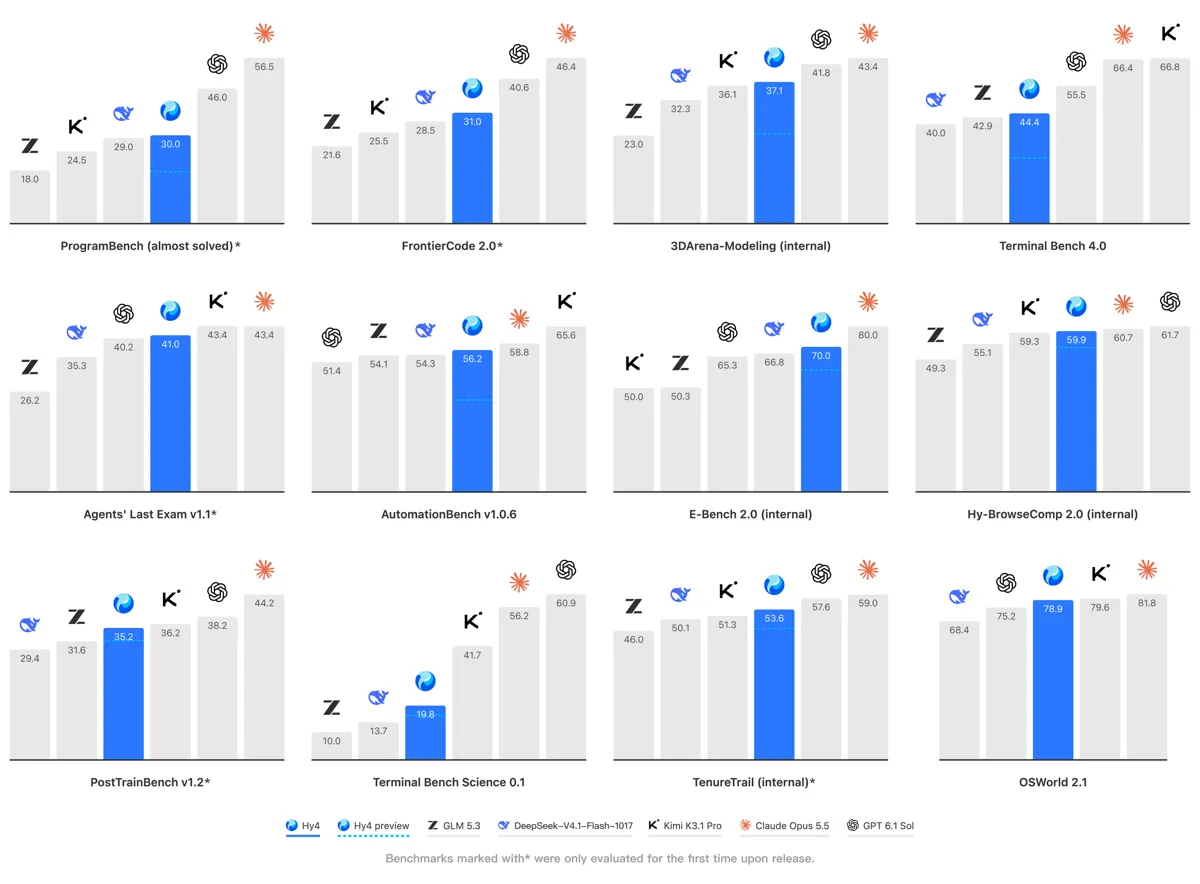
The model card's own benchmark tables put Hy4's base model at 91.6 on MMLU, 73.9 on MMLU-Pro and 62.7 on SuperGPQA, with 95.0 on C-Eval and 57.2 on SimpleQA. In finance, Hy4 scored 3.04 out of 4 across 579 real-world tasks judged by 213 finance professionals, first among open-weight models in Tencent's own exercise. Internal evaluations also claim the hallucination rate fell from 15.76% on the preview to 5.45%, and speculative errors from 23.1% to 5.6%.
Tencent's own chart is more honest than the headline numbers. On OSWorld 2.1, the desktop-agent benchmark, Hy4 scores 78.9 against 81.8 for GPT 6.1 Sol; on Terminal Bench 4.0 it scores 44.4 against 66.4. The model card's known-limitations section concedes the same gap to the top proprietary models on research-level maths, long-horizon coding and advanced visual question answering. All of these are vendor numbers, and the point of an open-weights release is that they no longer have to be taken on trust — independent evaluations can now run the real thing. The safety picture was already reported when Hy4 launched on November 4, and the system card published with the weights is where the fuller version lives.
What it takes to run it
Almost nobody will run the full model at home. The official serving recipes use vLLM or SGLang with tensor parallelism across eight GPUs, plus DFly2, Hy4's built-in speculative-decoding drafter, to keep long-context generation fast. Tencent also ships an AngelSlim GGUF build for end-to-end testing, and the community quantisations will follow — they did for Hy4 Flash within days. For most people the practical route is unchanged: the API, or the smaller Hy4 Flash, whose weights landed on November 17 at a fifth of the size.
What to watch: independent benchmarks in the coming days, which will say more than Tencent's charts; whether community quantised builds make Hy4 usable outside a data center; and whether the license's Section 10 chills hosted fine-tunes and forks, or is simply priced in as the new normal for frontier open weights. The weights are out. The argument about what “open” means is now in writing.
Sources: Tencent Hy4 model card, Hugging Face; Tencent Hy License, Version 1.0; Sulat, “Tencent releases Hy4 open weights: 770B MoE, custom licence”; CellCog, “Tencent Hy4: Out of Preview, Now With Vision”; r/LocalLLaMA, Hy4 release thread
Frequently asked questions
What exactly did Tencent release?
Three checkpoints on Hugging Face, ModelScope and GitCode: the instruction-tuned Hy4, the FP8-quantised Hy4-FP8, and the pre-trained Hy4 base model, announced on November 20, 2026, plus a system card. The model has 770 billion total parameters with 49 billion active per token and a 1-million-token context window.
Can I use Hy4 commercially?
For most uses, yes, under the Tencent Hy License. But if you run a model-as-a-service business with more than US$50 million in annual worldwide revenue, or a product with more than 100 million monthly active users, you need a separate written license from Tencent first. Purely internal use is exempt.
How big is it, and what hardware do I need?
About 1.55 TB for the full model and 0.79 TB for the FP8 version. The official serving recipes use vLLM or SGLang with tensor parallelism across eight GPUs. Most individuals will use the API or the smaller Hy4 Flash instead.