From research question to submission-ready paper: hands-on with academic-research-skills
academic-research-skills packs five Claude Code skills — deep research, paper writing, peer review, a full pipeline, and a systematic-review screener — into one CC BY-NC collection with integrity gates that verify every citation. This tutorial installs all five, runs each one, and prices a full paper at $3–$7.
- Verified versions:
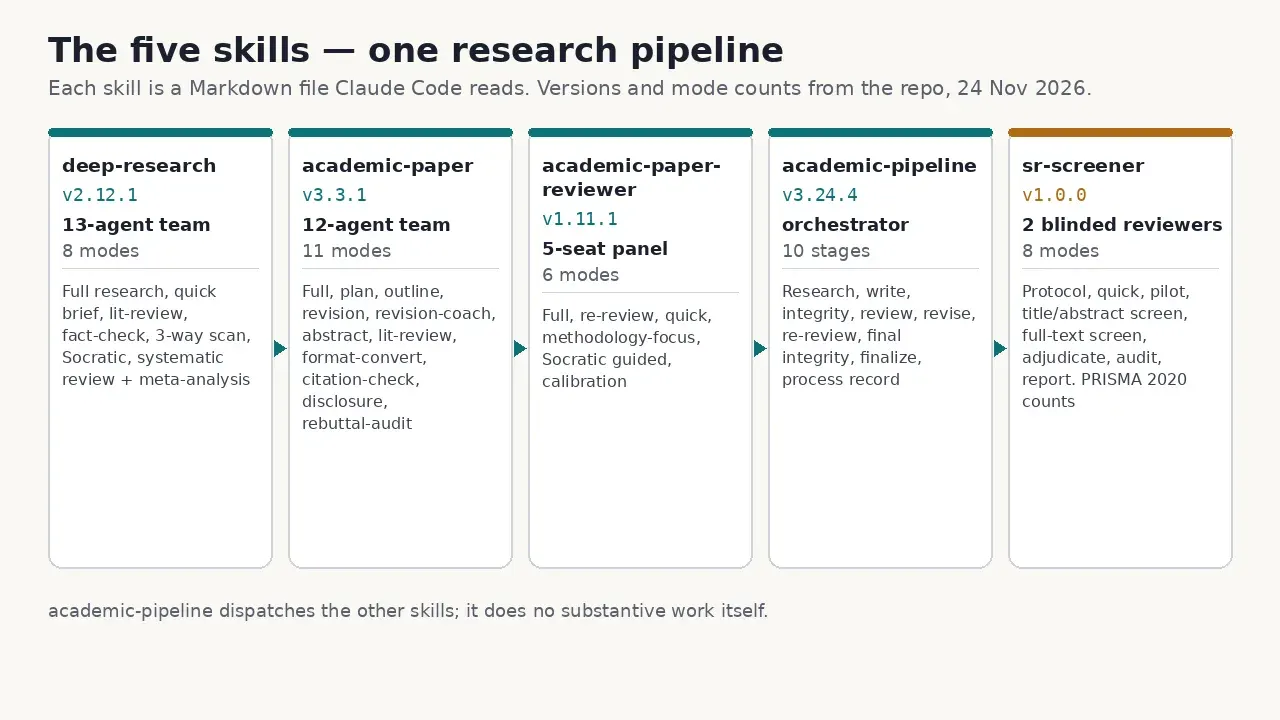
Imbad0202/academic-research-skillsat commit1d42587(v3.24.4, November 19, 2026);deep-researchv2.12.1,academic-paperv3.3.1,academic-paper-reviewerv1.11.1,academic-pipelinev3.24.4,sr-screenerv1.0.0. - Counts checked against the clone, not the README: 5 skills, 3,276 lines of SKILL.md, 1,159 Markdown files, 16 slash commands — all matching the repo.
- The gates caught real problems in the repo’s showcase: Stage 2.5 failed with 15 problem references (8 bibliographic errors, 6–8 likely fabricated) plus 3 statistical errors; all 22 fixed on re-verification.
- Honest scope: no live Claude Code session was run here — there is no agent subscription on this machine — so the slash commands and the pipeline run are verified against the skill files, not executed. The
git clonecommand ran successfully. - Why now: the repo is at 58,303 stars and 4,447 forks, and number seven on GitHub’s Python daily trending list — the agent-skills wave has reached academic research.

Marketing is the part of running a small software business that most developers put off until it is too late — and the part where an AI coding agent is least useful out of the box. Ask a bare model to write your homepage and you get confident, generic copy with invented statistics. Ask it to audit your SEO and you get a checklist it cannot apply. The missing piece is not a better model. It is instructions: what good copy looks like, what a real audit checks, and what your product actually is, in a form the agent can read before it starts.
Ask a bare language model to write a research paper and it will. It will also invent references that do not exist, cite papers that say the opposite of what it claims, and present the result with total confidence. That is not a hypothetical failure mode. The README of the project in this tutorial cites the audit behind it: Zhao et al. counted an estimated 146,932 hallucinated citations in 2025 alone, and Lu et al.'s fully autonomous AI Scientist — the first system to get a paper through blind peer review at a machine-learning venue — shipped with implementation bugs, hallucinated results, and fabricated methodology in its limitations section. The problem with AI-written research is not that the prose is bad. It is that the evidence is unverified, and the reader cannot tell.
academic-research-skills is built on the opposite premise: the human stays the author, and the machine does the grunt work under gates that can stop it. It is five Claude Code skills — deep research, paper writing, peer review, a full pipeline orchestrator, and a systematic-review screener — written as Markdown instructions the agent reads, with integrity checks that verify every citation against real bibliographic databases and refuse to proceed when the evidence does not hold up. It has 58,303 stars and 4,447 forks on GitHub, 918 commits, and it is number seven on GitHub's Python daily trending list today. The current release, v3.24.4, shipped on November 19. This tutorial installs all five skills, runs each one through its paces, and prices a full run — about $3 to $7, by the repo's own accounting.
What you will need#
- Claude Code, on a paid plan. The skills run inside Claude Code — CLI, VS Code, or JetBrains, version 3.7.0 or later. If you do not have it, the repo's quickstart installs it with
curl -fsSL https://claude.ai/install.sh | bash, then you sign in. The skills themselves are free; the cost is the API usage of the sessions that run them, priced in the costs section below. - Git. One
git clonefetches the whole collection — 61 MB, 1,159 Markdown files, five skill directories. - No GPU, no local models, no API keys of your own. Everything runs through your Claude Code session. The citation-verification gate calls public bibliographic APIs (Semantic Scholar, OpenAlex, Crossref, arXiv) and costs no tokens.
- A note on the license. The collection is released under Creative Commons Attribution-NonCommercial 4.0. That covers research, study, and personal use; commercial use is not permitted under it. If you are writing for a university, a lab, or yourself, you are in the clear.
Step 1: Install the five skills#
There are two supported routes. The plugin route is two commands inside Claude Code:
/plugin marketplace add Imbad0202/academic-research-skills
/plugin install academic-research-skills
The symlink route — the one this tutorial verified file by file — clones the repo and links each skill into your project's .claude/skills/ directory, where Claude Code discovers it:
git clone https://github.com/Imbad0202/academic-research-skills.git ~/academic-research-skills
cd /path/to/your/project
mkdir -p .claude/skills
ln -s ~/academic-research-skills/deep-research .claude/skills/deep-research
ln -s ~/academic-research-skills/academic-paper .claude/skills/academic-paper
ln -s ~/academic-research-skills/academic-paper-reviewer .claude/skills/academic-paper-reviewer
ln -s ~/academic-research-skills/academic-pipeline .claude/skills/academic-pipeline
ln -s ~/academic-research-skills/sr-screener .claude/skills/sr-screener

# sr-screener's reviewer subagent, for dual-review screening runs
mkdir -p .claude/agents
cp ~/academic-research-skills/sr-screener/agents/screening_reviewer_agent.md .claude/agents/
Each skill must sit at .claude/skills/<skill-name>/SKILL.md for Claude Code to discover it. The repo also documents a global ~/.claude/skills/ install and a copy-based alternative in docs/SETUP.md, plus installs for claude.ai and Claude Desktop through their plugin settings — though hooks and plugin agents do not run in plain chat there.
Verify what landed. Each of the five directories holds a SKILL.md whose frontmatter names the skill, describes it, and pins a version. Checked against the clone on November 24, 2026: deep-research v2.12.1, academic-paper v3.3.1, academic-paper-reviewer v1.11.1, academic-pipeline v3.24.4, sr-screener v1.0.0 — five for five, name matching directory, description present. Together the five skill files run 3,276 lines. Sixteen slash commands ship in commands/, from /ars-plan to /ars-citation-check. If a SKILL.md is missing or a name does not match its directory, the install is broken; reinstall from the clone rather than debugging a half-linked skill.
Step 2: Sharpen the question with Socratic mode#
Most bad papers start with a vague question. The fastest way to feel what this collection does differently is to start there, with nothing but an idea. Launch Claude Code in your project and invoke the planner:
claude/ars-planThen describe the idea in plain words. The quickstart's example is: "I have a vague idea about AI's impact on higher education quality assurance, but I'm not sure how to frame the research question. Can you guide me?" In Socratic mode, Claude does not answer. It asks — 5 to 15 rounds of questions that narrow the topic, the population, the method, and what would count as evidence — until you have a focused research question and a methodology direction. That is the design philosophy in one interaction: the pipeline stops for your confirmation at every stage, and the decisions stay yours.
The same skill, deep-research, is a 13-agent team with eight modes. Use the mode that matches the job, not the biggest one:
| Mode | Use it when | What you get |
|---|---|---|
| full | You need a complete research report on a topic | Question, methodology, literature search, synthesis, APA 7.0 report |
| quick | You need a short brief, fast | A concise literature summary without the full pipeline |
| socratic | The idea is vague and needs framing | 5–15 rounds of guided dialogue ending in a research question |
| lit-review | You need the literature on a question, nothing else | A structured review of what is known, with sources |
| systematic-review | You need a PRISMA review with meta-analysis | Protocol, screening, risk-of-bias assessment, optional meta-analysis |
| three-way scan | You need the WHY / HOW / WHAT of a topic | Three angled literature scans synthesized into one view |
| fact-check | You need claims checked against sources | Per-claim verdicts with the sources that support or contradict them |
| paper review | You need a quick review of an existing paper | A structured review without the full five-seat panel |
Two behaviours are worth knowing before you run any of them. First, the skill's report compiler flags claims the cited sources do not support as [MATERIAL GAP] instead of hedging them — a gap you can see is better than a smooth sentence that is wrong. Second, the citation gate is deterministic: it checks each reference against Semantic Scholar, OpenAlex, Crossref, and arXiv, and caches the result in ~/.cache/ars/verification.db for 90 days, so a reference is verified once and reused across drafts. That check costs no tokens — only network latency on first lookup.
Step 3: Write the paper#
academic-paper is a 12-agent writing pipeline with eleven modes: full, plan, outline, revision, revision-coach, abstract, lit-review, format-convert, citation-check, disclosure, and rebuttal-audit. It covers six paper types and five citation formats, writes bilingual abstracts, and outputs LaTeX, DOCX via Pandoc, or PDF. Two features do most of the quality work. Style Calibration, at intake, learns your voice from three or more of your past papers — sentence rhythm, vocabulary, citation style — and applies it as a soft guide, with discipline conventions always taking priority. The Writing Quality Check runs diagnostics before the draft is finalized: vague or overused terms, throat-clearing openers, paragraph shapes that impair clarity.
Start with plan mode, not full:
Help me plan a paper about the impact of declining birth rates on private universities in TaiwanPlan mode walks the paper chapter by chapter before a word of body text is drafted. When the outline is right, full mode writes it. The other modes are for the jobs around writing: abstract drafts the abstract, format-convert moves between citation styles and formats, citation-check verifies every reference in an existing draft, disclosure writes the AI-use disclosure for the venue, and rebuttal-audit checks a response to reviewers before it is sent — whether the reply actually answers what the reviewer asked, and whether it concedes points it should not.
A practical note: the pipeline runs in eight phases, from intake to formatting, and the writing agents inherit your session's model. They never silently fall back to Haiku — the project policy is "no Haiku for ARS runs" — so a Sonnet session gets Sonnet agents and an Opus session gets Opus agents, matching the cost and depth you chose.
Step 4: Put the draft through peer review#
academic-paper-reviewer simulates a complete journal peer review: five role-separated seats — a Journal-Fit Reviewer, three peer reviewers with field-specific expertise, and a Devil's Advocate whose job is to challenge the core argument and surface the strongest counter-arguments. A separate editorial synthesizer turns the five reviews into a structured Editorial Decision and a Revision Roadmap. Six modes cover the full panel, re-review after revisions, quick assessment, methodology focus, Socratic guided review, and calibration.
Calibration mode is the one to know about. It measures the reviewer's own false-negative and false-positive rates against a gold set you supply — papers with known outcomes — so you can see whether the panel is too lenient or too harsh before trusting it on your own draft. The v3.8 release adds an opt-in claim audit (ARS_CLAIM_AUDIT=1) that fetches each cited source against its anchor and judges whether the claim is actually supported, with five high-severity warning classes — claim-not-supported, fabricated-reference, anchorless, and others — that refuse output through the formatter's hard gate. It is off by default while the calibration evidence is gathered; the honest status is that the shipped calibration runner uses a synthetic gold set with a stub judge, so it checks the tooling, not a live judge, and no live-judge calibration result is recorded yet.
To review a draft, the prompt is the obvious one:
Review this paperThen attach the manuscript. The panel reads it, identifies the field, configures its reviewers, and returns the five reviews plus the editorial decision. Expect it to be harsher than a friendly colleague — that is the point.
Step 5: Run the full pipeline, gates and all#
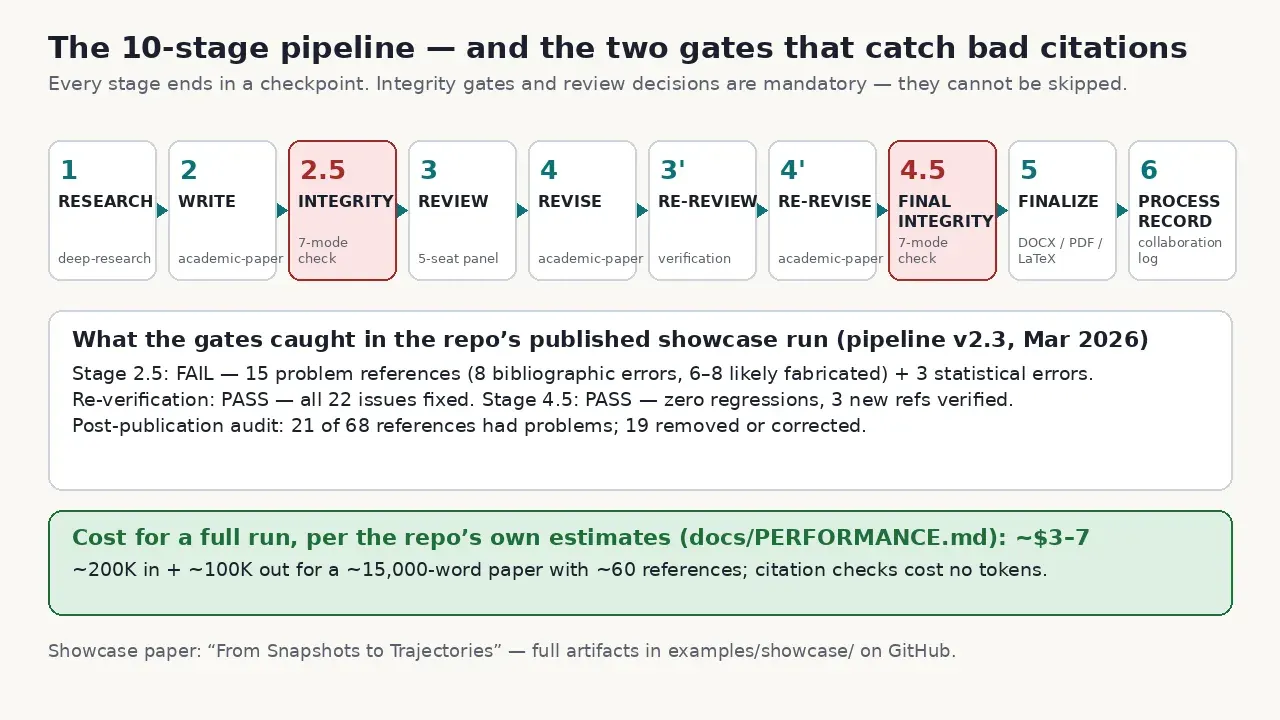
The four skills above work alone. academic-pipeline is the orchestrator that chains them into one run: research, writing, integrity check, review, revision, re-review, re-revision, final integrity check, finalize. It does no substantive work itself — it detects stages, recommends modes, dispatches skills, manages transitions, and tracks state. Start it with a plain sentence:
I want to produce a complete research paper about how agentic AI is reshaping student learning outcome measurementThe run has ten stages, and the ones that matter most are the two with decimal points. Stage 2.5 and Stage 4.5 are integrity gates: a seven-mode blocking checklist that verifies references, data, logic, and consistency before the paper is allowed to proceed. If a gate fails, the pipeline fixes the issues and re-verifies, up to three rounds; after that, the failure is recorded as a user decision rather than silently passed. Checkpoints come in three strengths — FULL, MANDATORY, SLIM — and the integrity boundaries, the review decisions, and the Stage 5 entry gate are always MANDATORY: they cannot be skipped, and the pipeline waits for your explicit input.
The gates are not theoretical. The repo ships a complete showcase — examples/showcase/ — from a real pipeline run in March 2026 that produced a paper on agentic AI and student learning outcomes, in English and Chinese, APA 7.0. Stage 2.5 failed on the first pass: 15 problem references (8 with bibliographic errors, 6 to 8 likely fabricated) plus 3 statistical errors. Re-verification passed with all 22 issues fixed. Stage 4.5 passed with zero regressions and 3 new references verified. A post-publication audit of all 68 references found 21 with problems; 19 were removed or corrected. Read the caveat with the numbers: that run used pipeline v2.3, before the current citation gate and claim audit existed, and the current gates have not been measured on that paper. The direction is what matters — the gate catches fabricated references instead of polishing them — and the numbers are the repo's own, published with the artifacts.
Resuming a run is deliberately low-tech. The pipeline keeps no orchestrator state between sessions; instead it issues a Material Passport — a YAML record of stage completions and compliance history — that you paste back into a new session to pick up where you stopped. A full run takes hours to days of collaborative work, because the pipeline stops for your confirmation at every stage.
Step 6: Screen studies for a systematic review#
The fifth skill, sr-screener, is for systematic, scoping, and rapid reviews — the job where screening is usually where studies get quietly lost. It turns a proposal or PROSPERO protocol into confirmed eligibility rules before any record is read, then screens titles, abstracts, and full texts with two blinded AI reviewers and a third-reviewer adjudicator for disagreements. Nothing is ever decided by default, and every decision carries an ordered exclusion code. It reads RIS, PubMed .nbib, Web of Science, and CSV exports, removes duplicates, and produces PRISMA 2020 counts, EndNote and Zotero RIS groups, an Excel log, a methods draft, and a literature_corpus handoff to academic-paper. Quality control includes seed studies, near-miss rechecks, and kappa and PABAK agreement statistics. Eight modes cover the workflow: protocol, quick, pilot, ta-screen, ft-screen, adjudicate, audit, and report. If you run systematic reviews, this is the skill that justifies installing the collection on its own.
What a full run costs#
All figures below are the repo's own estimates from docs/PERFORMANCE.md, for a ~15,000-word paper with ~60 references — not re-measured here.
| Run | Input tokens | Output tokens | Estimated cost |
|---|---|---|---|
deep-research Socratic mode | ~30K | ~15K | ~$0.60 |
deep-research full mode | ~60K | ~30K | ~$1.20 |
| Full 10-stage pipeline | ~200K | ~100K | ~$3–7 |
The pipeline figure breaks down by model at November 2026 list prices: about $5.60 on Claude Fable 5.2, about $7 on Fable 5.1, and about $2.80 on Claude Opus 5.5, before cache discounts. Dialogue-heavy modes cost more, because every model in this lineup always reasons. Two cost controls are worth setting. First, the citation-existence gate adds no token cost — it calls bibliographic APIs, not the model. Second, the opt-in ARS_MODEL_TIERING switch can drop execution-type agents one tier below your session model (with Opus-class as the floor) when you want to trade some depth for price; with the flag unset, every agent inherits your session model and costs track the table above. Cache misses between checkpoints are normal — when a stage pauses longer than five minutes, the next stage reads its context uncached — so the cheapest way to run a pipeline is to stay with it and answer the checkpoints promptly.
When to use this vs alternatives#
There are several honest ways to get AI help with research, and this collection is not always the answer.
| Approach | Best when | Watch out for |
|---|---|---|
| academic-research-skills | You write academic papers in Claude Code and want research, writing, review, and citation verification in one pipeline with gates that can stop it | Needs a Claude Code subscription; the CC BY-NC 4.0 license rules out commercial use; the live runs are not free |
| PaperOrchestra | You want a multi-agent paper-writing framework on Gemini, with LaTeX output and an arXiv paper behind it | Writing-focused — no systematic-review screener, no citation-existence gate, no Socratic research mode |
| Scientific Agent Skills | Your work is lab science — bioinformatics, drug discovery, publication figures — and you want 168 skills for it | Breadth over depth on the paper pipeline; a different tool for a different bench |
| book-to-skill | You want to turn a technical book into a skill your agent can consult | It builds a knowledge source, not a research workflow — no review panel, no gates |
| Bare Claude Code | A one-off draft, a quick literature skim, or a paper you will heavily rewrite yourself | No integrity gates, no citation verification, no review panel; fabricated references are the default failure mode |
The deciding factor is whether the paper has to survive contact with reviewers. A blog post or an internal memo: prompt the model, rewrite it yourself, move on. A manuscript you will submit — where a fabricated reference is a career problem, not a typo — is where the gates pay: the citation check is deterministic, the review panel is adversarial by design, and the pipeline refuses to finalize while issues are open. The price is the discipline of answering the checkpoints honestly, because every gate downstream treats your confirmations as fact.
The takeaway#
academic-research-skills is the most complete answer yet to a simple problem: a coding agent can write a paper, and nothing in a bare model stops it from inventing the evidence. The collection's answer is not a smarter model but a stricter process — five skills that share one pipeline, integrity gates that verify citations against real databases and refuse to proceed, a five-seat review panel with a Devil's Advocate, and a human who has to confirm every stage. The numbers hold up: five skills, 3,276 lines of skill instructions, versions pinned in frontmatter, a showcase run where the gate caught 22 problems before review, and a full run priced at $3 to $7. Start small. Install with the plugin route or the symlinks, run /ars-plan on an idea you have been carrying around, and see whether the Socratic questions sharpen it. If they do, run deep-research in quick mode on the question, then let academic-paper plan the manuscript. Keep the pipeline's gates on, read the integrity reports instead of skimming past them, and remember the line the README puts in bold: you remain the author, and you answer for every claim you submit.
What was verified for this tutorial, and what was not. In this tutorial's sandbox: the repo was cloned (61 MB, commit 1d42587); all five skill files were read and their frontmatter checked (name matches directory, versions as listed); the mode, agent, and stage counts were checked against the skill files; the install commands were checked against QUICKSTART.md and the README; the cost figures were checked against docs/PERFORMANCE.md; the showcase figures were checked against examples/showcase/README.md. The git clone command ran successfully here. What was not run here: no live Claude Code session — there is no agent subscription on this machine — so the slash commands and the pipeline run are documented and verified against the skill files, not executed; and the repo's own test suite was not executed in this sandbox. Treat the pipeline walkthrough as a verified map of the tool, and your first run in your own Claude Code session as the test drive.