AGIBOT unveils GO-3 Preview: a robot model that tops three benchmarks — and keeps learning on the job
AGIBOT has unveiled GO-3 Preview, an embodied foundation model the Shanghai robotics company says ranks first on three robot benchmarks. The pitch is not just the scores: GO-3 is built to keep improving after deployment, learning from the work it does in the real world.
- Who and when: AGIBOT, a Shanghai robotics company, unveiled GO-3 Preview on November 3, 2026, via PRNewswire.
- What: An embodied foundation model built on the WRAM architecture, unifying task understanding, future-state prediction and action generation.
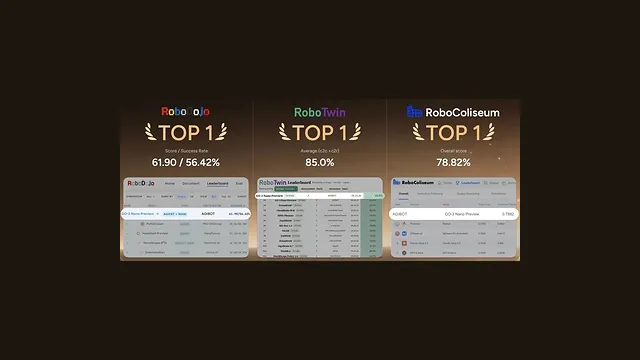
- Benchmarks claimed: First place on RoboDojo (61.90 / 56.42%), RoboTwin (85.0% average) and RoboColiseum (78.82% overall), per the graphic accompanying the release.
- Post-training: Genie Evolver, a hybrid system combining a fleet of 100 physical robots with physics simulation and world models.
- After deployment: Genie Master and its EEP protocol; a Genie G2 robot demonstrated in a real convenience store, improving without human demonstrations, according to AGIBOT.
- Open source: Fully open-sourced by the end of 2026, AGIBOT says; no model size, licence terms or download details were given.
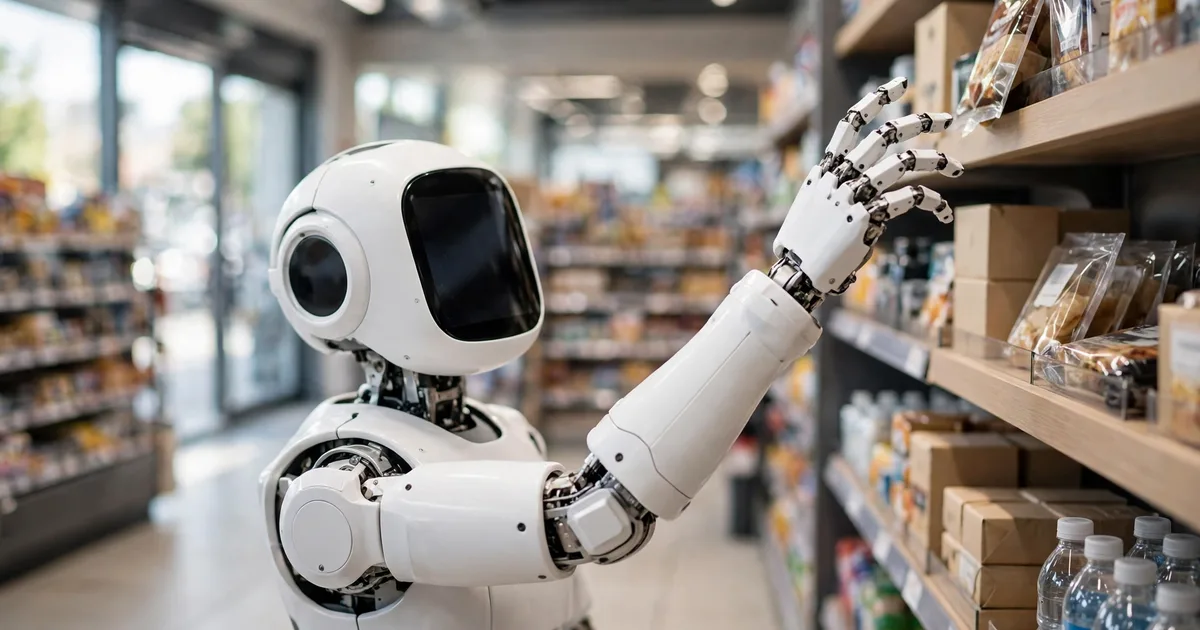
Shanghai-based AGIBOT unveiled GO-3 Preview on November 3, 2026, describing it as an embodied foundation model that learns across the full lifecycle of pre-training, post-training and post-deployment. The announcement, issued via PRNewswire, says the model has secured first-place rankings on three embodied AI benchmarks — RoboDojo, RoboTwin and RoboColiseum — and will be fully open-sourced by the end of 2026. A second wire carrying the same release confirms the announcement date and the three benchmark claims.
The argument behind the model is that physical work demands more than language-style reasoning. Grasping a small object or assembling components requires anticipating how the environment will change, managing contact forces and executing precise movements, according to the release. AGIBOT’s answer is to extend learning beyond pre-training: robots should also learn through post-training interaction and keep adapting once deployed, becoming more capable by performing tasks rather than only by being trained on them.
One architecture, three kinds of learning
GO-3 Preview is built on WRAM (World Reasoning Action Model), AGIBOT’s proprietary embodied-native architecture, which unifies task understanding, future-state prediction and action generation. Three designs inside WRAM divide the work: CoAE (Control-Oriented Autoencoder) extracts visual representations tailored to robotic control, preserving object positions, shapes and spatial relationships; SVP generates a complete prediction of future states in a single step from current observations and task conditions; and KASO selects future predictions that are more consistent with the actions actually taken during training, aligning prediction with action generation.
On the data side, the model learns from heterogeneous sources: human first-person videos showing object interactions and task execution, and robot trajectories connecting observations, actions and physical outcomes. After pre-training, AGIBOT says GO-3 Preview adapts to new tasks in zero-shot settings — applying learned capabilities without task-specific supervised fine-tuning on physical robots — and improves further with a small number of demonstrations for more complex operations. LEGO assembly is the worked example: identifying components, grasping them precisely, aligning positions and inserting them correctly, coordinated by an embodied agent into a complete assembly.
First on three benchmarks — on AGIBOT’s telling
The headline numbers are AGIBOT’s own. The benchmark graphic accompanying the release lists 61.90 / 56.42% for RoboDojo, an 85.0% average for RoboTwin and a 78.82% overall score for RoboColiseum, each labelled as a top-one ranking. The release gives no benchmark versions, evaluation methodology or independent scores, so the rankings stand as company claims until independent results appear. That caveat matters more than usual here: GO-3 is explicitly a preview, and the scores are part of a launch announcement, not a published evaluation.
Practice, in bulk: Genie Evolver
For post-training, AGIBOT built Genie Evolver, a distributed hybrid-environment training system combining a fleet of 100 physical robots with physics simulation and world models. Physical robots contribute collective experience through CEL (Collective Experience Learning), which aggregates execution experience across the fleet so lessons from one robot — including the context around failed attempts — can benefit the rest. Simulation expands the range of conditions robots can practise in, and world models let the system revisit decision points and test alternative actions against predicted outcomes before trying them on physical robots.
The demonstrations AGIBOT chose are deliberately awkward. In tabletop curling, the robot must balance force and angle against the positions of the stones; after a few hours of practice combining real-world interaction and world-model learning, it achieved a higher win rate than typical human players, according to AGIBOT. Block extraction punishes fixed movement sequences, because each removed block shifts the rest of the stack. Throwing a ball into a moving basket compresses observation, prediction and release into a fraction of a second. All three are company demonstrations, not independent tests — but they show what kind of manipulation the system is being tuned for.
Learning on the job: Genie Master
Genie Master, AGIBOT’s embodied agent framework, extends learning into deployment itself. It introduces EEP (Embodied Execution Protocol), which standardises four categories of interfaces — capabilities, guidance, feedback and continuity — so an agent can tell what a robot can do, how a task should run, whether the result met the requirement and what work remains unfinished. Operational experience then feeds improvement through two pathways: reusable knowledge consolidated into long-term memory at the end of each day’s operations, and trajectories and feedback processed for further training of the robot’s action policies.
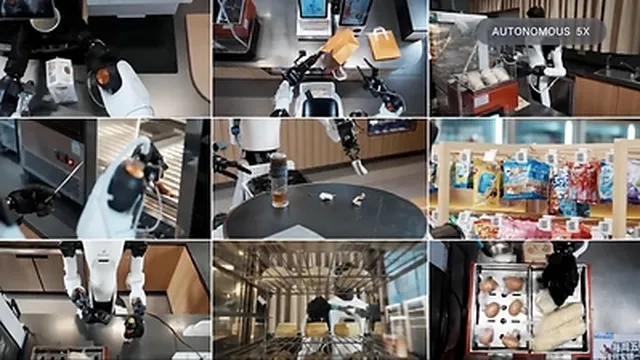
AGIBOT demonstrated the approach with its Genie G2 robot in a real convenience store, where the robot identified causes of task failures, adjusted strategies and accumulated experience while performing operational tasks. According to the company, it kept improving across multiple complex tasks requiring precise manipulation without relying on human demonstrations or manual tuning — an example, in AGIBOT’s term, of Physical RSI (recursive self-improvement in the physical world). The lineage runs from the ViLLA framework introduced with GO-1 to the action chain-of-thought approach of GO-2; GO-3 Preview extends scaling from pre-training to post-training and beyond deployment.
What to watch
The context is a company scaling fast: AGIBOT describes itself as a pioneer in general-purpose AI robotics, with a “Three Intelligences in One” architecture spanning locomotion, interaction and manipulation, and announced in September 2026 that its 20,000th robot had rolled off the production line. The open-source commitment is the concrete thing to judge next. AGIBOT says GO-3 Preview will be fully open-sourced by the end of 2026 — roughly eight weeks from the announcement — but the release gives no model size, licence terms or download details, and no independent benchmark results yet exist to check the headline scores against.
What is established is narrower, and still notable: a dated announcement, a named architecture with a specific account of how its parts fit together, three named benchmarks with published figures, and a deployment demonstration in a working store rather than a lab. If the open-source release lands on schedule and independent evaluations confirm even part of the benchmark story, full-lifecycle scaling will have earned its hearing. Until then, GO-3 Preview is best read as a claim about where robot learning should happen — everywhere, all the time — backed by the company’s own numbers.
Frequently asked questions
What is GO-3 Preview?
GO-3 Preview is an embodied foundation model from AGIBOT, unveiled on November 3, 2026. Built on the company’s WRAM architecture, it is designed to learn across pre-training, post-training and post-deployment, unifying task understanding, future-state prediction and action generation.
What benchmark results does AGIBOT claim for GO-3 Preview?
AGIBOT says GO-3 Preview ranks first on three embodied AI benchmarks: RoboDojo, RoboTwin and RoboColiseum. The graphic accompanying the release lists 61.90 / 56.42% for RoboDojo, an 85.0% average for RoboTwin and a 78.82% overall score for RoboColiseum. These are the company’s claims; no independent scores were included in the release.
When will GO-3 be open-sourced, and what is still unknown?
AGIBOT says GO-3 Preview will be fully open-sourced by the end of 2026. The announcement gave no model size, licence terms or download details, and the benchmark rankings await independent verification.