Cloudflare open-sources Clairic: its document-extraction models are now free to run anywhere
Cloudflare has released open weights for Clairic and its new 9-billion-parameter sibling Clairic-flash, a month after the extraction model’s hosted-only preview. Both turn receipts, PDFs, and support tickets into typed data — and developers can now download and run them on their own hardware.
- The release: updated Clairic, 27 billion parameters, and new Clairic-flash, 9 billion — both open-weight on Hugging Face under Apache-2.0, built on Qwen3.8-27B and Qwen3.5-9B according to the model cards.
- What’s new since the preview: PDF and image reading (up to four images or PDF pages per request), line items returned as rows, a redesigned architecture, and special heads for estimates, forecasts, durations, and arithmetic.
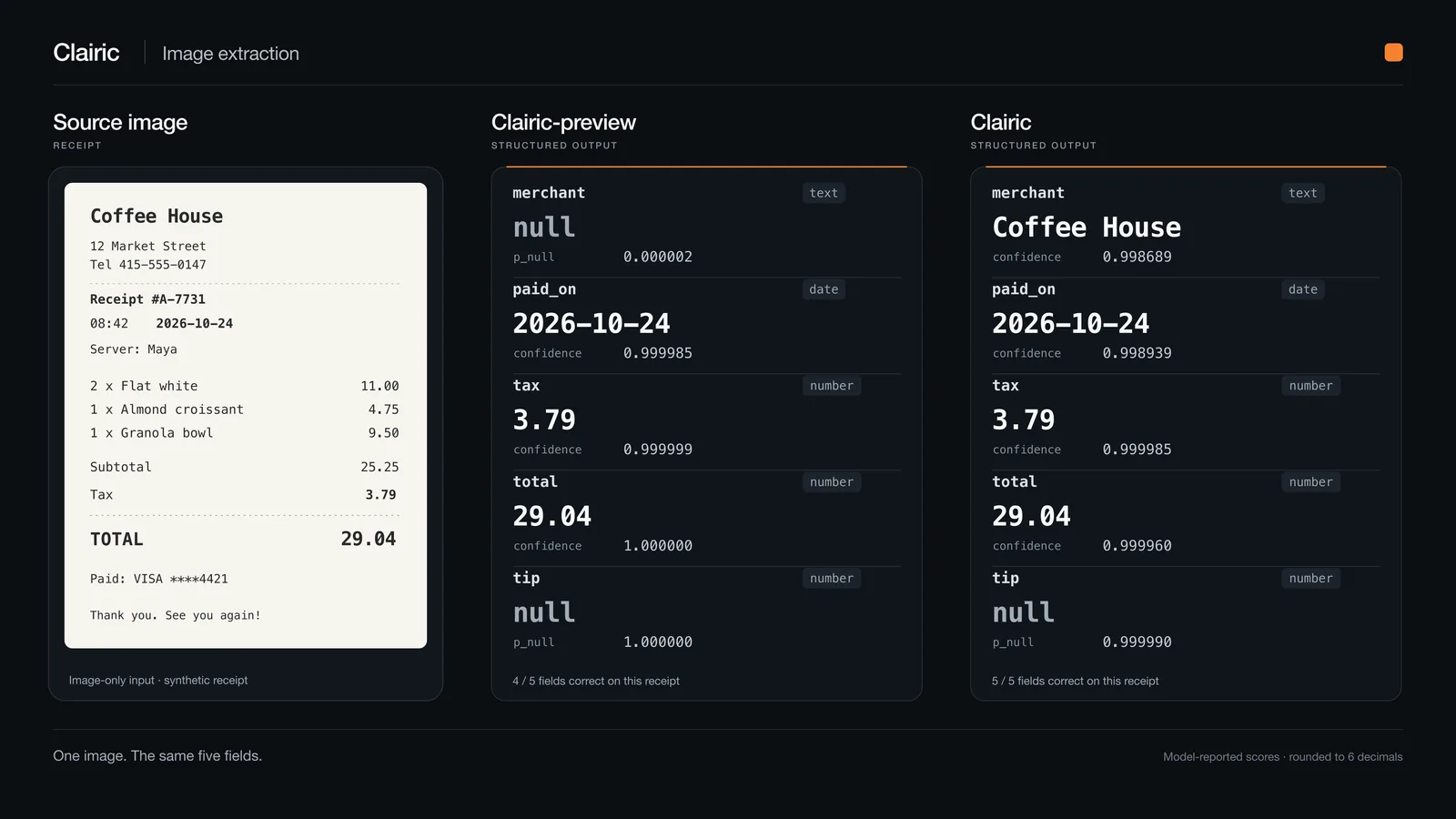
- The numbers (Cloudflare’s internal evals, self-reported): fresh text fields 335/336 correct (preview: 295/336); synthetic receipt fields 576/576 (preview: 369/576); tracked customer assertions 1,263/1,263 (preview: 1,033/1,263); image-reading errors down from 207 to zero.
- Speed: median response 358 ms for Clairic and 155 ms for Clairic-flash on fresh text fields; 95th percentile 736 ms and 328 ms.
- Pricing: Clairic $0.24 per million input tokens, Clairic-flash $0.10; both $0.10 until December 1, 2026. Output tokens are not charged, and the preview endpoint upgrades to the new 27B model automatically.
A month after Cloudflare previewed Clairic as a hosted-only service, the extraction model is now something anyone can download. On November 18, the company released open weights for an updated 27-billion-parameter Clairic and a new 9-billion-parameter Clairic-flash, both published on Hugging Face under the Apache-2.0 licence. The announcement also re-introduced the team behind the models as the Workers AI Superintelligence team — and it was among the morning’s most-discussed open-model releases on r/LocalLLaMA.
Clairic does one job: it reads messy, unstructured input — a photographed receipt, a multi-page PDF, a support ticket — and returns typed values: a merchant name, a date, a total, a forecast. The preview in October showed the idea worked. This release is Cloudflare saying the model is now good enough, and cheap enough, to run anywhere — including on your own hardware.
What changed since the preview#
The headline change is the redesign. For ordinary text and number fields, Clairic no longer produces its answer in a single forward pass. Instead, it uses what Cloudflare calls parallel slot autoregressive generation: each field draws on the tokens it has already written, stops at its own end marker, and all the fields advance together in the serving batch. The trade is a small latency cost for a large accuracy gain — and the latency is still, by Cloudflare’s measurements, under a second per request.
The second change is scope. The preview could read a photo of a receipt. The new models read PDFs too: you can ask for the supplier, the line items, and the total in a single request even when they sit on different pages, with up to four images or PDF pages per request. Line items come back as rows that keep each description, quantity, and price together. Cloudflare also trained special heads for computation — estimates, forecasts, durations, calculated dates, and explicit arithmetic — while keeping the typed API from the preview: every answer still carries a confidence score, character spans, and probabilities.
The numbers — and the caveat#
Cloudflare’s internal evals show a large jump over the preview. On fresh text fields, the new Clairic got 335 of 336 right, against 295 for the preview; on synthetic receipt fields in text and images, 576 of 576, against 369. Tracked customer assertions went from 1,033 of 1,263 to a perfect 1,263. Image-reading errors on the company’s internal benchmarks fell from 207 to zero.
| Eval | Clairic-preview | Clairic | Clairic-flash |
|---|---|---|---|
| Fresh text fields (96 requests) | 295/336 | 335/336 | 328/336 |
| Tracked customer assertions (139 request shapes) | 1,033/1,263 | 1,263/1,263 | 1,263/1,263 |
| Synthetic receipt fields, text and images | 369/576 | 576/576 | 576/576 |
Read those numbers with the caveat Cloudflare itself states: there is no public extraction benchmark yet, so these are self-reported internal results, and the comparisons it ran against Liquid AI’s D1.2 (paired with OCR) and Scaledown’s Extract are directional guidance, not an independent ranking. Latency is easier to take at face value: median response times of 358 milliseconds for Clairic and 155 for Clairic-flash on fresh text fields, with 95th-percentile times of 736 and 328 milliseconds.

Open weights, and what you can do with them#
The weights are on Hugging Face, and the model cards list an Apache-2.0 licence, which permits commercial use and modification. According to the cards, Clairic is built on Qwen3.8-27B and Clairic-flash on Qwen3.5-9B — Alibaba’s open models as the base. The files are large — MACCUS reports about 56 GB for Clairic and 20 GB for Clairic-flash — and they ship as standard PyTorch and Transformers files, not the GGUF format that local tools like Ollama and llama.cpp use, so running them locally means a GPU server rather than a laptop.
The hosted route stays open. Both models run on Workers AI as @cf/cloudflare/clairic and @cf/cloudflare/clairic-flash, and Cloudflare charges only for input tokens — it absorbs the cost of generating output tokens, keeping with its System One pricing. The 27B model lists at $0.24 per million input tokens and the 9B at $0.10; until December 1 both cost $0.10. Anyone already calling the preview endpoint gets the new 27B model automatically, as Cloudflare is rolling it out in place; the 9B preview model moves to the new clairic-flash endpoint.

What to watch#
Three things decide whether this release matters beyond the announcement. First, independent verification: with no public extraction benchmark, the real test is what developers measure once the weights are in their hands. Second, the community layer — fine-tunes, quantizations, and ports to local runtimes — which is where open-weight releases usually prove their worth; Cloudflare points to the “outpouring of experiments and tuned models” that followed its Clef release on October 1 as the pattern it hopes to repeat. Third, the team itself: the Workers AI Superintelligence group is, by its own account, just getting started and hiring, with “lots more in the works.” Extraction is a crowded niche — Liquid AI and Scaledown are already shipping in it — and Cloudflare’s bet is that a small, fast, purpose-built model beats a general-purpose LLM on the unglamorous work of reading documents. The weights are now public. The verdict will come from the people who run them.
Sources: Cloudflare, “An updated Clairic and Clairic-flash are now open-weight, from the new Workers AI Superintelligence team”; Unite.AI, “Cloudflare Releases Open-Weight Clairic Models for Data Extraction”; MACCUS, “Cloudflare releases the weights of Clairic, its AI that reads invoices and receipts”.