Gemini Robotics 2.5 puts humanoids on the Mercedes-Benz line — Apollo packs parts at 96% success
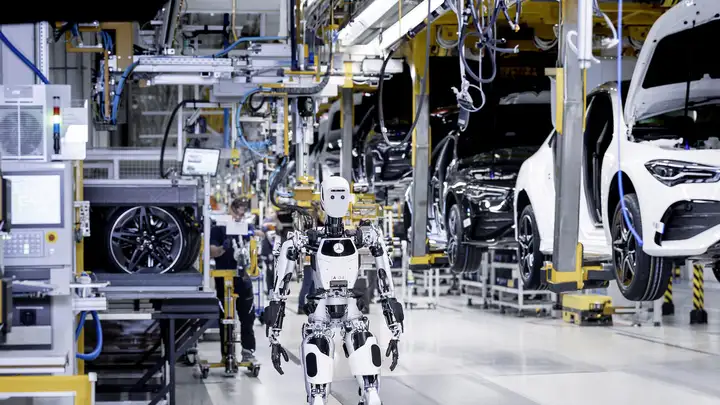
Google DeepMind introduced Gemini Robotics 2.5 on November 10, 2026, calling it its most capable vision-language-action model to date — and the headline is a factory floor, not a lab demo: Apptronik’s Apollo 2 humanoids are already picking and packing automotive parts on live Mercedes-Benz production lines, at a 96% success rate.
What we checked: Google DeepMind’s announcement, published November 10, 2026, cross-checked against Crypto Briefing’s same-day coverage.
- What: Gemini Robotics 2.5 — Google DeepMind’s most capable vision-language-action (VLA) model to date.
- When: announced November 10, 2026; rolling out to DeepMind’s robotics partners.
- Tested on: more than 200 distinct tasks, including serving food with tongs, tying a bow on a gift box, and pipetting liquid.
- Performance: 30–100% higher success rate than previous baselines, depending on task type, with tasks completed 20–30% faster.
- Factory test: Apptronik Apollo 2 humanoids performed automotive kitting on live Mercedes-Benz lines in Kecskemét, Hungary and Sindelfingen, Germany, at 96% success.
- Safety: ASIMOV-Jailbreak, a new open-source benchmark; Gemini 4 Argon scored 99.5% jailbreak resistance, up from 82% for the previous baseline.
Robot demos usually end at the lab door. This one starts on a factory floor. DeepMind’s new model isn’t just better at the delicate work — tying bows, pipetting liquid, serving food with tongs — it is already doing the boring, repetitive work on a car production line, where a mistake stops the line.
What 2.5 actually does#
Gemini Robotics 2.5 is a vision-language-action model, or VLA: it takes a spoken or written instruction, watches the scene, and turns the plan into physical motion. DeepMind splits the job in two. Gemini Robotics ER, the embodied-reasoning model, tracks the workflow and works out the strategy; the 2.5 actions model drives the robot’s hands and arms. The same model runs on very different bodies — Apptronik’s Apollo 2 humanoid, with its five-finger, 22 degree-of-freedom SharpaWave hand, and the Franka Duo platform with two-fingered parallel grippers.
DeepMind evaluated it on more than 200 distinct tasks, a set it says could scale to many more. The tasks are deliberately fiddly: serving food with tongs, tying a bow on a gift box, pipetting a liquid — work that combines tool use, deformable objects and delicate handling. Against previous baselines, success rates rose 30% to 100% depending on the type of task, and the same jobs finished 20% to 30% faster.
| Number | What it is |
|---|---|
| 200+ | Distinct tasks in DeepMind’s evaluation set |
| 30–100% | Higher success rate vs previous baselines, by task type |
| 20–30% | Faster task completion |
| 96% | Success rate for Apollo 2 kitting on live Mercedes-Benz lines |
| +33% / +43% | Safe task completion around obstacles / around nearby people |
| 99.5% vs 82% | Jailbreak resistance, Gemini 4 Argon vs previous baseline |
The launch lands the same day as another robot brain with a similar pitch: NVIDIA’s GR00T 2 teaches robots dexterous skills by watching human video. The two models are converging on the same idea — general-purpose robot intelligence, trained on broad data rather than programmed task by task — and the contest is now about who has the factory receipt to prove it.
The Mercedes-Benz test#
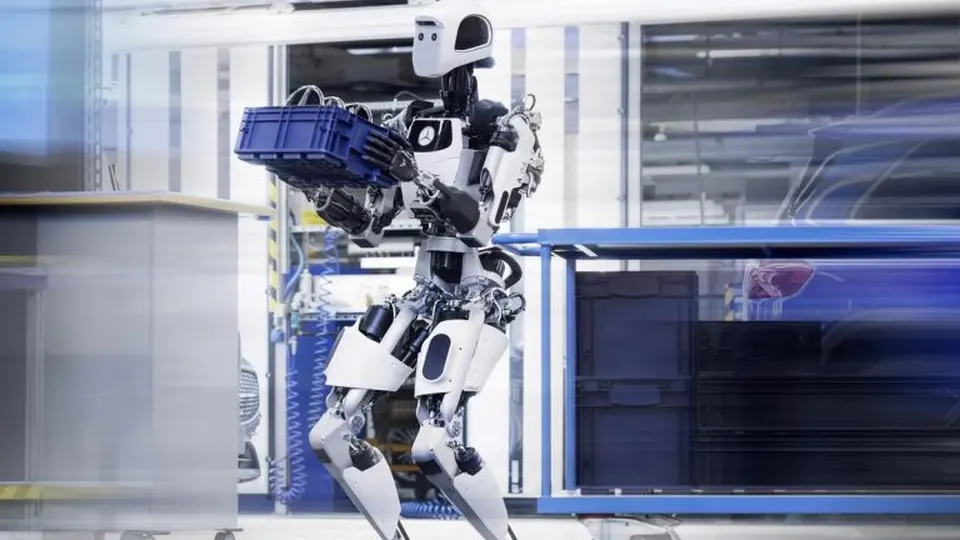
The proof-of-concept runs with Apptronik and Mercedes-Benz on active automotive production lines in Kecskemét, Hungary, and Sindelfingen, Germany. Apollo 2 does automotive kitting: the repetitive, physically taxing job of sorting individual parts from bulk bins into organized trays, in the exact order each vehicle on the line needs. The robot reaches into supply bins, picks up metal automotive brackets, and places them into sequencing containers, correcting for gaps as it goes.
It hit a 96% success rate. DeepMind frames the payoff plainly: offloading the monotonous prep work keeps the line moving and frees technicians for complex build tasks. That is the pitch that matters to manufacturers — not a humanoid that can dance, but one that can keep up with a line that never stops.
The wider industry is already trying to grade this kind of work. RLWRLD’s DexBench, published a day earlier, scores humanoids on 15 factory-handiwork tasks — the same dexterity the Mercedes test is now measuring in production rather than in a benchmark harness.
Safety is half the announcement#
As robots move into messy, everyday spaces, DeepMind is pushing safety as hard as dexterity. Gemini Robotics 2.5 uses inference-time reasoning guidance to steer around physical hazards in real time — a protective layer around the robot’s actions, much like safety classifiers around a chatbot’s replies. In DeepMind’s evaluations, that guidance boosted safe task completion around obstacles by 33% and around nearby people by 43%.
The more unusual move is ASIMOV-Jailbreak, a new open-source benchmark that tests whether a robot can be talked into doing something dangerous: hundreds of prompts that disguise unsafe requests across dozens of scenes. Gemini 4 Argon, the model DeepMind used to train and accelerate 2.5, scored 99.5% jailbreak resistance on it — up from 82% for the previous baseline, Gemini Robotics ER 2. Making the benchmark open means other labs and robot makers can test their own systems against the same yardstick, and it gives regulators and buyers a shared test when they ask how easily a machine can be manipulated.
Argon did double duty in this release. As a simulation engine it generated thousands of varied, simulated practice runs from a real-world camera scene and built realistic digital twins, so the robot could generalize to new scenes and objects faster — and it helped researchers hypothesize why failures happened from video footage, then test fixes in simulation and on real robots. Argon belongs to the same Gemini 4 family as Gemini 4 Carbon, which Google made generally available the same day.
The catch#
Three things temper the launch. First, access: Gemini Robotics 2.5 is rolling out to DeepMind’s robotics partners only. No public API, no price, no wider rollout has been announced — so for everyone outside that circle, this is a demo with a factory address, not a product. Second, every performance number here is DeepMind’s own evaluation; no independent testing was published with the launch, and the 96% figure comes from a proof-of-concept at two hand-picked plants, not a fleet deployment. Third, the cadence is fast: Gemini Robotics 2 arrived in July 2026, and 2.5 is already here four months later — which means today’s most capable VLA model has a short shelf life by design.
None of that undercuts the direction of travel. A humanoid that holds a 96% success rate on a live production line, doing work nobody enjoys, is the first concrete answer to the question the whole physical-AI race keeps asking: what is this actually for? The answer, for now, is kitting car parts in Hungary and Germany — and the next test is whether the same reliability survives the hundredth plant, not the second.
Frequently asked questions
What is Gemini Robotics 2.5?
Google DeepMind’s most capable vision-language-action (VLA) model to date, announced November 10, 2026. It turns spoken or written instructions and live video into robot motion, and it runs on different robot bodies, including Apptronik’s Apollo 2 humanoid and the Franka Duo platform. It is rolling out to DeepMind’s robotics partners.
What did it do at Mercedes-Benz?
In a proof-of-concept with Apptronik and Mercedes-Benz, Apollo 2 humanoids performed automotive kitting — sorting individual parts from bulk bins into organized trays in the exact order each vehicle needs — on active production lines in Kecskemét, Hungary and Sindelfingen, Germany, with a 96% success rate.
What is ASIMOV-Jailbreak?
A new open-source benchmark from DeepMind that tests whether robots can be talked into unsafe actions, using hundreds of prompts that disguise unsafe requests across dozens of scenes. Gemini 4 Argon scored 99.5% jailbreak resistance on it, up from 82% for the previous baseline, Gemini Robotics ER 2.