Hedra Model Factory: autonomous post-training that builds custom physical AI models for robots and factories
Hedra, the Andreessen Horowitz-backed research company best known for AI video, launched Hedra Model Factory on November 10: a service that builds custom AI models for robots, factories, biology labs and defense teams — then keeps improving each model after it ships, using the data it collects in production. The pitch is a factory floor for model-making: bring your data and your simulator, and Hedra’s researchers, working alongside autonomous AI agents, run the post-training loop for you.
What we checked: Hedra’s GlobeNewswire press release, published November 10, 2026, cross-checked against SiliconANGLE’s November 10 report. Performance figures are Hedra’s own test results; no independent verification has been published.
- What: Hedra Model Factory, an autonomous post-training and inference platform for real-world (physical) AI models.
- When: launched November 10, 2026; available starting today at hedra.com.
- Who it’s for: robotics, manufacturing, biology and defense teams that need a custom model for their own data.
- Proof point 1: Hedra retrained MiniMax H3 for physical consistency — 34.9 on Google DeepMind’s Physics-IQ benchmark, vs 30.3 for H3 Max; a distilled version renders a five-second clip in under three seconds on AMD MI355X GPUs.
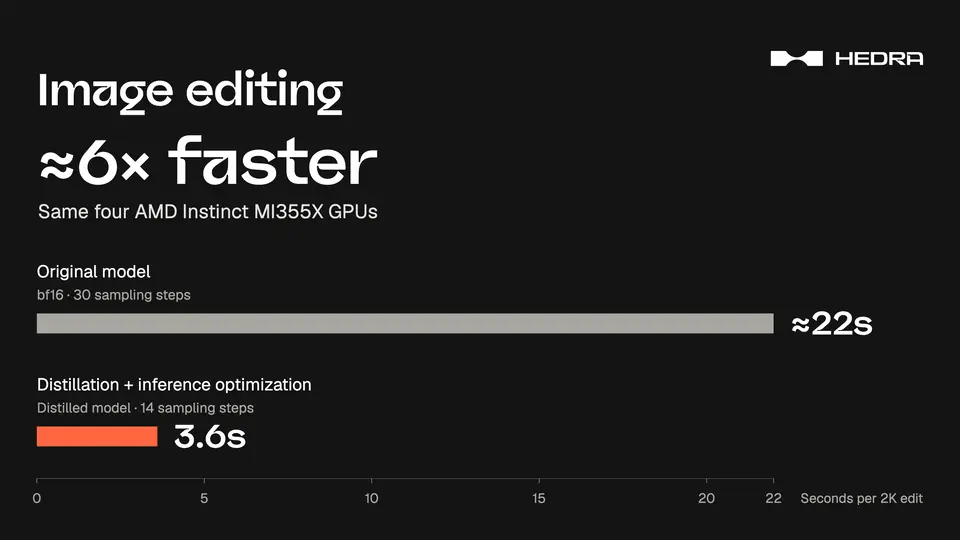
- Proof point 2: 2K image edits cut from about 22 seconds to 3.6 seconds — roughly 6x faster — on the same four AMD Instinct MI355X GPUs, in under a week.
- Proof point 3: in a simulation study, swapping a robot’s gripper restored task success from near zero to near 100% with no retraining.
- Business: Hedra says revenue grew 15x over the past 12 months; the company is backed by Andreessen Horowitz (a16z).
| Route | What you get | Who runs the training loop | Proof it works | Available |
|---|---|---|---|---|
| Hedra Model Factory | Custom model, deployed and continuously improved | Hedra researchers + autonomous AI agents | Physics-IQ 34.9 (vs 30.3); image edits 6x faster; gripper swap fixed with no retraining | Today, at hedra.com |
| Open model: GR00T 2 + Isaac Lab 3.0 | Open world action model + simulation framework | Your team, starting from 100,000 hours of open human video | 95% success across 50 tasks with five demos (NVIDIA’s own tests) | Dataset out now; code in December; weights undated |
| In-house RL team | Full control over data, models and infra | Your researchers, your GPUs | Depends entirely on your team | As fast as you can hire |
The table is the whole pitch in miniature. Every robotics team needs a model tuned to its own hardware, its own tasks and its own data — and there are only three ways to get one. Hedra is selling the middle path: not a downloadable model and not a hiring plan, but a service that does the post-training for you and never really stops.
Hedra Model Factory: the factory#
The service runs in four stages, and the loop is the product. First, compute: flexible GPU sandboxes on Hedra’s inference engine, so teams can scale training without locking into long-term GPU commitments. Second, post-training: teams bring their simulation engines and data, and Hedra helps build the reinforcement-learning environments and datasets — vision-language models caption and score the data and give feedback during online reinforcement learning.
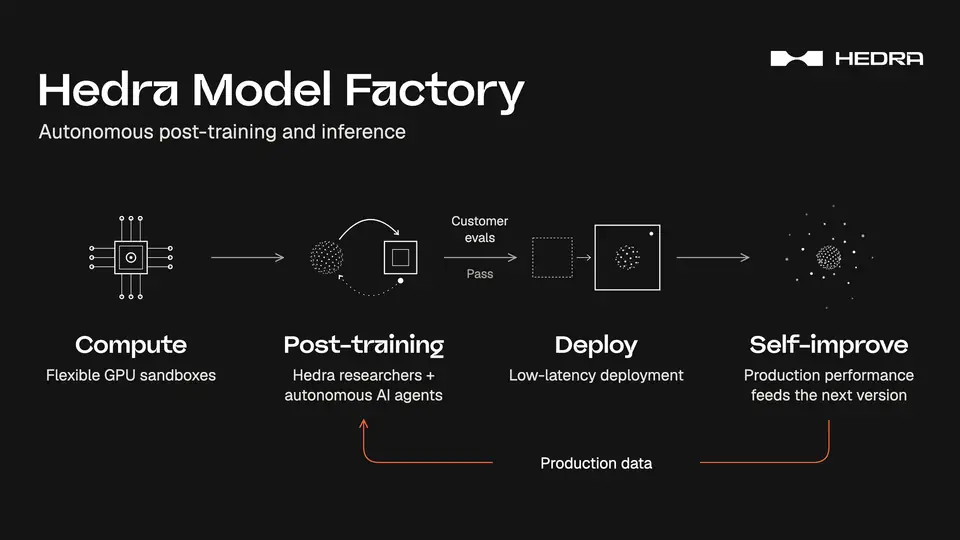
Third, deploy: models run on low-latency compute, on premises or at Hedra’s nearest partner data center — from distilling world action models to run faster than real time without losing physical coherence, to fitting a vision-language-action model onto an edge device. Teams can also bring an existing model and serve it on Hedra’s inference engine. Fourth, self-improve: once deployed, Hedra researchers analyse production performance, retrain, and release only versions that pass the customer’s evals.
The idea Hedra is leaning on is recursive self-improvement — systems that get better at improving themselves. Researchers work alongside autonomous AI scientists that run experiments and iterate on training runs, and every deployed model feeds data back into the next version. For companies without their own research lab, Hedra researchers also set up the data capture, evaluations and the training-to-serving loop. Founder and CEO Michael Lingelbach, a former reinforcement-learning researcher at Stanford and NVIDIA, puts it bluntly: “The next step is the real world, where the data is video, sensors and simulation.”
The proof Hedra is pointing to#
Three numbers carry the announcement. Hedra retrained MiniMax’s H3 video model for physical consistency and scored 34.9 on Google DeepMind’s Physics-IQ benchmark, against 30.3 for H3 Max, with comparable visual quality — and an autonomously distilled version rendered a five-second clip in under three seconds on AMD MI355X GPUs. On image editing, distillation and inference optimisation cut 2K edits from about 22 seconds to 3.6 seconds on the same four AMD Instinct MI355X GPUs, roughly six times faster, in under a week. And in a simulation study, fitting a robot running a trained policy with a new gripper restored task success from near zero to near 100% with no retraining, by matching the new gripper’s reach and grasp point in the wrist camera view.
That last result is the most striking of the three, and the easiest to over-read. A gripper swap that needs no retraining is exactly the kind of adaptation physical AI has to get cheap — every robot, and every task it performs, needs a slightly different model, and training all of them from scratch is not feasible. But it is a simulation study, not a factory floor, and all three figures are Hedra’s own, with no independent replication published.
The open route: GR00T 2 and Isaac Lab#
The closest alternative landed a day earlier. NVIDIA’s GR00T 2, unveiled at the Conference on Robot Learning on November 9, is an open world action model that learns dexterous manipulation from human video, with a 100,000-hour dataset available now under a Creative Commons licence — but the code arrives in December and the weights have no release date. Isaac Lab 3.0, the simulation framework behind it, is open source now. For a team with its own researchers, that is a real route: download the data and the simulator, run your own loop. What it does not give you is the loop itself — the researchers, the evals, the retraining — which is precisely what Hedra is selling. The honest way to read the two launches together is as a fork in the road: build the capability in-house on open foundations, or rent it as a service.
The in-house route#
The third route is the one Hedra is betting against: hire the researchers, buy the GPUs, build the RL environments yourself. It buys full control and full cost — and it is slow. Physical AI models need massive volumes of multimodal data, from high-resolution video to sensor feeds and 3D simulations, and running a self-improvement loop against that data is, in SiliconANGLE’s telling of Hedra’s argument, simply not practical for most teams given the compute involved. Hedra’s counter-offer is to amortise that cost across customers: its revenue grew 15x over the past 12 months, and the platform, the company says, opens the research and infrastructure behind that growth to teams that need custom models built on their own data.
The verdict#
Model Factory is a credible answer to a real bottleneck: every physical-AI deployment needs its own model, and almost nobody can afford to build the training loop from scratch. The gripper-swap result, if it holds up outside simulation, is the kind of thing that changes the economics — adaptation without retraining is the whole game. But the announcement is a vendor claim until a customer says so in public: the numbers are Hedra’s, the evals are the customer’s, and the service is aimed at enterprises, not individual developers. What to watch: the first named customer deployment, whether that 15x revenue growth holds for another year, and whether an independent benchmark — the kind RLWRLD’s DexBench is trying to build for humanoid handiwork — ever gets to grade a Model Factory model in public.