Google DeepMind launches Humanity’s First Exam, a 544-prompt test of whether LLMs get easy questions right every time
Frontier models can solve graduate-level maths, write working code and argue about the Riemann hypothesis. Ask one to read the third letter of every word on a neon sign — five times over, with the wording shuffled slightly each time — and the picture changes. That gap is the subject of Google DeepMind’s newest benchmark, Humanity’s First Exam, launched on Kaggle on November 24. It does not test what models can do at their best. It tests whether they can do the easy stuff right, every single time.
- What it is: Humanity’s First Exam (HFE), a 544-prompt benchmark from Google DeepMind, live on Kaggle with a public leaderboard and a technical report. It tests reliability on elementary tasks, not capability ceilings.
- How it works: the 544 prompts form 136 families — a seed question plus three controlled variants that change entities, clause order or visual attributes. A family only passes when all four are answered correctly. 112 prompts in 28 families are public under CC-BY-4.0; the other 432 stay private to limit contamination.
- The headline numbers: the five leading models score 96–98% on a single attempt but average 85.8% once every variation must be right. GPT-6.2 Astra leads at 92.4% family pass^4, ahead of GPT-6.2 Sol (86.9%) and Gemini 4 Neon (85.8%); all three reached 100% on family pass@4. Single-rater human accuracy on the seeds was 90.8%.
- The example: a neon sign reading “Dance While The Music Plays”, with the question: “List the color of the third letter of each word in the neon sign in order, separated by a semicolon.” Answer: green; yellow; white; blue; blue.
- What’s next: a three-week Kaggle competition through December 15 invites submissions of everyday questions today’s models still get wrong, so the dataset can be refreshed.

Frontier models can solve graduate-level maths, write working code and argue about the Riemann hypothesis. Ask one to read the third letter of every word on a neon sign — five times over, with the wording shuffled slightly each time — and the picture changes. That gap is the subject of Google DeepMind's newest benchmark, Humanity's First Exam, launched on Kaggle on November 24. It does not test what models can do at their best. It tests whether they can do the easy stuff right, every single time.
The framing is a deliberate break from how benchmarks usually work. Most of them measure capability ceilings: the hardest problem a model can solve, once. Humanity's First Exam — HFE for short — measures reliability instead. The dataset is 544 elementary text and image prompts across 20 foundational capabilities: reading, counting, comparing, following directions, describing what is in a picture. The question is never whether a model can answer. It is whether it answers correctly, consistently, when the same task comes back slightly changed.
The test is easy on purpose#
The 544 prompts are organised into 136 families. Each family starts with one seed question and adds three controlled variants that preserve the underlying task while changing entities, clause order or visual attributes. A model only passes a family by getting all four prompts right. That is the whole trick: a model that answers correctly nine times out of ten still fails the family if the tenth attempt goes wrong.
Google's own example shows what "elementary" means here. The public dataset includes a photograph of a neon sign reading "Dance While The Music Plays" in a shop window, and asks: "List the color of the third letter of each word in the neon sign in order, separated by a semicolon." The answer — green; yellow; white; blue; blue — is trivial for a person. For a model, it means reading five words, counting to the third letter of each, naming five colours, and formatting the answer exactly as asked, four times running.
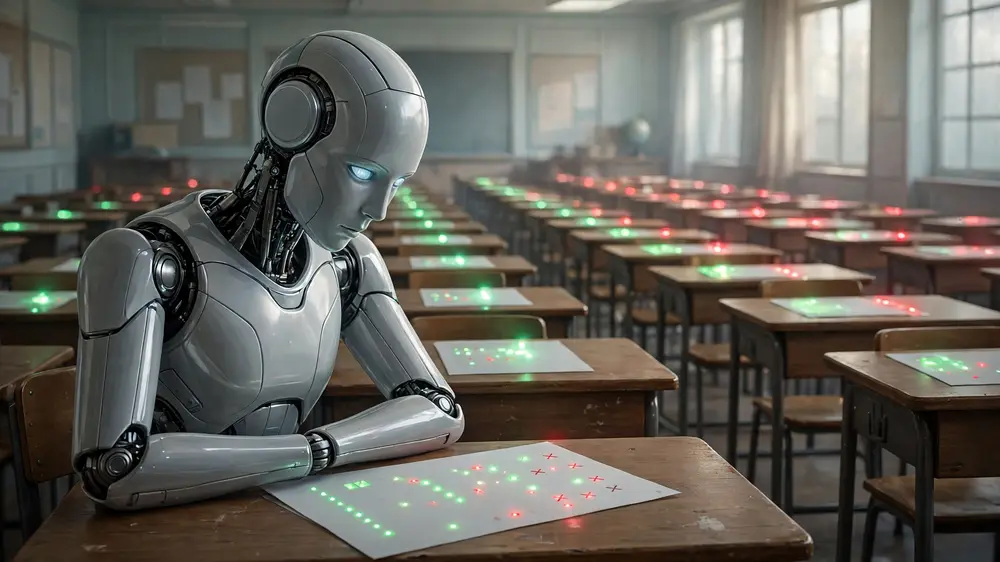
Only part of the test is public. Of the 544 prompts, 112 in 28 families are released under a CC-BY-4.0 licence; the other 432, in 108 families, stay private to limit contamination and overfitting. The Kaggle benchmark runs in an isolated evaluation environment with no public internet access, and carries a 16-model leaderboard. The screening was strict: DeepMind started from 315 complete five-prompt families and kept only those whose seed was solved by at least three of four independent human raters. Single-rater human accuracy on the 136 retained seeds was 90.8% — the test is easy, but not so easy that people never slip.
Brilliant once, shaky every time#
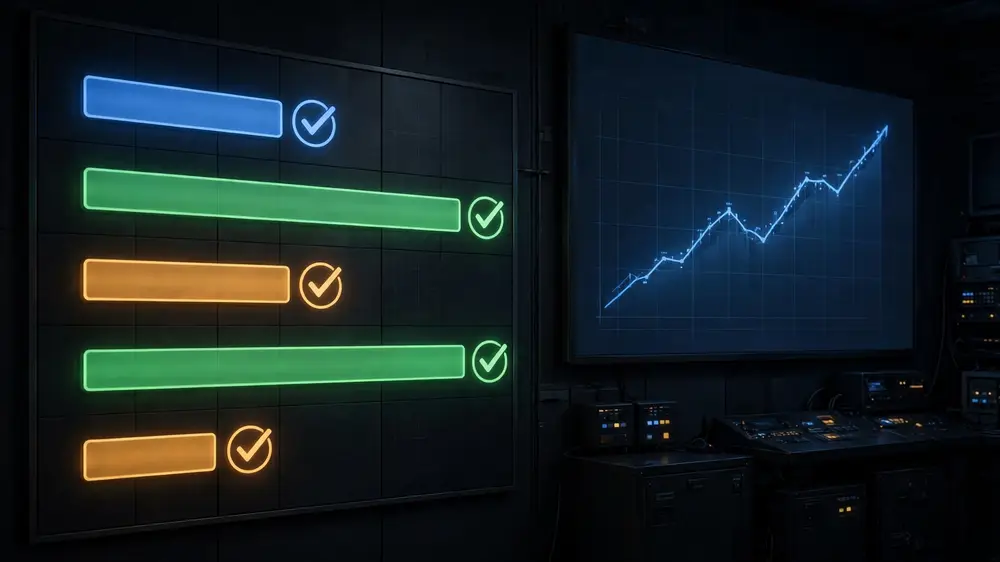
The results make the case for the benchmark better than any manifesto. The five leading models in DeepMind's study scored 96% to 98% on a single attempt — near-perfect on questions a child could answer. But when every variation of a question had to be right across repeated attempts, they averaged 85.8%. The gap between "can do it" and "does it every time" is roughly one question in eight.
The technical report, which evaluated 18 frontier and fast-tier models, ranks GPT-6.2 Astra first at 92.4% on its headline metric, family pass^4 — the share of families passed on all four variants — followed by GPT-6.2 Sol at 86.9% and Gemini 4 Neon at 85.8%. All three reached 100% on family pass@4, which counts a family as passed if any one of four attempts succeeds. The difference between the two numbers is what DeepMind calls the Family Reliability Gap: 7.6 points for Astra, 13.1 for Sol, 14.2 for Neon. In other words, even the best model in the world fails at least one variant in nearly one family in thirteen.
Why consistency is the metric that matters#
The timing is not accidental. Models are moving from chat windows into agentic roles — booking, filing, operating software, acting on a user's behalf — where a task is not a single clever answer but a long chain of small steps, each of which has to be right. A model that is right 96% of the time on easy steps is wrong often enough, across a hundred-step workflow, to be unusable without supervision. Reliability on trivial tasks is the floor that everything else stands on, and until now there has been no standard way to measure it.
DeepMind is also candid that the benchmark has moved fast: over the last six months, frontier models have made significant progress on HFE, according to the announcement. The test is designed to keep moving too. To stop the dataset going stale, Google is running a three-week Kaggle competition through December 15, inviting anyone to submit everyday questions that today's models still get wrong, so the benchmark can be refreshed with new blind spots.
What to watch#
Three things decide whether HFE becomes a standard reference or a curiosity. First, whether the leaderboard stays live and competitive — a benchmark only matters if labs keep running it. Second, whether the reliability gap narrows: Astra's 7.6-point gap is the number to beat, and the competition for the top of the board is now explicitly about consistency, not capability. Third, the caveats in DeepMind's own report, which are worth taking seriously: the tasks were adversarially selected to expose model blind spots rather than sampled uniformly from everyday queries, some imagery is synthetic, scoring relies on one Gemini autorater family, and human testing covered the seeds only. HFE is a stress test of elementary reliability, not an estimate of how often models fail in ordinary use.
Still, the shift in what gets measured is the news. For years the race has been about higher ceilings — harder maths, longer code, tougher science. Humanity's First Exam asks the opposite question, and it is the one that matters most to anyone about to hand a model a real job: not can it do it once, but can it do it every time?
Sources: Google DeepMind, "Humanity's First Exam: Testing LLM reliability" (November 24, 2026); Unite.AI, "Google DeepMind's 544-Prompt HFE Test Exposes LLM Consistency Gaps" (November 24, 2026); iClarified, "Google Launches 'Humanity's First Exam' to Test AI Reliability" (November 24, 2026)