Impossible Metals' Eureka robot collected deep-sea nodules 2.5 miles down — one rock at a time
Impossible Metals announced on Monday, November 9, 2026, that its Eureka robot became the first fully autonomous underwater vehicle to selectively collect polymetallic nodules from the deep ocean — diving more than 4,000 meters into the Clarion-Clipperton Zone and returning with about 450 grams of the mineral-rich rocks, while leaving every nodule carrying visible life untouched. It is a small haul with a large claim attached: that AI-guided picking, not vacuuming, is the future of deep-sea mining.
What we checked: Impossible Metals, “Impossible Metals’ Autonomous Robot Selectively Harvests Deep-Sea Nodules 2.5 Miles Down” (Business Wire press release, November 9, 2026, 2:00 p.m. UTC), and Reuters, “Impossible Metals says it has successfully tested AI seabed mining robot” (November 9, 2026).
- Who: Impossible Metals, an American marine-technology company; its Eureka Collection System; executive chairman and CEO Steve Curnutte.
- What: The first fully autonomous underwater robot to selectively recover polymetallic nodules from the deep ocean.
- When: Announced November 9, 2026; the scientific dive took place in September 2026 in the Clarion-Clipperton Zone.
- Depth: More than 4,000 meters (2.5 miles) — deeper than the wreck of the Titanic.
- Haul: About 450 grams (roughly one pound) of nodules, collected for Viridian Biometals to study bacteria populations living in them.
- Patent: US patent 12,704,065, granted August 11, 2026, naming co-founders Oliver Gunasekara and Jason Gillham as inventors.
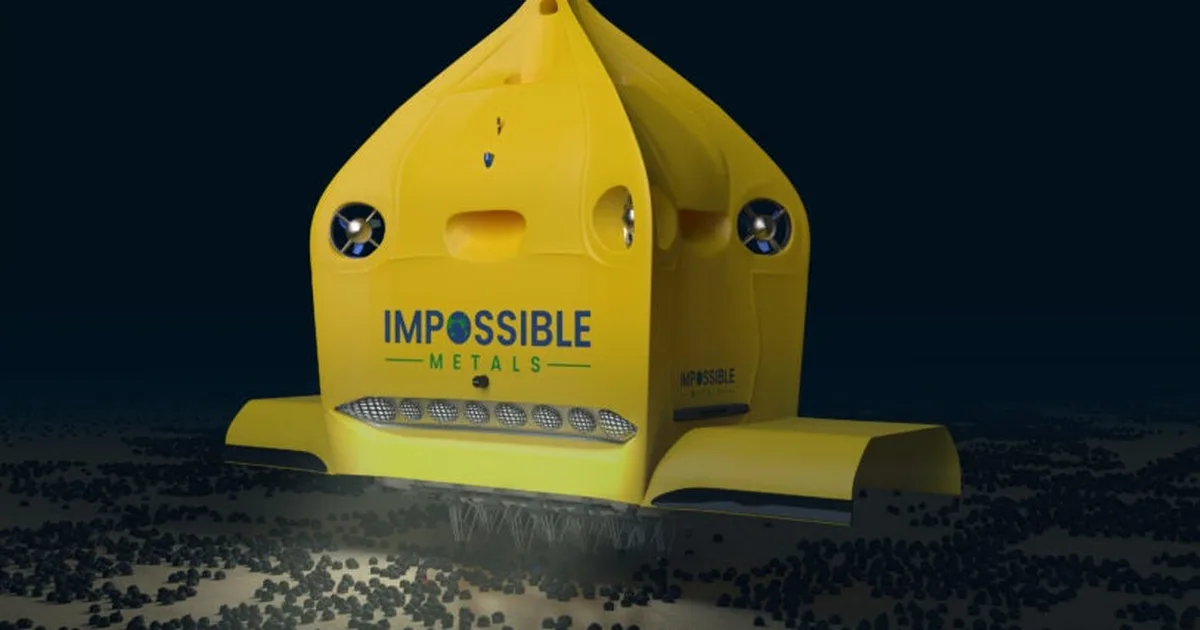
Two and a half miles down, there is no sunlight and no margin for error. In September, in the Clarion-Clipperton Zone of the Pacific Ocean, a bright yellow robot called Eureka drifted over a field of potato-shaped rocks on the seabed, its cameras scanning each one — and picked up a few, one at a time, while leaving the rest exactly where they lay.
On Monday, November 9, Impossible Metals announced that the dive worked. Eureka became the first fully autonomous underwater robot to selectively collect polymetallic nodules from the deep ocean, the company said — a first that, if it holds up, changes what deep-sea mining looks like.
What happened#
The dive took place in the Clarion-Clipperton Zone, a vast stretch of Pacific seabed between Hawaii and Mexico, at a depth of more than 4,000 meters — 2.5 miles, deeper than the wreck of the Titanic. Eureka directed itself to the seabed, collected about 450 grams — roughly a pound — of nodules, and returned to the surface, according to the company’s announcement and a Reuters report the same day.
The haul was deliberately small. The dive was conducted as marine scientific research, and the nodules will be studied by Viridian Biometals, a research partner, to learn about the bacteria populations living inside them. The point of the dive was not the tonnage. It was the picking.
Eureka does not drive across the seabed or vacuum it. It hovers above it. A buoyancy engine lifts its payload by harnessing water displacement, which removes the need for a riser pipe — the long tube conventional systems use to pump material to a surface ship — and the process-water discharge that comes with it. As it works, the system’s perception layer identifies visible life on and around each nodule and leaves those nodules where they are, selecting only from the remainder. Robotic arms pick the chosen nodules one by one. Robots that read a scene and choose what to touch are advancing fast — MIT’s FLEX system teaches robots to interpret instructions like “don’t spill on the laptop” — and NVIDIA’s Cosmos 3 world models are built to train that kind of physical judgment before a robot ever leaves the lab.
| Eureka (Impossible Metals) | Conventional riser-based collection | |
|---|---|---|
| Contact with seabed | Hovers above it | Collector vehicle drives across it |
| Riser pipe | None — buoyancy engine lifts the payload | Required to pump material to a surface ship |
| Selectivity | Picks individual nodules; skips ones carrying visible life | Collects material indiscriminately |
| Process-water discharge | None | Discharge from the riser system |
| Scaling | Add robots one at a time | Build larger infrastructure and more surface ships |
Why it matters#
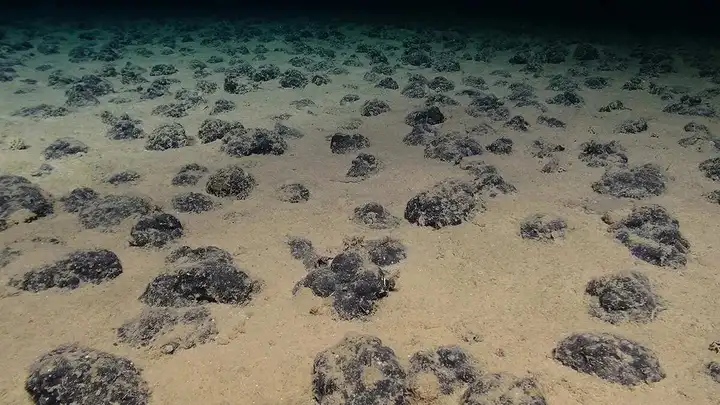
The rocks are the reason anyone is down there at all. Polymetallic nodules are potato-shaped lumps rich in copper, nickel and other minerals used in electric vehicles and electronics, and parts of the ocean floor are covered in them. The industry’s problem is how to get them up without wrecking the place: most plans use a vacuum-like device to hoover them off the seabed, an approach environmentalists have attacked for years.
Eureka’s pitch is precision instead of suction. If a robot can tell a bare nodule from one carrying visible life and take only the first, the environmental case for mining changes — at least in principle. The company says all scientific data from the dive will be published openly, as it did after its Eureka II dives on the Blake Plateau two years ago.
The business case has backers with unusual weight. Investors include In-Q-Tel, the US intelligence community’s strategic investor, and the Smith family of FedEx, now the company’s second-largest shareholder. Media reports put its Series A round, which closed earlier this year, near $25 million at a roughly $110 million valuation; the company declined to confirm the figures. The technology is protected by US patent 12,704,065, granted on August 11, 2026, naming co-founders Oliver Gunasekara and Jason Gillham as inventors.
“Eureka is proven, patented, and ready,” said Steve Curnutte, the company’s executive chairman and CEO. “What remains is scaling and manufacturing, not invention.” The company plans to offer robots as a service, partnering with licensed resource holders to supply and operate the Eureka system.
What’s next#
The next test is bigger and, crucially, not run by the company. In 2027, Impossible Metals will put Eureka III, a scaled-up version, in front of an independent scientific team aboard the German research vessel RV SONNE, under an environmental impact study initiated by Germany’s Federal Institute for Geosciences and Natural Resources (BGR). The company also works with a standing group of nine independent scientists, convened on terms that leave them free to disagree with the company in public.
That study is the one to watch, because the gap between this announcement and a working mine is still wide. The company still needs regulatory approval from the International Seabed Authority or the US government before it can mine commercially, and the environmental claims — that selective collection meaningfully reduces harm — are design claims so far, not measured outcomes. A 450-gram sample proves the robot can pick. Whether selective collection measurably reduces harm is the question the 2027 study is designed to answer. Robots are getting more capable in the physical world — Atlas can now drift, slide and jump on wheels — but capability and permission are different things, and for Eureka, permission is the long pole.
Sources: Impossible Metals, “Impossible Metals’ Autonomous Robot Selectively Harvests Deep-Sea Nodules 2.5 Miles Down” (Business Wire, November 9, 2026), here; Reuters, “Impossible Metals says it has successfully tested AI seabed mining robot” (November 9, 2026), here.