Boston Dynamics put wheels on Atlas — and the humanoid can drift, slide and jump 360
Boston Dynamics has put wheels on Atlas. In a video posted on Monday morning, the humanoid rolls through a warehouse on a scooter rim bolted to each ankle — drifting through aisles, sliding sideways and landing a 360-degree jump. The clip traveled fast: within two hours of appearing on Reddit it was the fastest-moving robotics post of the morning, and the YouTube original passed 90,000 views in about three hours. But the wheels are not a product. They are a stress test, built to find out where Boston Dynamics’ simulation of its own robot stops matching the real machine.
What we checked: Boston Dynamics’ blog post and YouTube video, both published November 9, 2026, and the Reddit thread that carried the video. View and vote counts are as of Monday afternoon, and they move fast — treat them as a snapshot, not a final tally.
- The video: “Atlas on a Roll | Classical Motor Controls and Whole-Body RL,” posted by Boston Dynamics on YouTube on November 9, 2026; 2:50 long, past 90,000 views within about three hours.
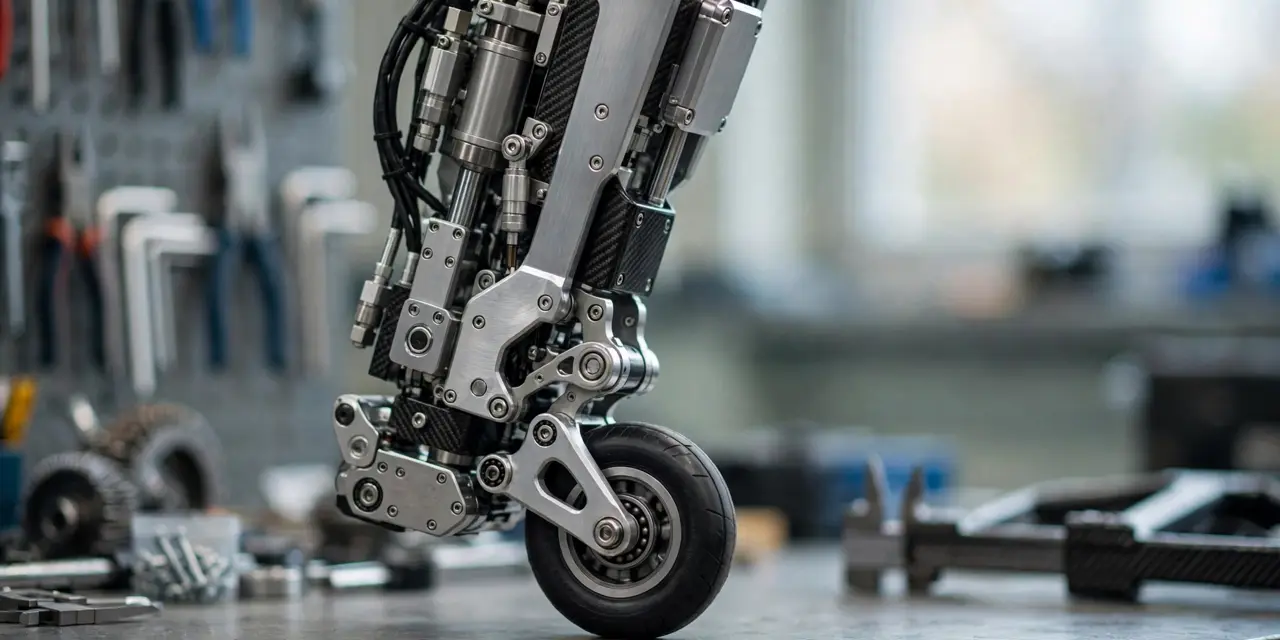
- The build: a single custom adapter mounts an off-the-shelf scooter rim onto each existing ankle actuator — the only new part. Each wheel is modeled in software as an ankle that spins continuously.
- The point: a testbed for learned whole-body control — pushing the motors across their full torque-speed range to see whether simulation-trained policies transfer to real hardware.
- The moves: drawn from a library of human motion-capture clips; the 360 jump follows a recording of a person doing the jump and worked on the first try.
- The reaction: a Reddit thread in r/singularity, posted at 12:08 PM EST, gathered 272 upvotes and 72 comments within two hours; top comments praised the control work while asking when Atlas stops dancing and starts working.
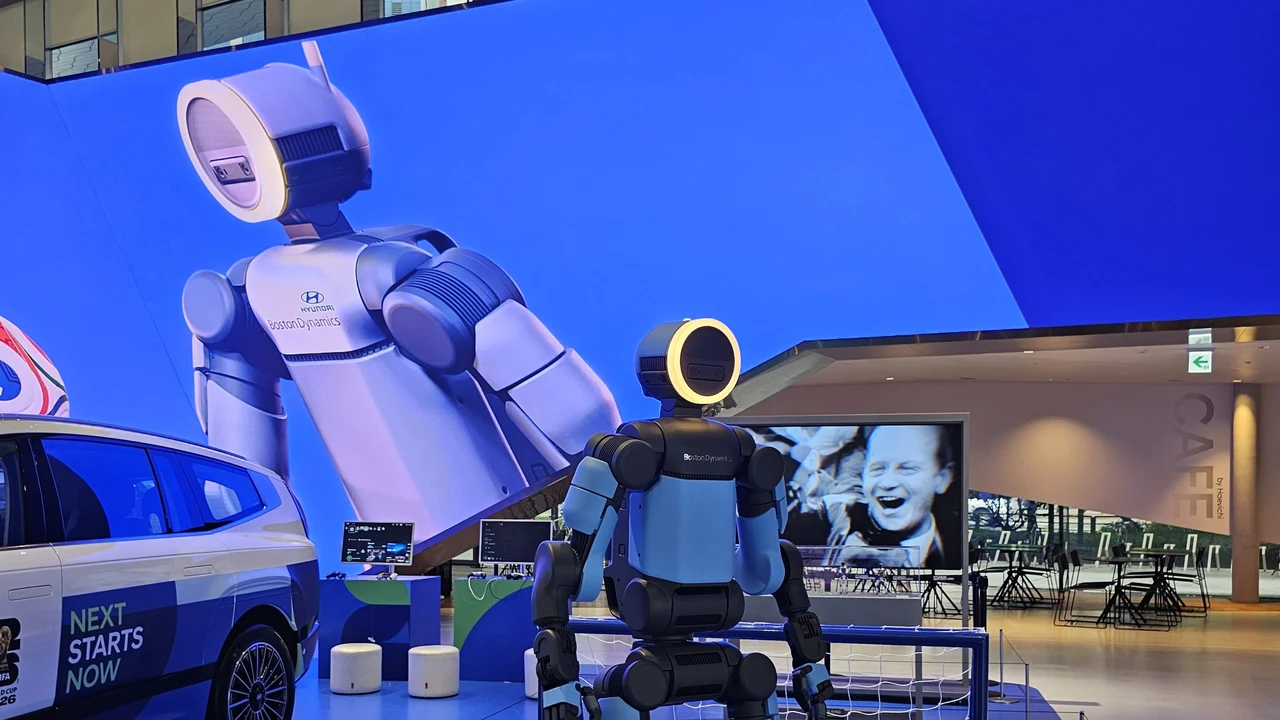
Boston Dynamics has put wheels on Atlas. In a video posted on Monday morning, the humanoid rolls through a warehouse on a scooter rim bolted to each ankle — drifting through aisles, sliding sideways and landing a 360-degree jump. The clip traveled fast: within two hours of appearing on Reddit it was the fastest-moving robotics post of the morning, and the YouTube original passed 90,000 views in about three hours. But the wheels are not a product. They are a stress test, built to find out where Boston Dynamics’ simulation of its own robot stops matching the real machine.
The setup is disarmingly simple, according to the write-up by Xiaoyu (Andy) Wu, the controls engineer on the Atlas team who led the project. Atlas’s feet came off, and a single custom adapter went on, mounting an off-the-shelf scooter rim onto the existing ankle actuator. That adapter is the only new part in the whole build. In software, each wheel is simply an ankle that can spin forever, so the existing robot model needed only the feet swapped out for wheels. “I’m still amazed at just how easy the whole process was,” Wu writes.
Why wheels?#
The point is torque and speed. Wheels force the motors to deliver high torque and high speed continuously, carrying real load the whole time — every launch, turn and stop pushes the motors across their full torque-speed range. That is exactly the regime where a learned whole-body controller either holds up or falls apart, and where small errors in the motor model turn into moves the hardware cannot actually perform.
Training happens in simulation, millions of runs before a policy ever touches hardware. So the simulated motor has to behave like the real one, or the policy learns tricks the robot cannot perform. Closing that gap — known as sim-to-real — is the real challenge of the project, and much of the work was unglamorous: matching control parameters across setups, running characterization experiments, and tuning the simulated motor to measured data.
The moves came from motion capture#
The fun part is where the moves came from: a library of human motion-capture clips. Wu deliberately picked clips with a lot of foot sliding, figuring wheels would make them interesting — and they did. Where a person slides their feet in a side dash, the policy learned to steer the wheels and roll through it instead.
The 360 jump looks like the riskiest move in the video and was actually the safest: a trajectory-tracking policy following a recording of a person doing the jump, which worked on the first try. What surprised the team was how differently Atlas used traction with wheels — in the windup before the jump, the lower body rolled into place to set up the upward push. “Give the policy wheels, and it figures out how to use them,” Wu writes.
A testbed, not a product#
The wheeled Atlas will not be sold. Boston Dynamics is explicit about that: the point was to learn how accurate motor models speed up reinforcement-learning policy design, and the insights are already being adapted back into the standard two-legged Atlas. The next step is tighter integration between actuator dynamics and whole-body RL — pushing hardware limits, hardening the robot against failure modes, and expanding what Atlas can do.
It is also a callback. Boston Dynamics has tried wheels-plus-legs before: Handle, its 2017 warehouse robot, rolled on two wheels with an Atlas-derived torso. The difference now is that the wheels are a probe for the learning stack, not a locomotion strategy — a way to interrogate the controller, not a product direction.
What the thread thought#
The Reddit thread that carried the video — posted in r/singularity at 12:08 PM EST by u/Distinct-Question-16 — was mostly delighted, with a skeptical edge the blog itself invites. The top-voted comment suggested a third leg for stability when standing still, like a tripod. Others joked that it was another video of a robot dancing in an empty warehouse, and asked — fairly — whether any Boston Dynamics humanoid is actually deployed anywhere. One reply pointed to Stretch, the warehouse robot, as having real deployments at large companies.
That deployment question is the one that matters. The production Atlas is slated to start work at Hyundai’s Georgia plant in 2028, and the thread’s verdict, in short, was: impressive control work — now show it doing a job.
What to watch#
Whether the motor-modeling lessons show up in the production Atlas’s reliability, and whether the reinforcement-learning stack’s robustness claims survive contact with factory floors. And what Boston Dynamics’ next stress test looks like — the company has made a habit of using its research Atlas to probe one limit at a time, most recently a cartwheel-to-backflip routine in February.
Sources: Boston Dynamics, ‘Atlas On a Roll’ by Xiaoyu (Andy) Wu (November 9, 2026), here; YouTube, ‘Atlas on a Roll | Classical Motor Controls and Whole-Body RL’, Boston Dynamics (November 9, 2026), here; Reddit, ‘Boston Dynamics demos Atlas over wheels’ (u/Distinct-Question-16, November 9, 2026), here.