Medium launches TK: an AI writing app that lives inside your drafts
Medium launched TK on Monday, November 9, 2026 — a private notebook and writing app with an AI assistant built into the editor, free for anyone with a Medium account. It is the publishing platform’s bet that the future of AI in writing is not a chatbot sitting beside the document, but an assistant inside the draft — and a direct answer to the question of who really wrote what.
What we checked: TechCrunch’s report by Sarah Perez (November 9, 2026, 11:12 AM EST), cross-checked against Unite.ai’s report the same day and Medium’s own launch post.
- What: TK, Medium’s private notebook and writing app with an AI assistant in the editor; opened to all Medium account holders on November 9, 2026, after an invite-only phase that began with a September 16, 2026 post.
- Price: free with a Medium account. Web at launch, plus a mobile app and widgets for voice and text capture; a desktop app is on the roadmap.
- How: type @TK mid-sentence to ask a question or retrieve earlier writing. Built-in skills give editorial feedback, headline feedback, and match drafts to a publication’s style guide.
- Agents: connects to a writer’s own AI agent through TK’s MCP server or Claude skill; a Claude Daily Note plugin builds one document per day in Claude Cowork or Claude Code.
- Trust: writing in TK is not encrypted — it is designed for collaboration, with user-set access permissions — and Medium says no AI company trains on a person’s writing without permission.
- Numbers: 71% of surveyed writers had used AI in writing in the previous three months; 60% distrusted their own AI-produced writing and 69% distrusted others’; 4.4 million unpublished drafts were written on Medium in the preceding year.
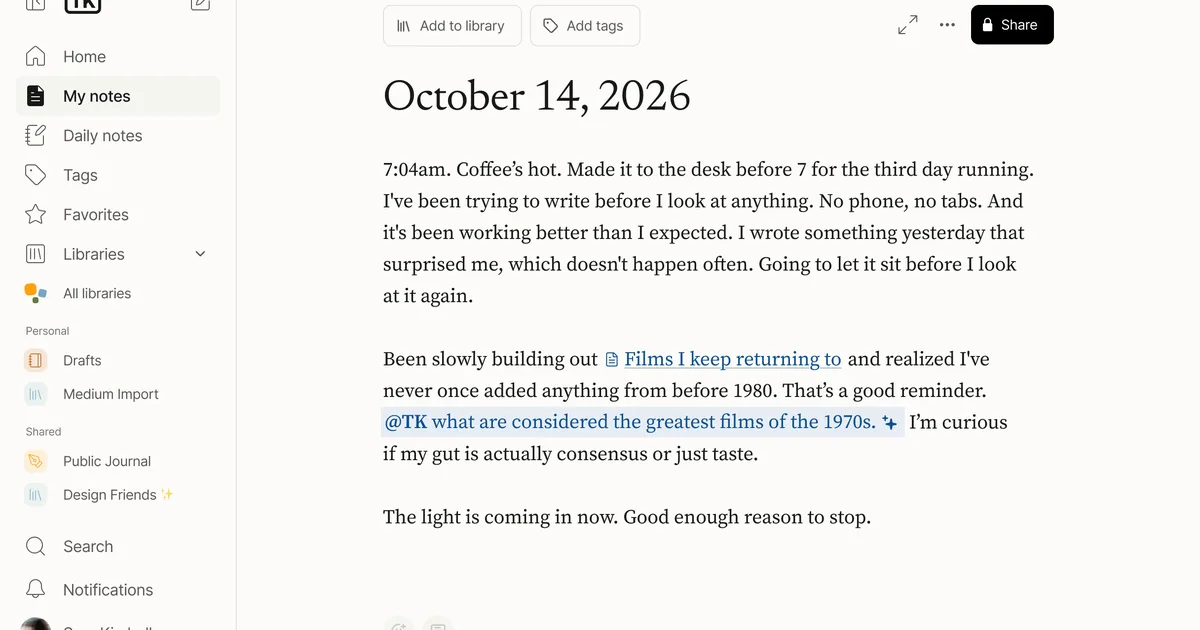
How TK works, step by step
Picture a writer halfway through an essay, stuck on a half-formed idea she jotted down last week. In TK, the fix is two keystrokes. Here is the loop Medium built, in the order a writer actually hits it.
1. Start in the notebook, not the publisher. TK is a private notebook first and a publishing tool second. Notes stay private until the writer chooses to share them — a deliberate split from Medium itself. Chief executive Tony Stubblebine’s shorthand for it: “TK is the gym and Medium is the stage.” The app runs on the web at launch, with a mobile app and widgets for capturing voice and text on the go.
2. Ask without leaving the sentence. Mid-draft, the writer types @TK followed by a request. The assistant answers quick questions that would otherwise mean opening a new tab — TechCrunch’s example is as small as asking how many days are in a particular month — without breaking the flow of the paragraph.
3. Let it pull from your own archive. TK reaches back into fragments the writer saved earlier, while ideas were still half-formed, and surfaces them in context. Searches, topics, tags, and libraries can also be turned into wiki-style summaries, with themes, key ideas, and links to the underlying notes — a route back into an unstructured archive when a later draft needs it.
4. Ask for feedback, not a ghostwriter. TK ships with skills for editorial feedback and headline feedback, and can match a draft to the style guide of a Medium publication. It can flag material that could grow into a book. And Medium draws a firm line here: TK will not write a user’s essay. The assistant checks, retrieves, summarizes, and critiques; authorship stays with the writer.
5. Come back tomorrow to a prompt. TK creates a writing prompt each morning, referring back to earlier notes. The point is habit: the app is built to be opened daily, the way a notebook is, rather than only when a piece is due.

Your own agent can plug in
Beyond its built-in assistant, TK includes an MCP server and a Claude skill, so a writer’s own AI agent can draw on stored positions, projects, and unfinished ideas. Medium’s example is its Claude Daily Note plugin: with TK’s MCP server connected in Claude Cowork or Claude Code, the plugin creates one document per day, updates it in place, and carries unchecked to-do items forward. The plumbing is the same model-context-protocol pattern that has become the standard way to give an agent access to a personal tool — here, the tool is the writer’s own thinking.
Sharing is a layer on top, not the default. Social libraries let writers share drafts with groups, including open libraries for public journaling, feedback before publication, and developing a self-published book. Notes otherwise remain private, with user-controlled access permissions. One trade-off is stated plainly: writing in TK is not encrypted, because the app is designed for collaboration. Medium says no AI company trains on or uses a person’s writing without permission.
The news: what opened today
TK is not brand new — Medium described it as invite-only, or available to Friends of Medium, in a September 16 post while broader access was being prepared. What happened on November 9 is the wider opening: the app is now free for anyone with a Medium account, no invite needed.
The launch package is practical rather than flashy. It imports Medium archives and Bear or Obsidian vaults, and imports and exports Markdown — though Medium notes it is not a Markdown app in itself. A desktop app is on the roadmap; the release available today is the browser-based tool, plus the mobile app. Medium, which describes itself as profitable, is giving TK away rather than charging for it.

TK by the numbers
Medium’s State of Writing Report 2026, built on a Harris Poll survey, is the context for the design choices — and it captures the tension TK is trying to resolve.
| Finding | Share |
|---|---|
| Writers who had used AI as part of their writing practice in the previous three months | 71% |
| Writers who distrusted their own AI-produced writing | 60% |
| Writers who distrusted AI-produced writing from others | 69% |
| Unpublished drafts written on Medium in the preceding year | 4.4 million |
| Writers surveyed (online US survey, August 12–17, 2026; ±4.0 points) | 1,175 |
Most writers already use AI, most distrust what it produces, and millions of drafts never see daylight. TK is Medium’s answer to all three facts at once: use the assistant inside the private draft, keep the writer in charge, and make the AI’s contribution inspectable when the piece goes public.
Why now: the authorship question
The timing is not accidental. The publishing and literary worlds have spent the past year arguing over AI’s role in long-form prose: authors have lost book deals over suspicions they used AI, and literary awards have come under scrutiny after winners were suspected of writing with AI assistance. Meanwhile, questions persist around the reliability of AI detection tools — whether they can tell assisted writing from generated writing at all.
Medium is picking a side, loudly. “Artificial intelligence makes writing more important, not less,” the company says, calling AI “a technology that has the power to amplify human intelligence and it uses the written word as a foundation.” Its concession is that AI raises the possibility of low-quality content and blurs the line between human-written and AI-written work. The fix it proposes is provenance: TK lets authors publish notes that transparently explain how AI was used in their writing. “This is a start of what we believe is required to publish in the AI era, which is to make the provenance of writing clear, transparent, and inspectable, right down to the prompting and source material,” Medium wrote in its launch post.
That puts TK in a crowded field — the best AI writing assistants already compete on drafting and editing — but none of them is attached to a publishing platform with millions of writers, and none makes disclosure a built-in feature rather than an afterthought. Whether provenance notes become a norm or a curiosity depends on whether writers actually publish them, and whether readers start asking for them. The Claude-powered tooling TK plugs into suggests Medium expects its writers to already have an AI agent of their own; TK wants to be where that agent meets the draft.
Frequently asked questions
What is Medium TK?
TK is Medium’s private notebook and writing app, opened to everyone with a Medium account on November 9, 2026, after an invite-only phase. It embeds an AI assistant in the editor — summoned by typing @TK — and adds AI feedback, archive organization, and connections to personal AI agents.
Is TK free, and where can I use it?
TK is free for anyone with a Medium account. At launch it runs on the web, with a mobile app and widgets for voice and text capture; a desktop app is on Medium’s roadmap. It imports Medium archives and Bear or Obsidian vaults, and imports and exports Markdown.
Does TK write your essays for you?
No. Medium says TK will not write a user’s essay. The assistant answers questions, retrieves saved writing, gives editorial and headline feedback, and helps organize notes — while the writer keeps authorship. Authors can publish notes disclosing exactly how AI contributed to a piece.