Mercedes-Benz signs Wayve to put end-to-end AI driving in production cars
Mercedes-Benz will integrate Wayve's map-free, end-to-end AI Driver into future vehicles under a definitive production agreement — the first premium-car production deal for a driving model that learns instead of following hand-coded rules.
Self-driving technology is finally graduating from demo fleets to dealer lots. Mercedes-Benz and London-based AI startup Wayve have signed a definitive production agreement to put Wayve's end-to-end AI Driver into future Mercedes vehicles, with the first customer systems expected within the next two years. It is the first time Wayve's learned driving model will ship in a premium-segment production car.
For an industry that has spent a decade promising autonomy while delivering fancier cruise control, this is the kind of deal that actually matters: a real automaker, real production hardware, and a timeline that isn't measured in "someday."
What Mercedes is actually buying#
Wayve doesn't build cars — it builds the software that drives them. For this agreement, the two companies integrated the Wayve AI Driver into Mercedes' own production system architecture: the automaker's hardware platform, its MB.OS operating system, and its map interfaces. The initial offering will be advanced urban and highway point-to-point driving assistance — a system that can handle a complete route from origin to destination under the driver's continuous supervision, in the same spirit as Tesla's supervised Full Self-Driving.
The deal builds on a multi-year technical partnership and follows Mercedes-Benz's strategic investment in Wayve's Series D round earlier this year, a financing reported at roughly $1.2–1.5 billion that also drew in Microsoft, Nvidia, Uber, Nissan, and Stellantis, according to Dow Jones Newswires. Wayve already had partnership agreements with Nissan and Stellantis, but the Mercedes contract is the first to carry a definitive production commitment — and the first in the premium segment. "Together with Wayve, we are laying the foundation to roll out this technology worldwide," said Mercedes-Benz CTO Jörg Burzer.
AV2.0: a car that learns to drive#
Wayve's pitch rests on what it calls its AV2.0 approach. Instead of the classical self-driving stack — hand-coded rules, centimeter-precise HD maps, and carefully geofenced operating zones — its system learns driving behavior from large-scale data, the way a human learns to drive. The result is supposed to generalize to cities and situations the car has never encountered, without city-specific retraining.
Philosophically, that puts Wayve closer to Tesla's end-to-end learning camp than to Waymo's mapped-and-geofenced approach. With one notable divergence: where Tesla removed radar from its sensor suite, Wayve's latest system added it. The company says its models are trained on NVIDIA AI infrastructure hosted on Microsoft Azure, and the stack has been exercised across Stuttgart, London, and San Francisco — city streets, freeways, and country roads.
Why the timing matters#
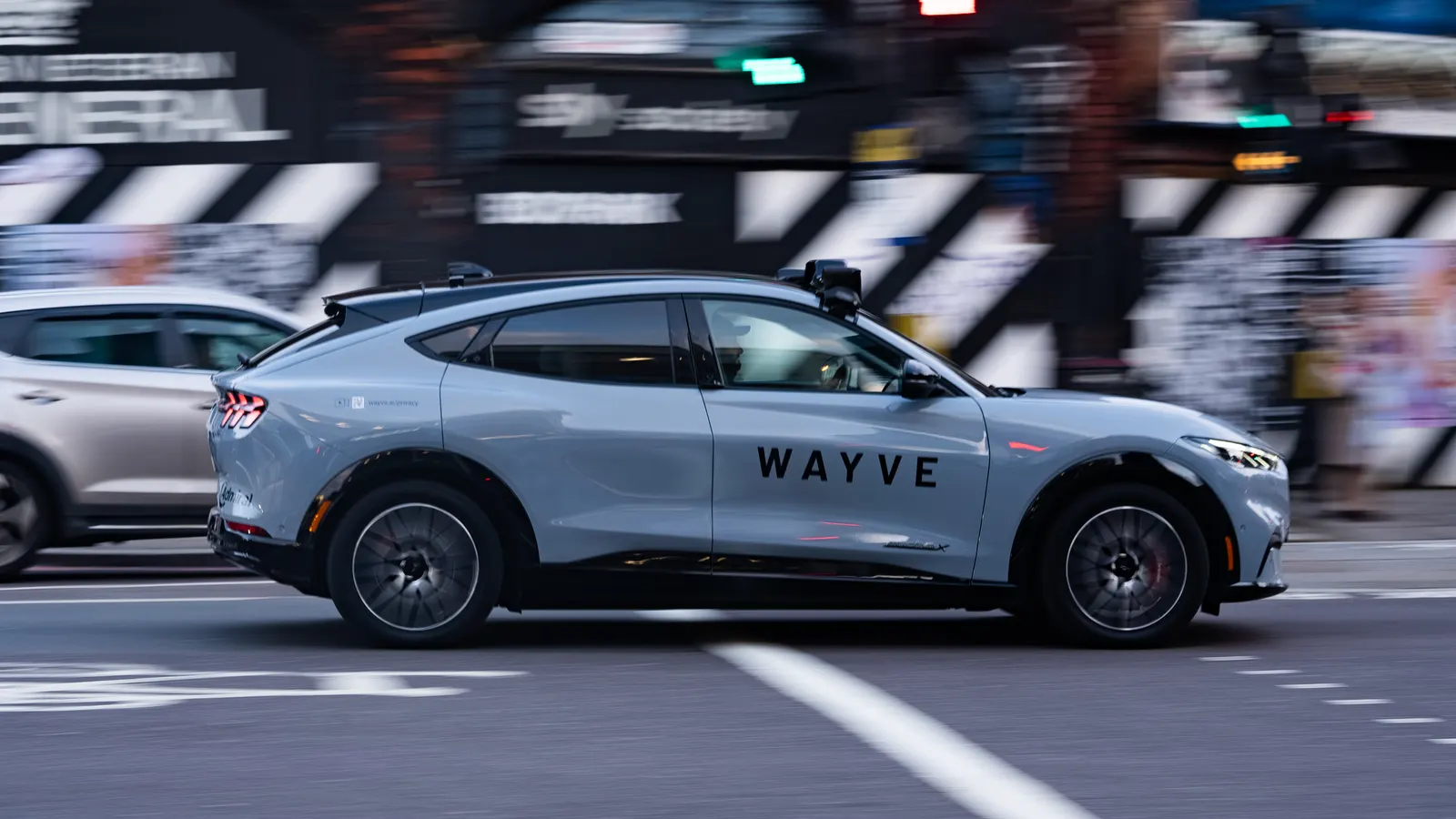
Wayve is not arriving from the lab. Its vehicles are already carrying paying passengers: Wayve-equipped Ford Mustangs run in Uber's London robotaxi service, which launched this month with a safety driver on board. The Mercedes agreement takes that same underlying technology and moves it from ride-hailing pilots toward mass-produced consumer cars — the transition the entire autonomous-driving industry has been trying to make for years.
For Mercedes, the logic is straightforward: license a best-of-breed AI stack rather than building every layer in-house. The automaker already fields Drive Pilot, its certified Level 3 system, but that operates only in limited conditions. Wayve's urban-capable, point-to-point assistance would extend advanced automation to the messy city driving that current systems avoid.
What the announcement leaves out#
Read the press release closely and the caveats stack up. There is no SAE automation level attached to the promised feature. No vehicle models are named, no launch markets specified, and no firmer date than "within the next two years." This is advanced driving assistance, not a driverless product — the driver remains responsible and monitors continuously.
A definitive production agreement is also not cars on roads today. The two companies describe the work so far as establishing the foundation for mass-production development, which means the engineering, validation, and regulatory gauntlet still lie ahead. Autonomy timelines have a long history of slipping between signing and shipping.
What to watch#
The first test will be regulatory. Germany, where Mercedes already holds approvals for its Drive Pilot system, is the natural launch market — watch whether the Wayve-based feature clears European type-approval on the promised timeline. The second test is the clock: two years is aggressive for production validation of an urban driving system.
And the competitive picture is about to get interesting. If Mercedes ships first, expect Nissan and Stellantis — both already Wayve partners — to accelerate their own production timelines. The map-free, end-to-end philosophy has spent years being called the reckless bet. With a luxury automaker now committing real production plans to it, the debate is no longer academic.