New York City Council unveils AI safety bills: kill switches, whistleblower bounties, and an October 5 hearing
Speaker Julie Menin's package would force AI systems sold in the city through third-party validation, require a human kill switch on every deployment, pay whistleblowers a cut of recovered fines — and summon five AI CEOs to a rare full-Council hearing on October 5.
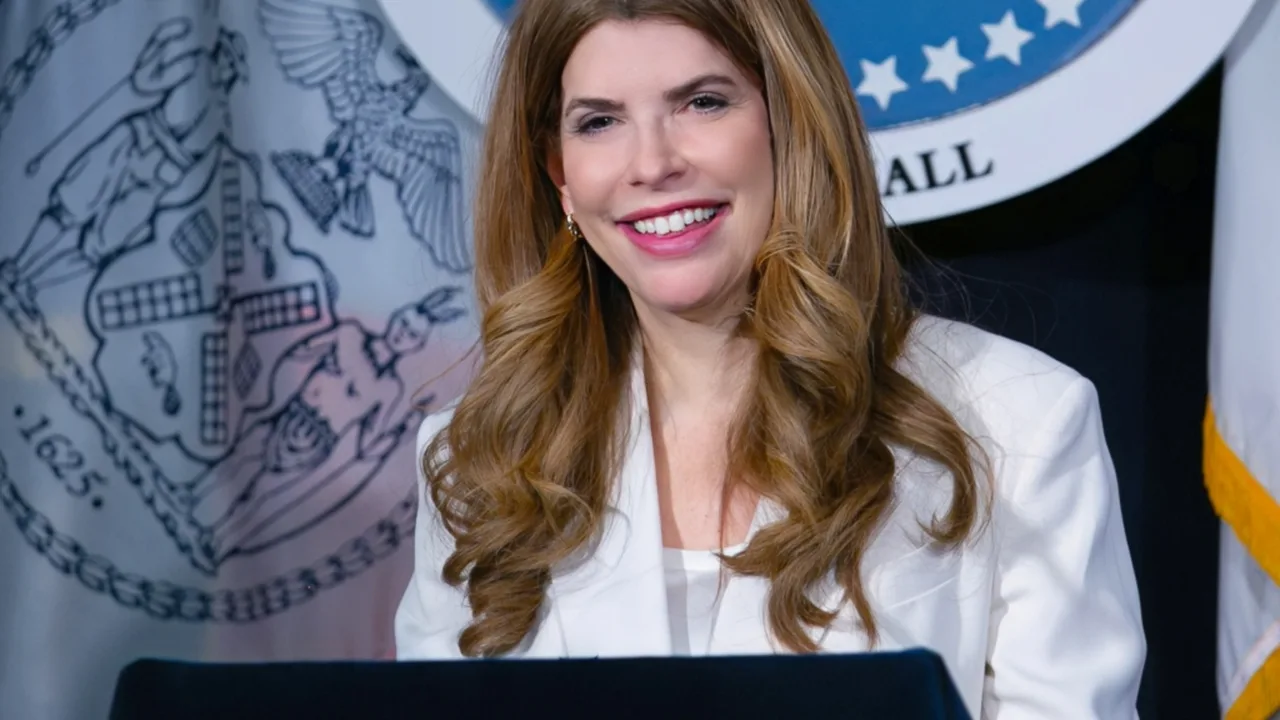
Washington has spent nearly a decade holding hearings on artificial intelligence without producing anything that resembles a safety law. On Friday, the New York City Council stopped waiting.
Council Speaker Julie Menin unveiled a package of AI oversight bills that reads like a wish list from the safety community: mandatory third-party validation of AI systems sold in the city, a human kill switch on every deployment, cash bounties for whistleblowers who report violations, and a private right of action letting residents harmed by AI sue developers directly. The full Council — all 51 members — will take up the package at a rare Committee of the Whole hearing on October 5, and Menin has invited the chief executives of OpenAI, Anthropic, Google, Meta, and xAI to testify.
What the bills would require#
The centerpiece is Intro. 26835, sponsored by Menin herself. It would make it illegal for any business to market, sell, or use an AI system in New York City that has not passed third-party validation. The validators would have to examine data quality, potential bias, decision outputs, data privacy, and security — plus whatever additional criteria the Council's Cyber Command sets — and disclose any conflicts of interest tied to the system under review. Every covered system would also need a human override capable of shutting it down, and the validator would have to confirm the kill switch actually exists.
The penalties are built to bite: $25,000 for each instance of selling or deploying an unvalidated system, or falsifying a validation — assessed against both the business and the validator. That dual liability is the part that could genuinely change behavior, since it makes the auditors themselves financially exposed.
A second Menin bill, Intro. 26887, creates what the Council describes as a first-in-the-nation whistleblower incentive: people who report major violations get a portion of the fines the city recovers. It is a bounty system for AI safety, and it arrives eight days after New York Attorney General Letitia James opened a dedicated whistleblower portal for AI workers — the reporting pipeline, in other words, is already being built from two directions at once.
Council Member Virginia Maloney's Intro. 26834 goes after the liability gap. It would give individuals a private right of action against AI companies for foreseeable harms caused when someone maliciously uses or circumvents a model's safety controls — the practice known as jailbreaking. A company would be liable when the harm was foreseeable, it failed to put reasonable safeguards in place, and a third party exploited that failure to cause the injury.
Two companion bills round out the safety architecture. Council Member Kevin Riley's Intro. 26831 would extend whistleblower protections to city employees, contractors, and subcontractors who report AI practices they believe threaten public safety. Council Member Chi Osse's Intro. 26378 would require the city to develop a response plan for AI-related incidents that compromise city systems, infrastructure, or public safety, drawn up by Cyber Command together with NYC Emergency Management. Other measures in the slate would prohibit deceptive deepfakes and order a study of how algorithmic tools are changing workers' job duties.

The October 5 hearing#
The hearing may matter as much as the bills. The Council has not convened a Committee of the Whole — all 51 members sitting together — since 2022; it reserves the format for issues it considers highest priority. Menin sent letters to Sam Altman, Dario Amodei, Sundar Pichai, Elon Musk, and Mark Zuckerberg asking them to testify, and the letters make clear the Council reserves the right to use its subpoena power if they decline. According to Fortune, sources close to the planning expect none of the five to show up — which would set up the first real test of whether the Council is willing to compel the most powerful executives in technology to answer questions on camera.
Menin's pitch is responsibility, not restriction. New York is becoming the AI capital of the world, she argues, and that status demands safeguards to keep public faith in the technology. “We can and must be both pro-innovation and pro-safety,” she said in a statement — framing the federal government's inaction as the opening rather than the obstacle.
New York is already the country's AI rule lab#
This is not the city's first pass at AI regulation. In 2023 it passed Local Law 144, requiring bias audits for AI-driven hiring tools — one of the first AI-specific regulations anywhere in the country. In 2025 the Council created an Office of Algorithmic Accountability to review city agencies' use of AI, run risk assessments, investigate potential harms, and demand corrective action. New York has also been stacking up fresh precedents this year: in July it became the first state to impose a one-year moratorium on new data centers drawing 50 megawatts or more, and earlier this month Mayor Zohran Mamdani banned generative AI in public schools from preschool through eighth grade, the largest school system in the country to take that step. The state's RAISE Act developer registration, which opens in November, adds the state-level frontier-AI layer.
That track record is what makes the new package credible as legislation rather than theater. The city has done this before, built the institutions to back it up, and kept expanding the perimeter. The question this time is whether the enforcement machinery can keep pace with the ambition.
What it means for the industry#
For AI companies operating in New York, the compliance arithmetic is about to change. Third-party audits cost money and slow deployment; mandatory kill switches may force architectural changes to systems designed without a clean human override; and the private right of action could rewrite the economics of deploying AI in high-stakes domains like housing, employment, and insurance, where people harmed by flawed algorithmic decisions often have little recourse today.
The larger significance is structural. With Washington effectively absent on AI safety, the rules are being written one jurisdiction at a time — a patchwork of city and state regimes rather than a national framework. It is messy, and compliance across dozens of different rulebooks is expensive. But it is also, for now, the only game in town. Every jurisdiction that goes first makes the next one easier, and New York tends to export its regulatory instincts: the 2023 hiring-audit law has already been copied in other states.
What to watch#
- October 5. Who actually shows up — and whether the Council reaches for subpoenas if the five CEOs stay home. The hearing is the enforcement credibility test.
- Passage and amendments. The bills still need votes. Watch for industry lobbying aimed at narrowing the kill-switch mandate and the audit requirements before they pass.
- The first bounty payout. Intro. 26887's whistleblower incentive only works if someone collects. The first paid tipster will tell us whether the design bites.
- Validator accountability. Auditors facing $25,000-per-instance liability need real technical capacity. Does the city have the means to check the checkers?
- Copycats. If New York pulls this off, expect other major cities to borrow the playbook within months — the hiring-audit law already showed how this spreads.