Seedance 2.5 made an AI film with real dialogue — and Reddit can barely tell it from the real thing
Paris, 1860: two painters at dinner, furious that photography has canceled a portrait commission. The twist is the film itself — every frame and every spoken line was made by ByteDance's Seedance 2.5, and r/singularity's verdict is that the line between AI video and the real thing is nearly gone.
- The film: 1:29, set in Paris in 1860 — two painters at dinner complaining that photography has canceled a portrait commission. Made with Seedance 2.5; the filmmaker's first AI film with real dialogue.
- The post: u/iFilmNedit on r/singularity, November 26, 2026 at 12:42 p.m. ET — 398 upvotes and 124 comments by Thursday evening.
- The verdict: the top comments say the facial expressions and lip sync are convincing, with several viewers saying they can no longer tell AI video from real footage; a minority says it is still detectable, but well above the usual standard.
- The open questions: whether the story and dialogue were written by the filmmaker or by AI, and what the film cost and how long it took — both asked in the thread, neither answered yet.
- The how-to: the filmmaker's own top comment links a making-of tutorial for the film.
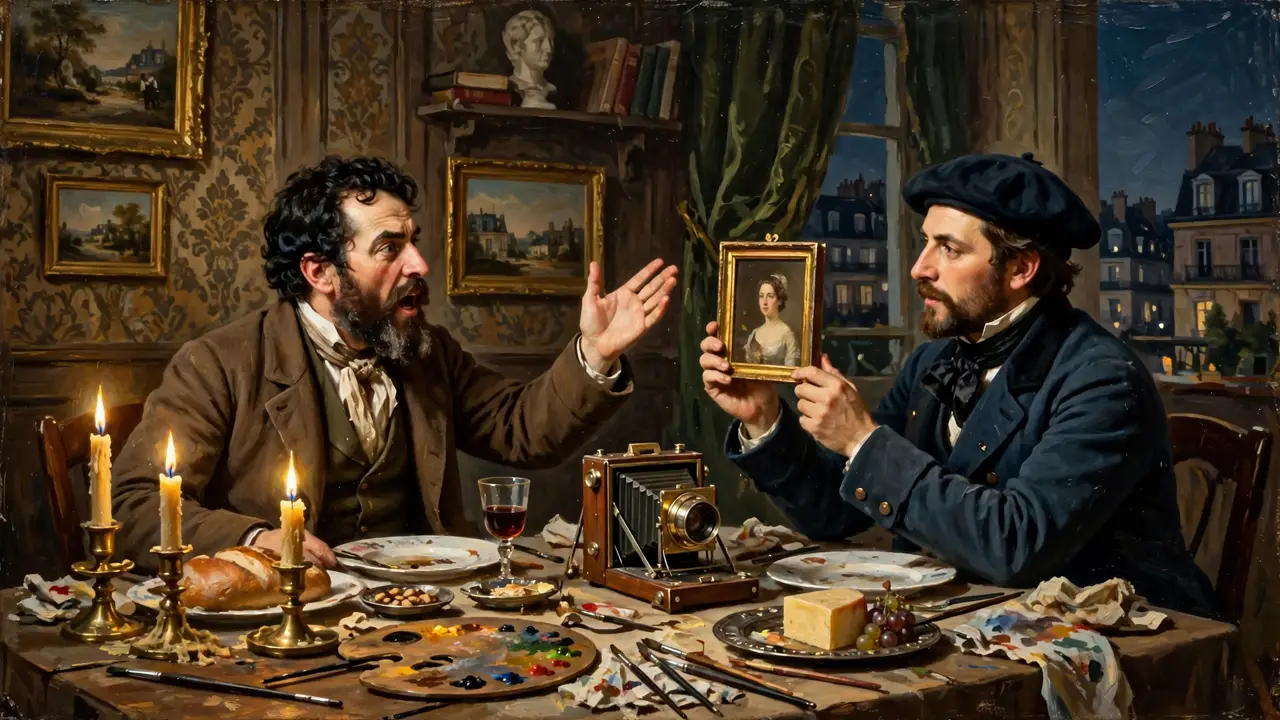
The post arrived on r/singularity just after lunch on Thursday: a 90-second film with no studio, no actors, and no camera. By the evening it had drawn nearly 400 upvotes and more than 120 comments, and the thread's most repeated sentiment was disbelief. “It's hard to believe this is an AI,” wrote one commenter. Another, in the thread's most-upvoted reply: “That's it. I can no longer tell AI video from the real thing.”
The film is the work of Reddit user u/iFilmNedit, made with Seedance 2.5, ByteDance's video model. It is set in Paris in 1860, where two painters sit down to dinner and spend the evening complaining about photography — the terrible new technology that has just, in the film's framing, “canceled her portrait.” The joke is deliberate: a film about artists fearing a new machine, made entirely by a new machine. But what the thread kept coming back to was not the premise. It was the dialogue.
What the film is#
The short runs 1 minute 29 seconds and plays as a single dinner scene: two painters, a candlelit table, and a conversation that carries the whole film. The filmmaker says he has made AI films before, but only visuals with voiceover — this was his first real attempt at dialogue, and he posted it explicitly to test how far AI acting and dialogue can go. His ask to the thread was direct: tell me honestly what still feels artificial.
That framing matters, because the film's subject is itself a test of the same question. In 1860, photography was the disruptive technology, and portrait painters were the workers watching their commissions disappear. The film stages that anxiety as a dinner-table argument, then lets the audience sit with the parallel: the people watching an AI film about artists fearing a machine are themselves deciding whether a machine's acting is good enough.
Why the dialogue matters#
Dialogue has been the stubborn giveaway in AI video. For the past two years, generated clips have looked increasingly convincing while sounding wrong — voices laid over the picture afterwards, lip movements drifting from the words, performances that read as narration rather than conversation. Filmmakers worked around it with voiceover, music, or silence. Seedance 2.5 is built to close that gap: it generates dialogue, music, and sound effects in the same pass as the picture, with speech timed to the characters' lip movements, in clips of up to 30 seconds.
That is what the thread is actually reacting to. The praise in the top comments is not about the premise or the period detail, though both get their due. It is about the performances: “the facial expressions are convincing and fit the context really well,” wrote one commenter, and the most-upvoted reaction called the result “genuinely impressive,” adding that “in a few months it will be literally impossible to tell.” The 90-second film is assembled from several of those 30-second generations, and nothing in the thread suggests the seams show.
The verdict from the thread#
The consensus is real, but it is not unanimous — and the dissent is the interesting part. “This is really well done. Still can tell its ai, but the direction is far above what 99 percent of people are doing,” wrote one of the thread's higher-voted commenters. Nobody in the top comments challenged whether the film is AI at all; the disagreement is over how close to undetectable it already is, and what that means.
Two comments cut in opposite directions. One joked that “the only thing AI films are ever about is the idea of AI films” — a fair observation about a genre that keeps making its own making its subject. Another pushed back on the film's message rather than its craft, calling the underlying argument about technology and art unconvincing. Both are worth more than the praise, because they point at where AI film still has to grow: not rendering faces, but having something to say that is not about rendering faces.
There are also questions the thread asked that have no answer yet. One commenter asked whether the story and dialogue were the filmmaker's own work or AI-generated as well; another asked whether he used the API or a subscription, how long the film took, and what it cost. Neither question had an answer in the thread when we read it. The filmmaker's own top comment does link a making-of tutorial for anyone who wants to see the process, which is the closest thing to an answer the thread has so far.
What to watch#
The film is one data point, not a verdict on the state of AI video — but it is a data point in a fast-moving sequence. In September, we covered a 10-minute AI sci-fi short made with Seedance that had Reddit talking for similar reasons, and this week alone the site has carried a Claude-directed animation film and an AI-made film about programmers. Dialogue was the missing piece in all of them; this is the first one where the talking, rather than the pictures, is the point.
What to watch now is how quickly the remaining tells disappear, and whether filmmakers start using the tool for stories that are not about the tool. The filmmaker asked the thread what still feels artificial, and the thread's honest answer was: less and less, every month. The harder question — the one the film itself poses, in 1860 dress — is what painters, and filmmakers, do when the machine stops being a novelty and starts being the competition.
Sources: r/singularity, “My first AI film with real dialogue (Seedance 2.5)” (u/iFilmNedit, November 26, 2026); Making-of tutorial linked by the filmmaker (YouTube); ComfyUI documentation, “Seedance 2.5 — AI video generation with audio” (ByteDance); AI Frontier Post, “One person, no studio, $500: the 10-minute AI sci-fi short that has Reddit talking” (September 26, 2026)