Nvidia, AMD, Intel, Google and Meta unite behind the SGLang Consortium to steer open-source AI inference
Eight companies that normally compete for the same AI workloads agreed this week to share a roadmap. LMSYS Org, the nonprofit behind the open-source inference engine SGLang, launched the SGLang Consortium on November 12, with Nvidia, AMD, Intel, Google, Meta, Cloudflare, Modal and RadixArk as founding members.
- The launch: LMSYS Org announced the consortium in the opening keynote of the inaugural SGLang Summit, held November 12–13 at the Fort Mason Center for Arts & Culture in San Francisco, with more than 100 speakers.
- The members: Nvidia, AMD, Intel, Google, Meta, Cloudflare, Modal and RadixArk — a cross-section of chipmakers, cloud operators and inference users.
- The job: Five focus areas: frontier model support, reasoning workloads, multimodal inference, distributed serving and hardware optimization.
- The structure: Each founding member names a technical representative and joins two roadmap meetings a year; working groups collaborate between meetings, with public updates on direction and progress. Maintainers keep responsibility for technical decisions and code acceptance.
- The scale: LMSYS says SGLang runs on hundreds of thousands of GPUs and powers production inference for Meta, Microsoft, Google, Amazon, Thinking Machines Lab, Cloudflare, Reflection and Modal — the project’s own figures, not an independent census.
- The context: Deloitte estimates inference will account for roughly two-thirds of all AI compute in 2026, up from about half in 2025.
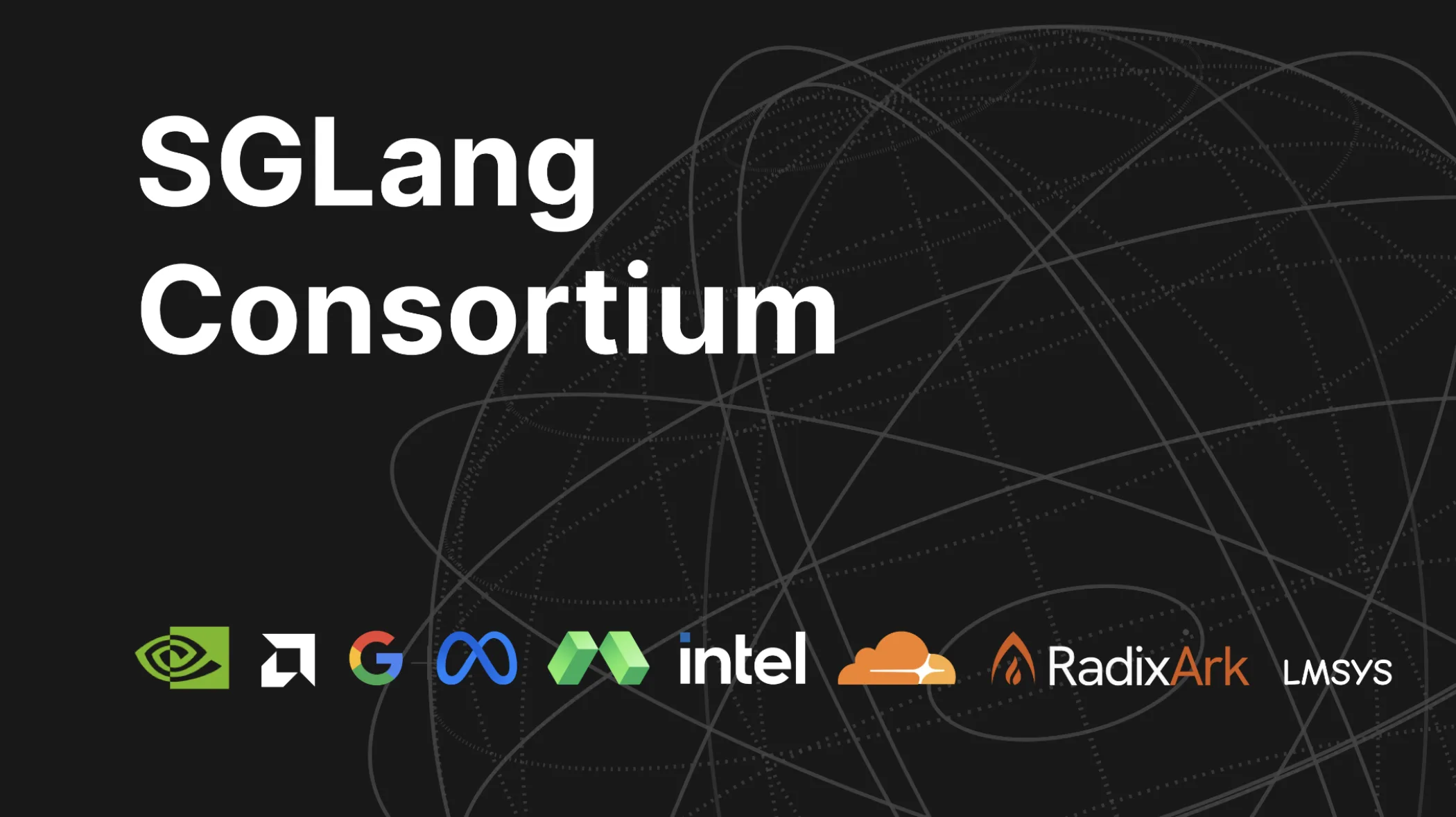
Eight companies that normally compete for the same AI workloads agreed this week to share a roadmap. LMSYS Org, the nonprofit behind the open-source inference engine SGLang, launched the SGLang Consortium on November 12, with Nvidia, AMD, Intel, Google, Meta, Cloudflare, Modal and RadixArk as founding members. The announcement came in the opening keynote of the first SGLang Summit, held November 12–13 at the Fort Mason Center for Arts & Culture in San Francisco.
The consortium itself ships no software — it is a governance body, not a product. But the bet behind it is concrete: the software that decides how fast and cheaply AI models answer is becoming as strategically important as the chips it runs on, and even direct rivals gain more from steering that software together than from pulling it apart.
What the consortium actually is#
SGLang is a full-stack inference engine for frontier AI models and part of the PyTorch ecosystem — the layer that sits between a model and the hardware serving it, deciding how efficiently each request runs. The consortium gives its members a standing forum to discuss emerging inference trends with SGLang’s maintainers and turn shared priorities into joint engineering work, across five focus areas: frontier model support, reasoning workloads, multimodal inference, distributed serving and hardware optimization.
Each founding member names a technical representative and joins two roadmap meetings a year, contributing engineering expertise, deployment feedback, testing resources or joint development. Working groups can collaborate between meetings, and LMSYS says it will publish updates on the roadmap’s direction and progress.
The governance design is the part worth reading closely. This is explicitly not a handover of the project to its corporate backers: the announcement stresses that SGLang’s maintainers keep final responsibility for technical decisions and code acceptance, and that the project stays open to the entire community. That matters because the members are also the project’s biggest users — and, in several cases, direct competitors. The consortium buys them a say in the roadmap, not a vote over the code.

Why inference, why now#
Training gets the headlines and the capital spending, but serving is where the bill lands. LMSYS cites a Deloitte estimate that inference will account for roughly two-thirds of all AI compute in 2026, up from about half in 2025. As models move from one-off training runs to answering billions of requests a day, the engine that serves them determines the cost of every answer.
SGLang’s own scale claims explain why eight giants want a seat at the table. LMSYS says the engine runs on hundreds of thousands of GPUs and powers some of the largest production inference deployments in the world, for companies including Meta, Microsoft, Google, Amazon, Thinking Machines Lab, Cloudflare, Reflection and Modal. Those are the project’s own figures, not an independent census — but the member list itself is the corroboration: the companies running the largest serving fleets just signed up to shape the tool they run.
The pitch from the project’s side is that the teams operating SGLang at the largest scale see what inference needs next before anyone else does — and that with new data centers hard to build, squeezing more out of existing hardware through software matters more than ever. Nvidia’s case is blunter: better serving software gets more performance out of its chips, and lower inference costs make AI affordable to more organizations. AMD’s is the open-hardware version of the same argument: an open engine that runs across hardware, including its own Instinct GPUs, is worth investing in.
The hardware angle#
The member list is the story. Nvidia, AMD and Intel are direct accelerator rivals; Google builds its own TPUs; Meta runs inference at enormous scale; Cloudflare and Modal serve models to customers; RadixArk is the commercial company behind SGLang’s development. SGLang already runs across Nvidia GPUs, AMD Instinct accelerators, Intel Xeon processors, Google TPUs, Huawei Ascend chips and Moore Threads hardware — the consortium is a bet that one serving stack can stay neutral across all of them.
Two concrete things landed alongside the announcement. Intel and RadixArk said they will optimize SGLang for Intel CPUs, GPUs and accelerators, including support for Intel’s Advanced Matrix Extensions. And SGLang-Neuron v0.1.0, co-developed by RadixArk and AWS Annapurna Labs, entered public preview, bringing the serving stack to AWS Trainium through a native PyTorch plugin. The team also announced a version 1.0 milestone, citing more than 330 adopting organizations and day-zero support for 217 models.
What to watch#
Governance announcements are cheap; the test is merged code. Watch for public cross-vendor benchmarks, reproducible performance gains on non-Nvidia hardware, and the SGLang 1.0 release itself — the announcement cites the milestone but no date.
Also watch the tension built into the design: eight large companies with their own hardware agendas, meeting twice a year, while the maintainers keep the final say. If the consortium produces shared engineering, serving gets cheaper everywhere. If it becomes a talking shop, SGLang’s roadmap stays where it already was — in the hands of its maintainers. Either way, the signal is clear: inference is where AI’s economics are now decided, and eight rivals just agreed to decide them together.
Sources: LMSYS Org, “LMSYS Org Launches SGLang Consortium…” (November 12, 2026); Bitcoin Versus, “NVIDIA, AMD, Intel and Google Join SGLang Consortium…” (November 15, 2026); Xenospectrum, “SGLang Consortium Launches With NVIDIA, AMD, Intel, Google and Four Other Members” (November 13, 2026). Scale and adoption figures are LMSYS’s own claims; the Deloitte estimate is cited by LMSYS.