TAU's teleoperated cleaning robot fumbles a dumpster lid — and the thread's verdict is the story
An 83-second clip of a TAU cleaning robot wrestling a dumpster lid drew 546 upvotes on r/singularity. The robot is not the story — the human driving it is.
- The post: u/Distinct-Question-16 on r/singularity, Saturday, November 14, 2026, 6:55 p.m. EST; 546 upvotes and 211 comments by about 6:10 p.m. EST on November 15; flair “Meme”; a video-only post with no body text.
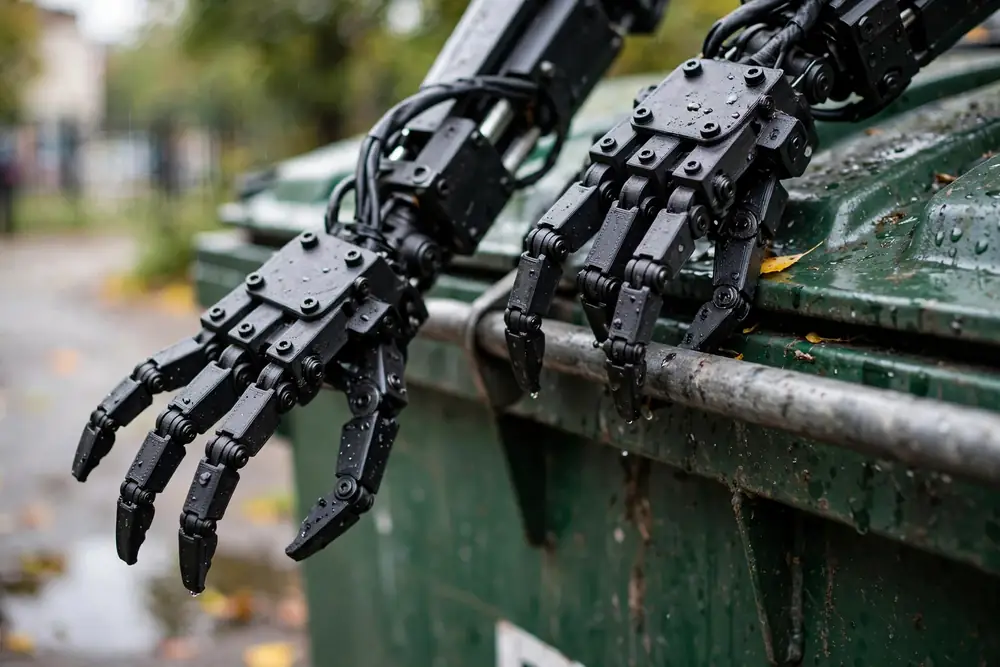
- The video: 1 minute 23 seconds, Reddit-hosted; a humanoid robot outdoors fumbling with dumpster lids with its claw hands, captioned with the on-screen text “AND YOU KNOW I’LL BE AROUND.”
- The correction: the robot is teleoperated — a human operator drives it in real time. The top comment (202 upvotes) notes “there’s a human at the wheel doing the best they can.”
- The company: Tau Robotics of San Francisco sends pairs of humanoid robots into homes to clean. Its terms of service state: “The robot is not autonomous. A person is controlling it.”
- The price: launched at $30 per robot-hour in July 2026; the standard rate is now $50 per humanoid per hour, $30 on a weekly subscription.
- The context: the poster says his city removed the foot pedals from large dumpsters, so the lids are hard to open by hand — for people as well as robots.

A humanoid robot in a black uniform spent 83 seconds wrestling with a dumpster lid — and the internet spent the next day arguing about what the clip actually shows. The video, posted to r/singularity on Saturday evening by u/Distinct-Question-16, shows a TAU cleaning robot outdoors beside a row of large bins, fumbling with the lids with its claw hands while on-screen text reads “AND YOU KNOW I’LL BE AROUND.” By Sunday evening it had 546 upvotes and 211 comments — and the thread had already decided the robot’s struggle was the least interesting thing about it.
The post itself says almost nothing: it is a video-only post, no body text, no links. The one piece of context comes from the poster, who wrote in the comments that his city recently removed the foot pedals that open the big dumpster lids without hands — “So i see often the elderly/small/disabled running into trouble.” In a reply, he added that he believes the pedals were removed because people swung the lids past 90 degrees and left them permanently open. The robot, in other words, was fighting a lid that gives humans trouble too.
What the 83 seconds show#
The clip is 1 minute 23 seconds of a small humanoid robot — a modified Unitree machine in a black TAU uniform, by the look of it — working the lids of a row of green dumpsters. Its hands are simple 3D-printed claws, built for wiping counters and folding laundry, not for hauling steel lids. It pries, slips, and re-grips, captioned with a lyric about doing someone else’s dirty work. The most upvoted joke landed within minutes: “Origin story,” wrote u/billFoldDog, above a Futurama clip of Clamps, the clamp-handed robot. Another commenter narrated the scene in the robot’s voice: “Now that I have finished smearing trash on my hand modules, let me make a nutritious breakfast for the family!” The humor is doing real work here: it is the thread noticing, before any analysis, that the hands are the wrong tool for the job.
The thread’s verdict: that’s not the robot failing#
The top comment, with 202 upvotes, cut straight to the point. “Who decided a domestic service robot should have the mode [sic] useless hands imaginable? And this is with teleoperation so there’s a human at the wheel doing the best they can,” wrote u/MysteriousPepper8908. That is the correction that reframes the whole clip: the fumbling is not an AI failure. A person is driving the robot in real time, and the person is doing their best with hands that were never designed for dumpster lids.
Several commenters admitted they had watched it the other way first. “The human-operated part is disappointing. When I first watched it I thought, ‘Wow, this is showing signs of continual learning,’” wrote u/SammaVaco. Others went darker: “Teleoperated cleaning bot might be the most dystopian thing I’ve heard of in a long time,” wrote u/chi_guy8, at 63 upvotes. “There’s a human being controlling that thing and getting paid a dollar per week? Jfc this is a dark timeline,” added u/im_bi_strapping. And u/SeriousGains, at 48 upvotes: “I’m so glad this is teleoperated, I was beginning to feel bad for the bot. Ironic I know.”
The counter-argument, also well upvoted, is that this is how the robots learn. “The teleoperation thing is really just training so that it can eventually learn to do these things itself,” wrote u/shakebakelizard. u/CckSkker made the same point: “this is the first generation of these things we’re seeing. As soon as they’ve worked out the issues and gathered enough training data they don’t need the teleoperation anymore and these will be everywhere.” The skeptical reply came from u/Magmatt7: you pay for a robot that is slower and less reliable than a human worker, then pay a human to drive it — “and then it’s just a cherry on top that everything this robot sees and do is recorded for future data training, so you get additional free of charge surveillance bonus!”
What TAU actually is#
The company behind the robot is Tau Robotics, a San Francisco startup that sends pairs of humanoid robots into people’s homes to dust, wipe, vacuum, mop and clean bathrooms. The service launched in late July as an invite-only pilot at $30 per robot-hour, according to The Register and ABC7 San Francisco. The robots are built on Unitree hardware — Tau builds the cameras, grippers and onboard computer in-house — and each machine costs about $50,000 to make, CBS reported. They stand about four and a half feet tall, wear little black TAU uniforms, and have names like Chelsea and Elon.
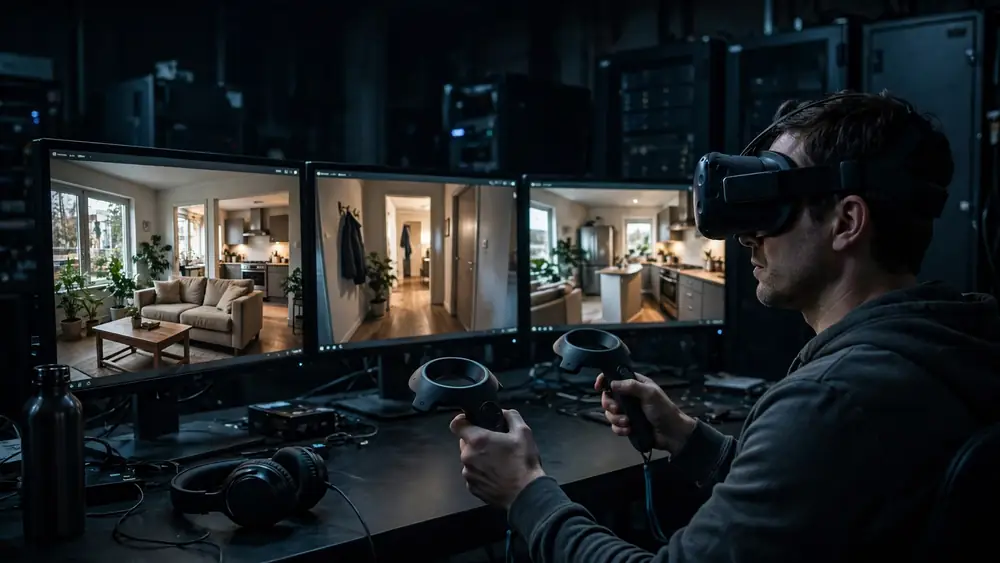
Tau is unusually upfront about the arrangement. Its terms of service state it plainly: “The robot is not autonomous. A person is controlling it.” Trained operators — background-checked W-2 employees working on-site at Tau’s San Francisco facility — steer each robot in real time, wearing VR goggles to see through the robot’s eyes, with AI assisting. Every clean is recorded: head and wrist cameras plus depth data for the whole visit, kept to train the models Tau hopes will one day do the job alone. “There is no version of this service without recording,” the terms say.
The price has climbed since launch. Tau’s terms now list a standard rate of $50 per humanoid per hour, with two robots per visit, while a weekly subscription brings it back to $30 per robot-hour — $60 for a one-hour visit. MarketWatch’s Christine Ji, who booked the service in October, reported the fleet had logged roughly 160 paid robot hours across nearly 100 sessions. CEO and co-founder Alex Koch has said he hopes to phase out operators around 2028 or 2029, and the company says it aims for 1,000 cleans a week in San Francisco by 2027. The same reporting carries the caveat: UC Berkeley robotics professor Ken Goldberg told ABC7 he thinks “it is too early,” and warned that demo videos can be sped up or staged.
That tension — a service sold as robot cleaning, delivered by remote humans, priced to harvest training data — is the same bet the rest of the humanoid industry is making in different forms. NVIDIA’s GR00T 2, for example, learns dexterous skills from 100,000 hours of human video rather than from teleoperated demonstrations, because human video is vastly cheaper to collect. Tau’s version of the same idea puts the robot in the customer’s home and lets the customer subsidize the data collection.
What to watch#
Three things to watch. First, whether Tau publishes an autonomy rate — what share of a cleaning, if any, now runs without a teleoperator. The company has not said. Second, whether the price keeps climbing as the novelty wears off: the standard rate has already risen from $30 to $50 per robot-hour since July. And third, whether the dumpster clip becomes a pattern — more outdoor footage of the robots struggling with the physical world, and more threads deciding, in real time, whether what they are watching is a robot failing or a person doing their best with the wrong hands.
For now the record is an 83-second clip, a lid that would not open, and a comment section that worked out the real story faster than the robot worked out the lid: the human was always the point. The robot is the body. The driver is the product. The footage is the training set.
Sources: the original post by u/Distinct-Question-16 on r/singularity; GadgetKing, “Tau Robotics Humanoid Cleaning Robots Have a Human Driver” (November 4, 2026); cobesa, “Tau Robotics prices robot cleanings to gather training data” (October 19, 2026, updated November 7), sourced from MarketWatch’s Christine Ji with additional reporting from Reuters, CBS News and ABC7 San Francisco. Vote and comment counts were read from the Reddit post page around 6:10 p.m. EST on November 15, 2026. The post has no body text; the dumpster context comes from the poster’s comments in the thread. The “160 paid robot hours” figure is as reported from MarketWatch’s visit.