Tavus Griffin passes the video Turing test: 48% mistook it for a real person
Tavus unveiled Griffin, its first “Human Interaction Model,” on October 1 — and in blind tests, nearly half the people who video-called it walked away believing they had spoken to a human. Reddit's verdict: impressive numbers, but the demo cuts are doing a lot of work.

Here is the claim: you spend one minute on a video call with Tavus's new model Griffin, and there is nearly a coin-flip chance you hang up convinced you just talked to a person. In a blind study, 48% of 54 participants believed they were speaking with a real human after a sixty-second call. Tavus's own previous stack managed 2.4%.
The announcement landed on October 1 and shot to the top of r/singularity within hours — 466 upvotes and 136 comments in three hours, one of the fastest-moving AI threads of the day. But the top comments did what top comments do: they reached for the scalpel. “An awful lot of cuts in that video,” one noted. Another: the YouTube demos of people actually using it “are not as impressive.” So what exactly did Tavus demonstrate, what did it measure, and what still needs independent confirmation?
Watch the demo#
The numbers#
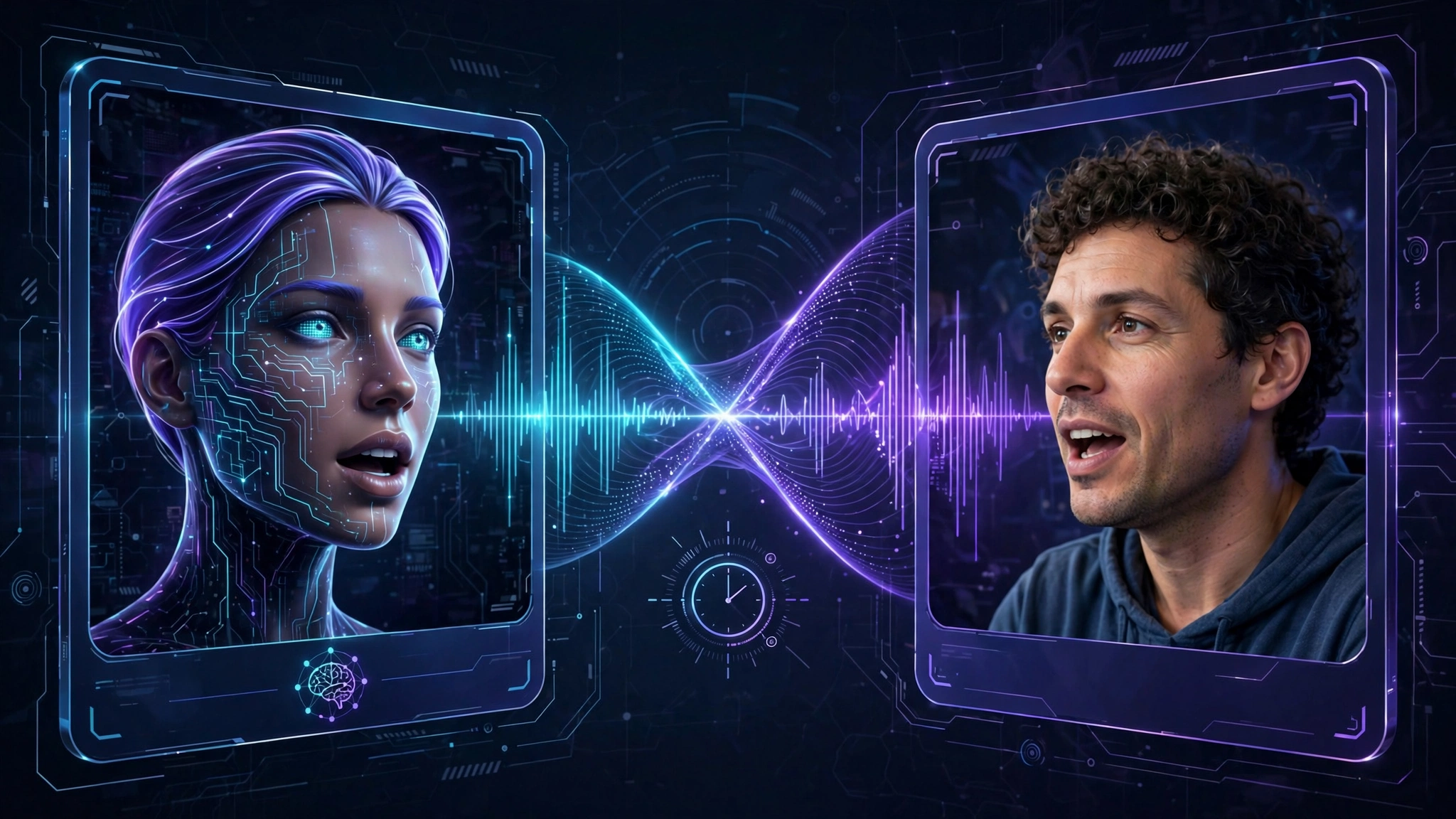
Griffin is a full-duplex, video-to-video model — both sides can talk, interrupt, nod, and overlap the way people do in a normal conversation, instead of taking turns like a walkie-talkie. Tavus calls it the first “Human Interaction Model” (HIM): a single architecture that perceives, decides when and how to respond, and generates speech and video simultaneously. Previously the company chained separate systems together — Phoenix for rendering, Raven for perception, Sparrow for speech — and Griffin folds them into one.
The Turing-test result comes from a live study: each of the 54 participants spent one minute on a video call with a Griffin-powered system. Twenty-six of them walked away believing they had spoken to a genuine human. With the older stack, 1 of 41 (2.4%) did. Participants also rated Griffin 5.4 out of 7 for seeming natural and 5.6 for seeming trustworthy.
The second leg of the claim is stronger because it is not Tavus grading its own homework. On NVIDIA's VideoFDB benchmark for full-duplex conversational AI — scored in September, before launch — Griffin ranked first on both tracks out of 15 models:
| System | Generation | Perception |
|---|---|---|
| Human reference | 3.92 | — |
| Tavus Griffin | 3.83 | 3.73 |
| Gemini 2.5 + Anam | 2.80 | — |
| MiniCPM-o 4.5 | — | 3.44 |
| Gemini 2.5 Flash | — | 3.17 |
| OpenAI gpt-realtime | — | 2.97 |
On generation, Griffin at 3.83 sits a hair below the 3.92 human reference and 37% above the next-best published system. On perception, it beat MiniCPM-o 4.5 (3.44), Gemini 2.5 Flash (3.17), and OpenAI's gpt-realtime (2.97). Tavus also claims the best real-time reaction metrics — responding to interruptions, laughter, and people entering the room — though that figure comes from the company's own evaluation.
Who built it, and who gets it#
The launch was led by co-founder and CEO Hassaan Raza and Head of Research Ioannis Patras. Tavus, founded in 2020 in San Francisco, started in personalized AI sales videos and has spent the last two years pushing into live conversational personas; it has raised roughly $64 million.
For now, access is tightly gated. A Griffin-Lite research preview is going out to selected testers, and Tavus says the fuller version arrives after it addresses safety measures. Named use cases so far: tutoring, practicing difficult conversations, and camera-based tech support — all domains where a face that listens helps.
What the internet is actually arguing about#
The r/singularity thread was not a coronation. The most-upvoted skeptical comments made three distinct points worth carrying into any reading of the announcement:
- The demo is edited. The launch video has conspicuous cuts, and commenters who tracked down raw usage footage on YouTube found it less convincing than the highlight reel. That is the eternal rule of AI demos: judge the uncut calls, not the trailer.
- The study is small and Tavus-run. Fifty-four participants, one minute each, one research preview. It is suggestive, not definitive. The NVIDIA benchmark — independent, comparative, pre-launch — is the load-bearing evidence, and it holds up.
- The scam question is real. Several top comments flagged the predatory uses: a video agent that half of callers mistake for a person is a social engineer's dream. Tavus gating the release behind safety measures is the right call, and the industry should hold them to whatever those measures turn out to be.
There is also an honest definitional caveat: “passing the video Turing test” is Tavus's framing. The study measured whether strangers, in a one-minute call, thought the system was human — a fair operational definition, but not the same as sustained deception over a long conversation.
What to watch#
The next milestones are all about independence: an independent replication of the blind study, public numbers from the Griffin-Lite preview testers, and details on the safety measures before the full release. Also worth watching: pricing and availability, how the inevitable open-source clones compare, and whether regulators start asking harder questions about real-time synthetic video agents as they approach indistinguishability. Forty-eight percent is not a majority. It is close enough to matter.
Sources
- Business Wire — “Tavus Introduces Griffin, the First Face-to-Face Human Interaction Model” (October 1, 2026)
- THE DECODER — “Nearly half of test subjects mistook Tavus' AI video avatar for a real person on a one-minute call” (October 1, 2026)
- Dealroom — “Tavus launches Griffin, a real-time video model that passed a video Turing test” (October 1, 2026)
- Crypto Briefing — “Tavus unveils Griffin, claiming the first video Turing test pass” (October 1, 2026)
- r/singularity — “Griffin, the first Human Interaction Model to pass video Turing Test” (October 1, 2026)