Thinking Machines releases Inkling 2 Mini: a 26B looped model that runs on your laptop
Thinking Machines Lab’s Inkling 2 Mini reuses its middle layers three times per token to punch above its weight: 26.4B parameters, a 20GB footprint, and agentic coding scores that lead every open-weights model under 100B — and it runs on a MacBook, offline, in airplane mode.
- The loop: 24 layers in four blocks; the two middle blocks run three times per token, giving 48 layer applications from 24 stored layers.
- Size: 26.4B total parameters, 3.4B active per token, ~20GB footprint; trained natively in NVFP4, last four layers in MXFP8.
- Scores: DeepSWE v1.1 48.2%, Vals Index v2.2 46.5%, SWE-bench Pro v2 Hard 77.9%, SWE-bench Verified 79.2% — best in class under 100B, per the lab.
- Runs on: Ollama on any Mac with 32GB+ RAM, DGX Spark, SGLang, vLLM, Unsloth and llama.cpp GGUF; Apache 2.0 weights on Hugging Face.
- Limits: behind Qwen3.8-27B on multi-turn chat and constrained instructions; looping adds reasoning depth, not stored facts.

Thinking Machines Lab released Inkling 2 Mini today, a 26.4-billion-parameter open-weights model built to run on a laptop. Instead of chasing scale, the lab took a different route: the model reuses the middle of its own network, running those layers three times for every token it generates. The result, according to the lab, leads every open-weights model under 100 billion total parameters on agentic coding benchmarks — and the whole thing fits in about 20GB.
The release landed on Hugging Face under an Apache 2.0 license this afternoon, and the local-model community moved fast: r/LocalLLaMA had a thread up within the hour that quickly climbed past 250 upvotes, and Unsloth shipped GGUF quants the same day. For a lab whose previous model, the 594-billion-parameter Inkling 2 Small, needs a data center, the Mini is a deliberate turn toward the other end of the spectrum: serious agentic work on hardware people actually own.
The trick: loop the middle, don't widen the model#
Inkling 2 Mini is a 24-layer mixture-of-experts transformer, split into four blocks of six layers. The first and last blocks run once per token; the two middle blocks run three times. That gives 48 layer applications per token from just 24 stored layers, with the middle blocks sharing weights across their three passes. Each pass starts from the output of the opening block, and the second and third passes also read the middle blocks' output from the previous pass — a signal the lab calls "the message."
The choice of which layers to loop was measured, not guessed: looping the middle 12 layers beat looping the last 12 on 27 of 28 evaluations the lab ran. Only 3.4 billion parameters are active per token — 5.4 billion weight activations once the repeated passes are counted — and each token is routed to 8 of 128 experts per layer. The model started training with 384 experts per layer; midway through, the lab pruned two-thirds of them, keeping the 128 most used in each layer, then trained on another trillion tokens distilled from a larger internal Inkling model. Supervised fine-tuning was followed by reinforcement learning totalling 2.2 trillion tokens over 2,000 steps.
The loop is a trade the lab quantifies honestly. A non-looped version of the same model cost 7.5% less compute to train — but needed 140% more inference compute to match the looped version's loss on 512k-token agentic traces. Looping costs a little up front and pays for itself every time the model runs.
The scores: best in its weight class#
The lab's headline claim is that Inkling 2 Mini leads every open-weights model with under 100 billion total parameters on benchmarks such as DeepSWE v1.1 and the Vals Index. The scores it publishes put it ahead of comparable models — Gemma 4 31B, Qwen3.8-27B, Nemotron 3.5 Super VL and Muse Glimmer are the table's comparators — on agentic coding in particular:
| Benchmark | Inkling 2 Mini |
|---|---|
| DeepSWE v1.1 | 48.2% |
| Vals Index v2.2 | 46.5% |
| SWE-bench Pro v2 (Hard) | 77.9% |
| SWE-bench Verified | 79.2% |
| SWE-bench Multilingual | 73.7% |
| Terminal Bench v2.1 | 71.6% |
| Vibe Code Bench v1.1 | 77.9% |
| BrowseComp | 79.0% |
| DeepSearchQA | 85.3% |
| MCP Atlas | 82.7% |
| AA Index v5.0 | 20.1 |
The lab is careful to say it is behind only Qwen3.8-27B on some benchmarks, not all of them — and the table bears that out. These are the lab's own numbers from its own harnesses, so independent verification still matters. But the pattern is consistent: the model's edge is in long-horizon agentic work — coding, tool use, multi-step research — rather than raw knowledge.

Small enough for a laptop, literally#
The size is the point. Most of the weights were trained and deployed natively in 4-bit NVFP4 precision, with the last four layers in 8-bit MXFP8 — and because the model ships in the same precision it was trained in, there is no accuracy lost to post-training quantization. The total footprint is about 20GB. At launch, Ollama runs it on any Mac with at least 32GB of RAM; it also runs on Nvidia's DGX Spark desktop AI computer, and open inference is available through SGLang, vLLM, Unsloth, Nvidia Dynamo and TokenSpeed, with quantized GGUF versions via Unsloth and llama.cpp. Hugging Face's launch notes list a context window of up to 1M tokens.
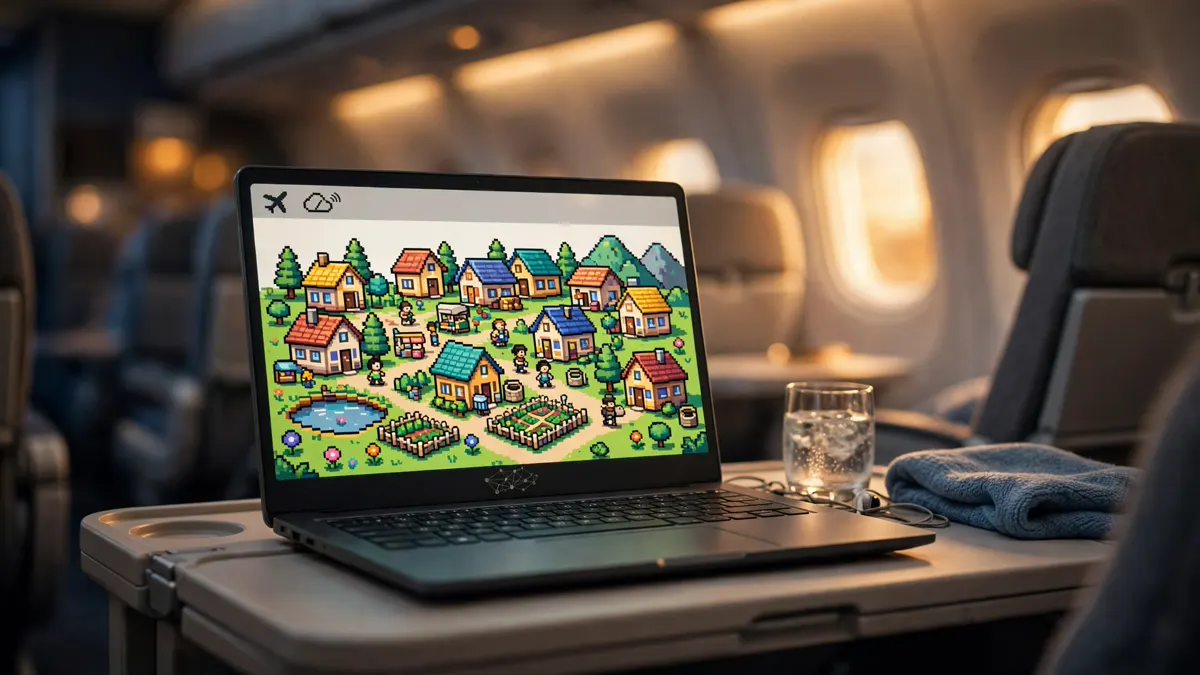
The lab's demos lean into the portability. Its researchers took the model on a flight, where it ran offline on a MacBook Pro with an M5 Pro chip and 48GB of memory and built a playable flight simulator in a few minutes. In another demo, a tiny pixel town called Thinkyville — all 20 residents planning their days, gossiping and hosting bake-offs — is managed by a single copy of the model running on one offline MacBook. And in a Stanford study of intelligence per watt on local hardware, Inkling 2 Mini scored 0.703 running on a DGX Spark, against 0.430 for Qwen3.6-35B-A3B, 0.159 for Gemma-4-26B-A4B and 0.036 for Qwen3.5-27B.
Where it falls short#
The lab is unusually direct about the model's limits. It is not the strongest small model for multi-turn chat or for instructions with many constraints: it scores 50.0% on MultiChallenge and 33.4% on ComplexConstraints v1.1, behind Qwen3.8-27B on both. It also trails larger models on reasoning-heavy benchmarks such as CritPt v2 and HLE-Diamond.
There is a structural reason for that. Looping adds reasoning depth, not stored facts — the lab says knowledge-intensive benchmarks do not improve with more passes, and its score on AA-Omniscience, a factuality measure, is in line with other models of the same size. A looped 26-billion-parameter model still knows what a 26-billion-parameter model knows; it just thinks harder about it.
What to watch#
The full weights are on Hugging Face now, alongside a variable-loop research model — TML-d24-varloop-research — trained with between one and five looping passes, which the lab is releasing so researchers can study how the loop count itself changes behavior. Inference and fine-tuning are available on the lab's Tinker platform, with chat on the Tinker Playground, and RL fine-tuning support on SkyRL, Miles and Nvidia AutoModel.
Three things to watch from here. First, independent evaluations: Hugging Face already calls the model state-of-the-art in its class on the Artificial Analysis Intelligence Index, but the lab's own benchmark table needs outside confirmation. Second, whether the loop trick spreads — if reusing layers beats adding them, other labs building small models will notice. And third, the bigger signal: the frontier of "small" keeps moving. A 20GB model that does long-horizon agentic work changes who can run a serious coding agent locally — from a data center to a laptop on a plane.
Sources: Thinking Machines Lab, 'Introducing Inkling 2 Mini,' November 20, 2026; Hugging Face model card, thinkingmachines/Inkling-2-Mini (release date November 20, 2026; Apache 2.0); Hugging Face, 'Welcome Inkling 2 Mini,' November 20, 2026; r/LocalLLaMA release thread, November 20, 2026.