The viral Topview AI demo: a teddy-bear hug re-skinned as a battlefield rescue — Reddit checks the seams
A 19-second demo turned a cozy clip of a man hugging a teddy bear into a cinematic battlefield rescue — keeping the exact same motion. The top comments corroborate the trick, then start listing the glitches.


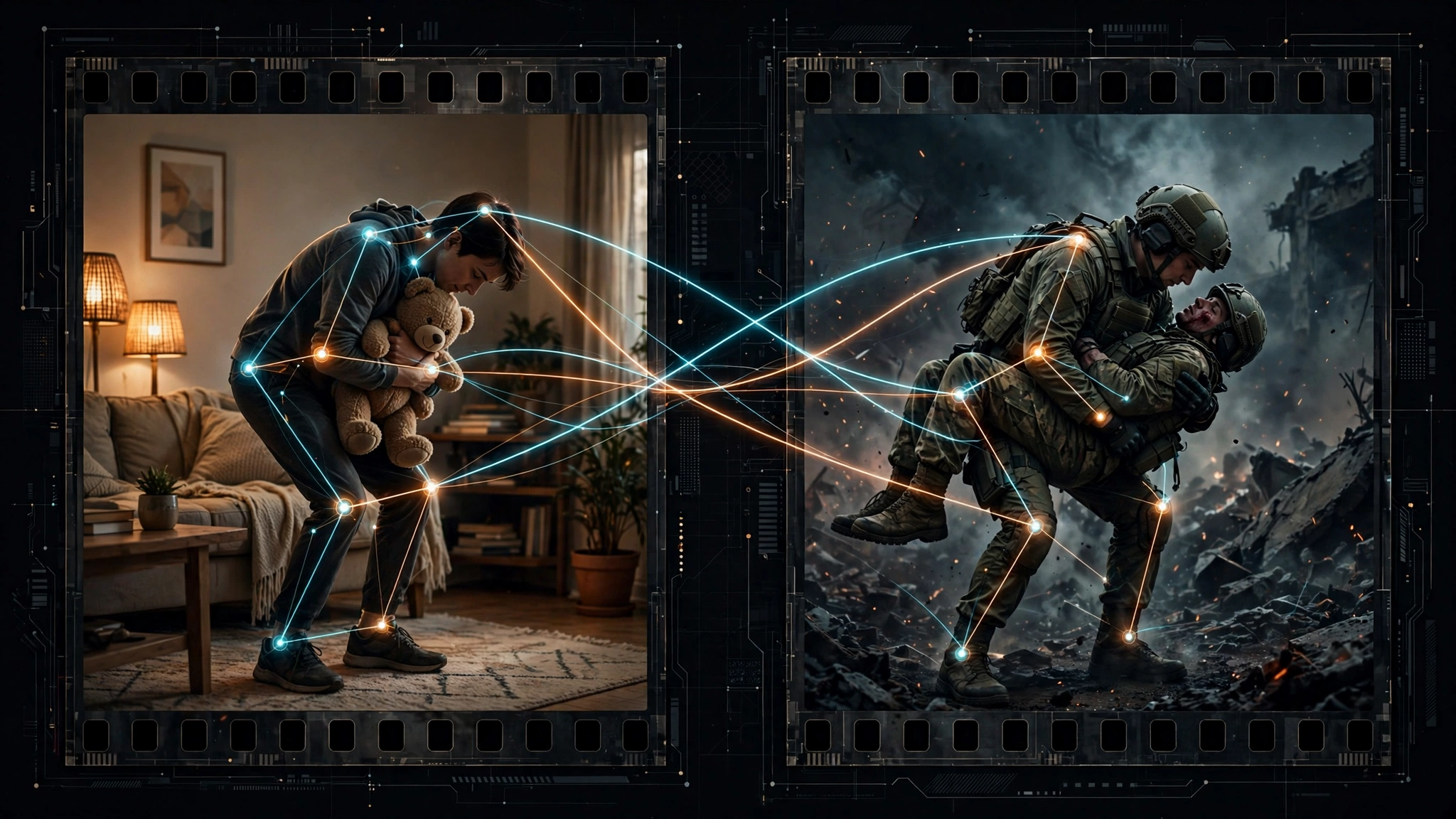
The most-shared AI video on Reddit this Sunday morning is nineteen seconds long and tells two stories at once: a man hugs a teddy bear; a soldier drags a comrade out of a burning street. The trick is that they are the same nineteen seconds. A Topview AI demo re-skins the cozy clip into a battlefield rescue without changing the performance — the lean, the reach, the shift of weight stay identical while every pixel of context is replaced.
Posted to r/accelerate at 6:07 AM EDT by u/stealthispost — a repost crediting Topview AI's own account as the original — the clip had gathered roughly 690 upvotes and 60 comments by early afternoon. Fast, concentrated traction for a Sunday. What makes the thread worth reading isn't the demo's polish but the comment section's audit: nobody disputes that the trick works, but the top comments immediately start listing the glitches.
The clip — and the claim#
The video runs 0:19, hosted natively on Reddit, with no narration and almost no text of its own — the post's title carries the pitch: a man hugging a teddy bear becomes a soldier saving his friend, “without changing the performance.” Watch it once and the claim reads as true: the soldier's lunge and drag map onto the cuddle's choreography with uncanny precision.
Topview, for context, is an agent-driven video creation platform whose stated pitch is exactly this kind of operation. Its site says the system can study a reference video's pacing, shot structure, hook, motion, framing, and visual tone, then rebuild it around a new story, product, or character. The demo is the company showing its homework: a motion-preserving re-skin, posted from its own account and reposted to Reddit under the #TopviewAI tag.
It is worth being precise about what the clip does not prove: that the transformation is fully automatic, how many takes or touch-ups were involved, or how it holds up across a two-minute scene instead of nineteen seconds. The post presents a result, not a method.
What the top comments caught#
The thread's most useful reply reframes the whole thing: both clips are AI-generated. The cozy “original” is synthetic too — so the demo is AI re-skinning AI, not AI re-skinning camera footage. Another commenter noted the source clip shows the teddy bear doing the dragging, which quietly confirms the same point: there is no camera original anywhere in this pipeline.
Then came the artifact audit. Commenters catalogued the tells: a gun that vanishes between frames, a hand that renders wrong, an earring that doesn't match its pair. None of it debunks the core claim — the motion preservation is real enough that the thread treats it as established — but it punctures the “without changing” framing. The performance survives; the props don't.
The pattern is becoming familiar from this weekend's AI threads: the audience no longer asks whether a viral clip is AI. It assumes it is, and grades the craft. The debate has moved from authenticity to execution — a harder test for the tools, and a more interesting one for everyone else.
Why motion, not pixels, is the new frontier#
The reason this nineteen-second clip outperformed most of the weekend's AI posts is that it demonstrates the capability the video world actually needs next. Generating a pretty clip from a prompt is a solved demo. Taking existing footage — an actor's performance, a director's blocking, a stunt's choreography — and re-skinning it into a new scene without re-shooting is a production tool. That is the difference between a toy and a pipeline, and it is why “without changing the performance” is doing the persuasive work in the title. (For where the broader field stands, see our comparison of the leading AI video generators.)
It is also an increasingly crowded race. AI video platforms have spent 2026 layering on exactly this: reference-driven generation, motion transfer, style-preserving edits. Topview's own numbers suggest serious scale — the company announced a $14 million Series A extension in February and says more than 5 million users generate hundreds of thousands of videos a day. The Reddit thread is a useful stress test of that pitch: the trick works, the artifacts are visible, and the audience is already fluent enough to spot both at once.
What to watch#
The clip will be forgotten by Tuesday; the questions it raises won't. Three to follow:
- Whether motion-preserving edits hold up at length. Nineteen seconds is a demo; a two-minute scene with dialogue, camera moves, and continuity is a product.
- The artifact floor. Vanishing props are today's tells; the interesting question is how long they survive as the models iterate.
- Who ships it first as a boring tool. The winner here isn't the flashiest demo — it's the version a working editor trusts inside a real pipeline.
Keep the performance, swap the world. That capability is about to become unremarkable — which is precisely when it starts to matter.
Sources
- “We Turned a Man Hugging a Teddy Bear Into a Soldier Saving His Friend—Without Changing the Performance #TopviewAI...” — u/stealthispost, r/accelerate (Reddit, September 27, 2026)
- Topview AI — official site; FAQ: “Can Topview recreate a reference video style?”
- “Introducing Topview 4.0: The First Collaborative All-in-One AI Content Workspace for Brands and Creators” — WebWire (February 9, 2026)