ETH Zurich teaches a 5-ton John Deere skid-steer to balance on two wheels — straight from simulation to the real machine
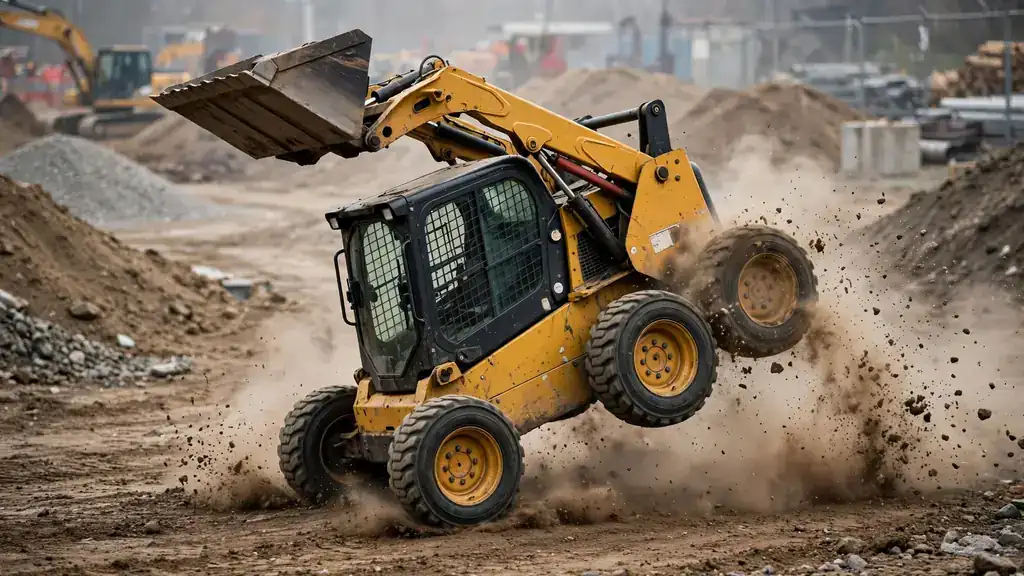
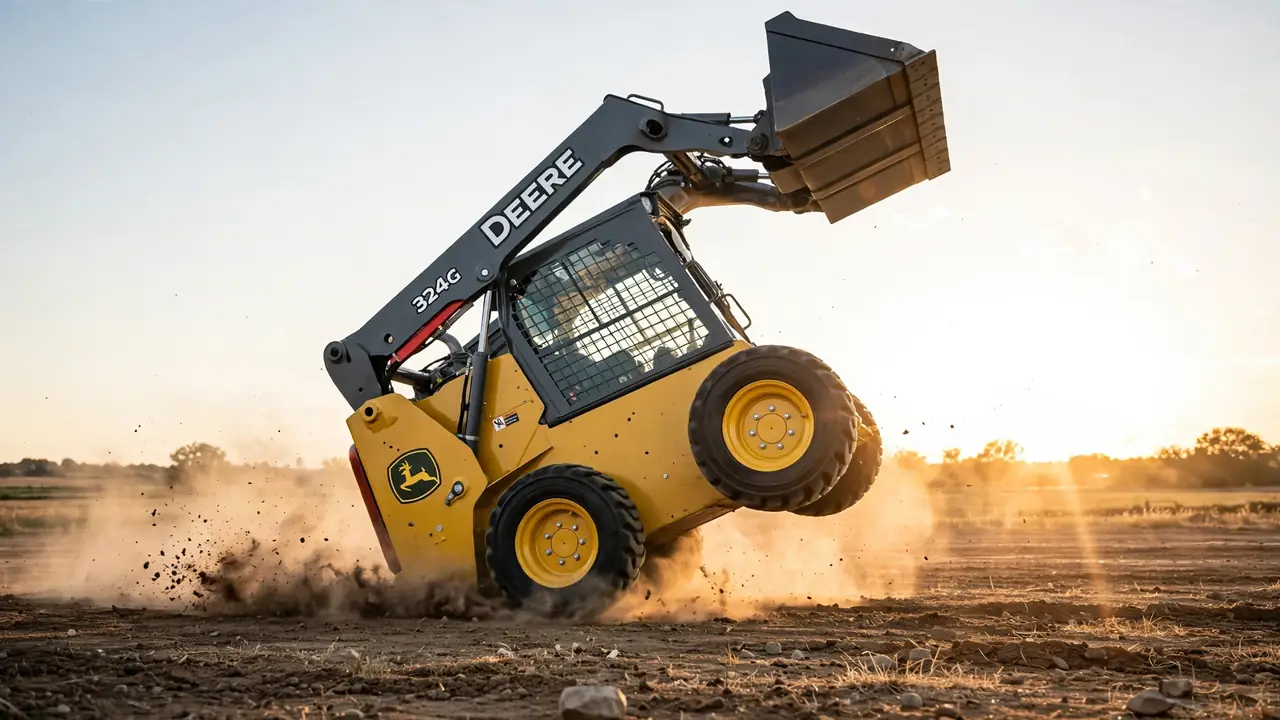
It lasts 69 seconds, has no narration, and the soundtrack is a pop song. A yellow John Deere loader rocks back and forth on a grass field to build momentum, then lifts its rear wheels off the ground and balances on its front two — bucket raised, five tons of steel swaying on two tires — before driving over a dirt mound and landing back on all fours. Posted to r/singularity in the small hours of Wednesday morning, the clip passed 400 upvotes within five hours.
- The post: r/singularity, Wednesday November 18, 1:32 a.m. EST; a 69-second Reddit-hosted video. More than 400 upvotes and 60 comments within five hours.
- The machine: a John Deere 332G skid-steer loader, about five tonnes — not a wheel loader, despite the post's title.
- The paper: "Heavy Metal Acrobatics: Learning Dynamic Control for Skid-Steer Loaders", arXiv:2611.18365, published in Science Robotics on November 11, 2026. Lead author Pierre-Jean Lorentz, ETH Zurich Robotic Systems Lab, with collaborators from Intel.
- The method: reinforcement learning trained in simulation on a dynamics model built from about 90 minutes of real operating data; four skills — lift, balance, move, land — trained separately, then combined and deployed to the real machine with no further training.
- The numbers: the loader lifted onto two wheels in 11 of 11 trials at one bucket angle and 12 of 12 at another, and crossed a 75 cm mound while balancing — using only onboard tilt and wheel-speed sensors, no cameras or lidar.
The clip is fun. The paper behind it is serious, and it arrived a week before the video did. On November 11, Science Robotics published the ETH Zurich team's work on teaching a five-tonne skid-steer loader acrobatic maneuvers with reinforcement learning; the arXiv version went up on November 13. The Reddit post that carried the footage to a general audience landed in the small hours of Wednesday — and by breakfast it was one of the most upvoted posts on r/singularity, with commenters alternating between awe, jokes about construction sites turning into stunt shows, and the exact technical corrections you would hope for.
What the video actually shows#
Sixty-nine seconds, no narration, music over the top. The loader — a John Deere 332G, an operational five-tonne skid-steer — rocks back and forth to build momentum, swings up onto its two front wheels, and holds the balance while it drives over rough ground, spins in place, and swings its bucket before setting itself back down on all four wheels. The Reddit title's other details check out against the paper: the machine does cross a 75 cm mound while balanced, and the policies were transferred from simulation to the real machine without further training.
Two small corrections to the post's framing are worth making. First, the machine is a skid-steer loader, not a wheel loader — different machine classes, and the paper is explicit that the test vehicle is a 332G skid-steer. Second, the "tiny" in the title is doing a lot of work: five tonnes is small for construction equipment and enormous for a stunt vehicle. That size is part of the point — the paper notes these maneuvers had previously only been pulled off by a small number of elite human operators in official world-record performances.
How it learned the trick#
The hard part of automating a machine like this is not the idea — it is the hydraulics. Fluid-driven joints, flexible elements and nonlinear delays make a skid-steer's dynamics difficult to model, and the machine is heavy enough that trial-and-error learning on the real thing would be dangerous. So the team, led by Pierre-Jean Lorentz at ETH Zurich's Robotic Systems Lab with collaborators from Intel, did the learning where failure is free.
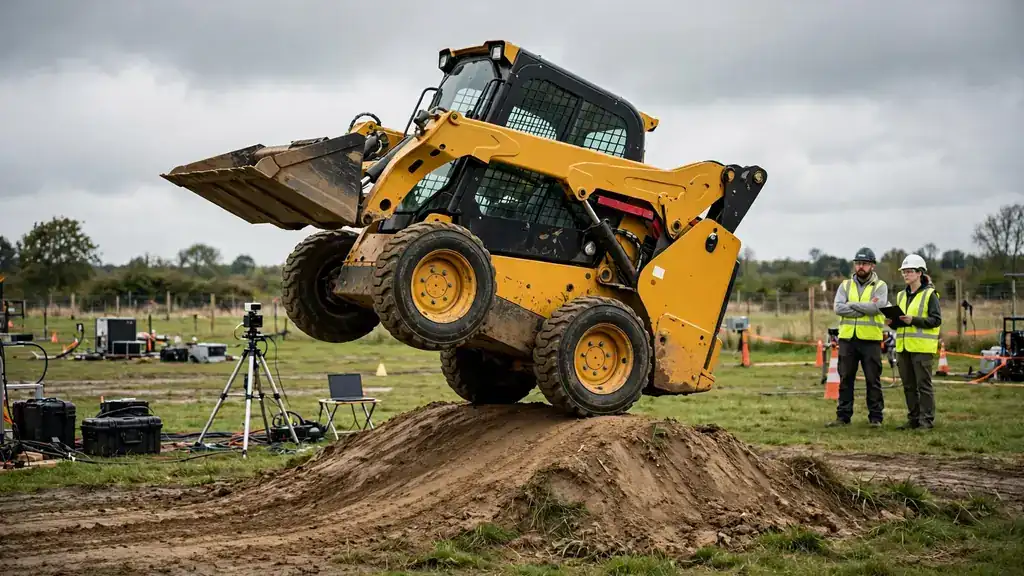
They collected about 90 minutes of operating data from the real loader and used it to build a neural-network model of how the machine responds to control inputs, then trained reinforcement-learning policies against that simulated machine — randomizing the center of mass, inertia and sensor error along the way so the policy could not overfit to one perfect virtual loader. Four skills were trained separately — lifting onto two wheels, balancing, moving while balanced, and landing — then combined and deployed to the physical machine. The transfer worked: in repeated real-machine trials, the loader lifted onto two wheels in 11 of 11 attempts at one bucket angle and 12 of 12 at another, and stayed balanced while crossing uneven ground that included a 75 cm mound. At a bucket angle outside the training range, it still succeeded in 11 of 14 trials.
One detail deserves emphasis, because it is the part that makes the result general rather than a party trick: the machine did all of this using only onboard sensor data — tilt and wheel speed — with no cameras or lidar mapping the terrain. The policy does not see the mound coming. It feels it.
What Reddit got right — and wrong#
The top comment thread did the fact-checking before most readers finished the video. One commenter joked that large language models might solve self-driving before the car industry does; the replies corrected the premise within minutes — this is reinforcement learning, the authors note, not a language model, and the architectures have little in common beyond the words "machine learning". Another commenter asked for the paper, which is how the thread found its way to the arXiv listing. The community verdict, in short: impressed, amused, and unusually precise about what the video does and does not show.
The skeptics had their say too, and the best objection is a fair one: a commenter argued that classical control theory could have produced the same maneuvers, and that a wheelie is not the job a loader is bought to do. The counter, also in the thread, is that the stunt is not the product — the product is a control policy that learned, from simulation alone, to push a five-ton hydraulic machine to the edge of its actuation and bring it back safely. Whether that capability ends up moving dirt more efficiently is a separate question, and the paper does not claim otherwise. A few commenters worried aloud about jobs, and the most-liked reply to that worry is the practical one: operating heavy equipment is about adapting to unpredictable, busy sites, not about sick tricks.
Why a wheelie matters#
Construction, mining and material handling run on machines whose dynamics are hostile to automation: heavy, hydraulic, and dangerous to experiment with. The ETH Zurich result matters because it shows that a simulation-trained policy can handle those dynamics on the real machine, at the limits of what the hardware can do, without a human demonstration to copy — the team trained the maneuvers without any demonstration data from a human stunt driver. That is the same sim-to-real pattern behind the recent wave of whole-body robot control, applied to a machine class that had been largely left out of it. The wheelie is the stress test. The transfer is the result.
It is also, to be honest, a very good video. The original poster, asked in the comments why anyone would teach a loader to do this, answered with a reaction GIF and the caption "It gets the people going!" — which is, as far as research communication goes, a defensible theory of change.
What to watch#
Three things will tell us whether this is a curiosity or a capability. First, whether the same sim-to-real recipe extends from stunts to the dull, useful end of the job — grading, loading, and precise repetitive work on real sites, where success is measured in hours saved rather than applause. Second, whether other labs reproduce the transfer on different machines: the paper's approach is built on a dynamics model of one loader, and the test will be how much of the recipe carries over. And third, whether the project page's videos — linked from the arXiv listing — draw the same scrutiny the Reddit thread applied, because the gap between a 69-second highlight and a full trial log is exactly where robotics claims usually get tested.
Sources: r/singularity (November 18, 2026); arXiv:2611.18365 (submitted November 13, 2026); Science Robotics (November 11, 2026); Iron Time News (November 16, 2026); Donga Science (November 2026).