Opus 5.5 built an infinite, self-evolving Backrooms — and Reddit is arguing over whether it feels like the Backrooms at all
A Reddit creator gave Claude Opus 5.5 one standing order — keep building this world — and the result is a browser game that grows new yellow rooms on its own. The 100-second tour passed 800 upvotes overnight, and then the top comment asked the awkward question: is it actually the Backrooms?
- The clip: a Reddit-hosted video, 1 minute 40 seconds, posted to r/ClaudeAI on November 7 by u/aCakeShip — 803 upvotes and 112 comments by Sunday midday, and still climbing.
- The game: a browser game at dimension9.space where Opus 5.5 builds new rooms in a loop on fal. The creator seeded 15 rooms by hand and now only reviews each new batch.
- The build: 70 rooms so far, multiplayer with proximity chat for up to 200 players per world — about 1,200 at peak — on three.js, Cloudflare Durable Objects and R2.
- The debate: the top comment (93 upvotes) says the Backrooms are about emptiness and the mundane, not spectacle. The creator says he deliberately avoided copying the Backrooms look.
- The bugs: players report a broken discoveries counter, heavy lag and desync far from spawn, and browser tabs using nearly 4GB of RAM. The creator has acknowledged the counter bug and is working on VR and a hunter-free mode.
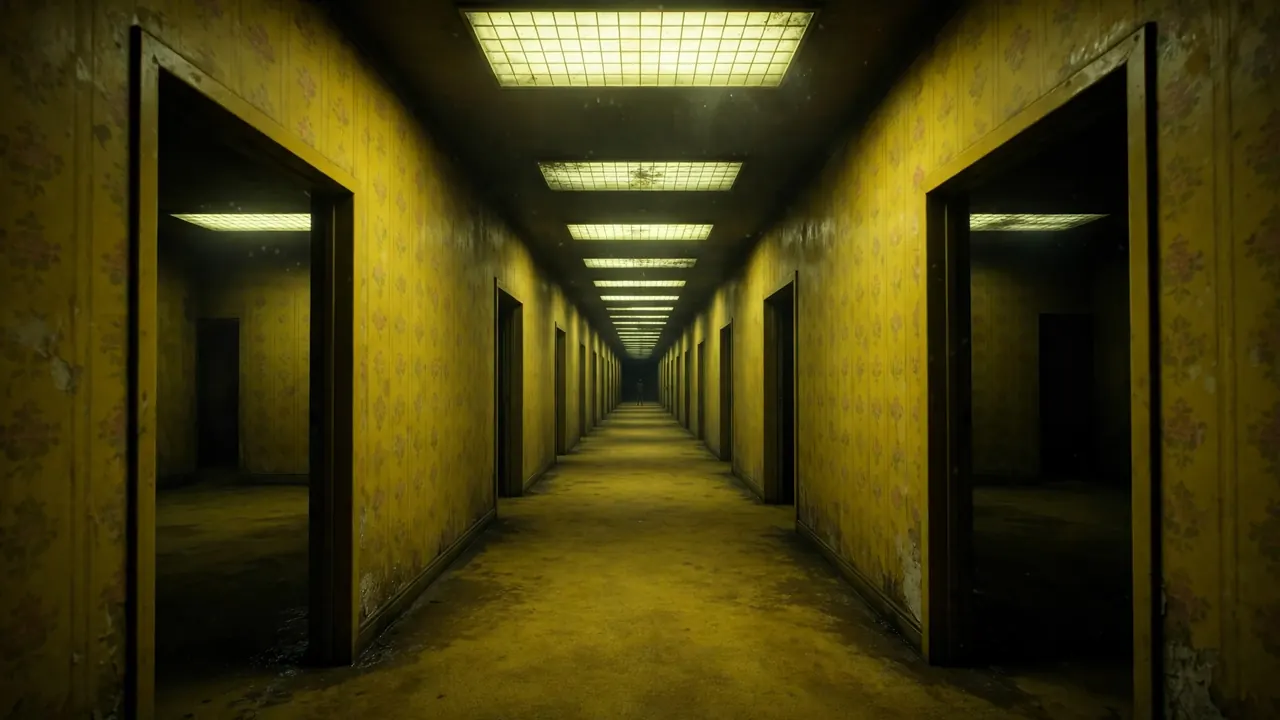
On Saturday night, r/ClaudeAI got a world that builds itself. A video posted by u/aCakeShip shows a first-person walk through endless yellow rooms — a carousel spinning in the dark, a chapel full of seated astronauts, a vast cylindrical atrium — all part of a browser game the poster says is still growing, because the model building it has not been told to stop. By Sunday midday the post had passed 800 upvotes and 112 comments. The idea landed immediately. So did the objection.
The game lives at dimension9.space, playable in the browser, with multiplayer and proximity chat built in from the start. The creator gave Claude Opus 5.5 a single standing instruction: keep building this world. New rooms, characters and creatures keep appearing, and by his own account, even he no longer knows what it will make next.
What the video actually shows#
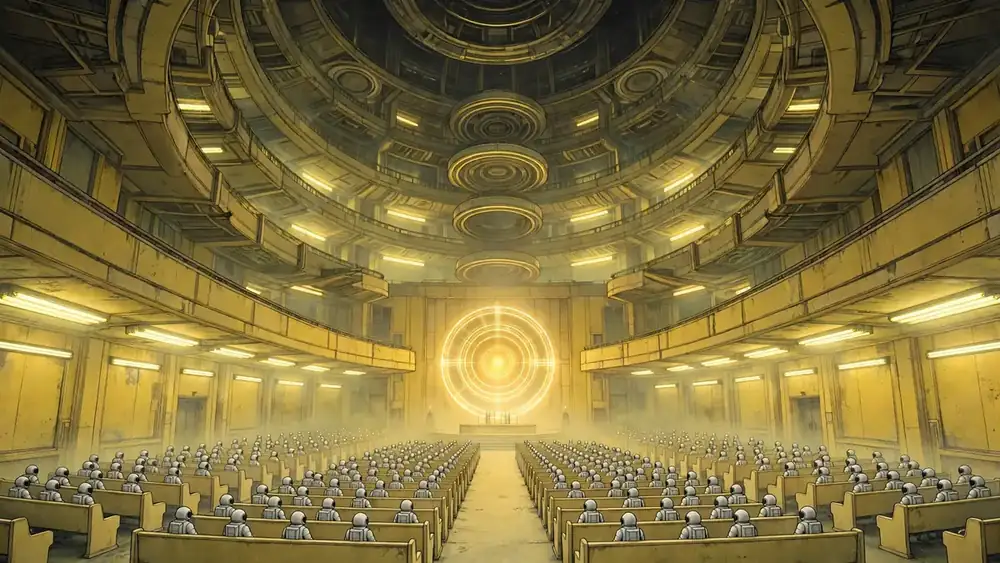
The clip runs 1 minute 40 seconds, silent, with no narration and no on-screen text beyond the game itself. It opens in a yellow room with a railing, a white chair and dark figures hanging from the ceiling like a carousel, then moves through a chapel-like hall filled with rows of astronaut figures seated in pews facing a glowing circular emblem, and ends looking up into a cylindrical atrium of concentric yellow rings studded with small glowing windows. It is a montage, not a playthrough — a highlight reel of the strangest places the world has produced so far.
The tour is the pitch. The game itself is the product: a shared world you walk through with other people, where the rooms around you were, in the creator’s telling, designed by a model working from a brief rather than by a level designer placing every wall.
How the world builds itself#
The process, as the creator describes it, starts with 15 rooms he built by hand, to his own taste. From those he distilled the world’s “DNA”: what makes a room feel liminal, the rules every room has to follow, the lore it has to tie back to, and a taste profile that learns from every note he gives it. Then the building runs without him. A serverless app on fal runs Opus 5.5 in a loop — it reads the DNA, reads where players go and what they linger on, and constructs the next room: the layout, the light and sound, the characters who live there, the things that hunt you, the writing hidden on the walls. fal’s image and 3D models supply the concept art and props; the model writes the code, tests it, and hands over a finished room for review. The creator’s job is now review: he walks the new rooms on a studio page and leaves notes like “stranger”, “too empty” or “more dread”, and the taste profile updates for the next batch.
What the loop has made so far: 70 rooms, including a carousel spinning in the dark, an aquarium, a night bus, a courtroom and a rooftop over a city that isn’t there. There are hunters — things that chase you, each with a tell and a way out — and residents, harmless uncanny things that just live there. Paintings can be taken off the wall and turned over to read what someone wrote on the back. Flooded corridors thread through the map, and a logbook of lore fragments slowly tells one story. An arcade with 150 cabinets, a mansion, a garden and a mini golf course are, per the creator, being built right now.
Under the hood it is three.js, an infinite level generated from fixed rules, multiplayer on Cloudflare Durable Objects (up to 200 players per world, about 1,200 at once at peak, per the creator), with every model and sound served from Cloudflare R2. The 3D props come from Tripo and Meshy 7.1, named by the creator in the comments when asked.
The Backrooms test#
The thread’s most-liked comment is a polite dissent, and it is the comment the whole thread ended up arguing about. u/Robot_Apocalypse, at 93 upvotes, writes that the Backrooms were strange in a familiar, unsettling way — empty and boring and mundane, which is what made them unsettling — and that this world has only the colour yellow and the occasional office ceiling in common with that. “There’s just too much stuff going on,” the comment reads; it feels “packed with interesting stuff, like an amusement park full of stuff to look at.” Others piled on in the same direction: the Backrooms are “way more about the lack of something than too much of something”; the ceilings are too high and too regular, and the clipped objects, nonsensical architecture and impossibly narrow hallways are missing.
The creator’s answer is that the gap is deliberate. He says he did not want to outright copy the Backrooms look, and wanted to explore what an infinite world could be rather than reproduce the source material as closely as possible. It is a fair defence of the game as a game — and it concedes the critic’s point about the vibe. One commenter summed up the split neatly: this is Backrooms-looking liminal space, and liminal space and the Backrooms have become two different branches of the same internet by now.
The distinction matters because the Backrooms are communal lore, not a franchise with a style guide. The original image — yellow wallpaper, humming fluorescent lights, damp carpet — became a genre precisely because it was almost nothing. A world that keeps adding a night bus, a courtroom and a carousel is doing something else: spectacle with a yellow filter. Whether that something else is better or worse is a matter of taste; whether it is the Backrooms is a matter of definition, and the thread spent the night on the definition.
What players found when they played#
Not everyone came to argue about genre. One player called the walk “soothing” — no objective, just wandering down stairs to a long hallway where a woman sang a lullaby as he walked away. That is the other side of the design: a world with hunters in it can still be a pleasant place to drift through, and the thread’s wishlist is full of people who want more of that and less of the chasing. An anxious player asked for a way to turn the hunters off; the creator said he is working on VR and on toggles, though a shared world may need private servers before a hunter-free wander is possible.
The bug reports are specific, and the creator has answered most of them. The discoveries counter is broken — it showed 89 of 44 found — and he has said he will fix it. One player who ran far from spawn reported heavy lag, repeated entities and events desyncing between friends, so that one person was being chased while the other saw nothing. Another reported a browser tab climbing to nearly 4GB of RAM and asked him to check for memory leaks. Footsteps need a volume slider. A malicious-site warning briefly appeared for one visitor; the creator said he would investigate, and the same visitor later reported it fixed.
Two of the sharper questions got honest, hedged answers. Asked how he checks that the evolving taste profile actually improves each batch rather than just changing it, the creator said he reviews batches of 20 rooms at a time and expects them to keep getting better — but conceded it “could also just run out of ideas”. Asked why the game is not on Steam, he said it only launched the night before and needs more polish, and that Steam’s 30% revenue cut is part of the calculation.
Why it matters#
Dimension 9 is the latest in a run of Reddit demos where the model is the builder, not the chatbot. A 4B model fetched a netherite ingot in Minecraft from a single sentence; Claude Sonnet built a six-year-old’s unicorn game in under a month. This one pushes the pattern further: the model is not executing a brief and stopping, but running a loop that never closes, with a human reduced to the role of taste — reviewing batches, leaving short notes, watching the world drift away from his original 15 rooms.
That is also the honest limit of the “infinite” and “self-evolving” claims. The world expands endlessly; it does not, as one commenter noted, rebuild its existing rooms or change how they connect. The evolution is additive, and the taste profile is a human’s notes fed back into a prompt. It is a real pipeline, and an impressive one — 70 rooms, a thousand players, a living game — but the self in self-evolving still has a person attached to it, reviewing 20 rooms at a time.
What to watch#
Three things will decide whether this stays a viral weekend or becomes a durable game: the performance fixes — the lag, the desync and the memory use that players flagged on day one; the VR mode and hunter-free toggles the creator promised in the thread; and whether the taste profile keeps producing variety or starts repeating itself, which even the creator admits is an open question. A Steam release, when it comes, will be the moment the project has to survive outside the subreddit that made it.
Until then, the fair description stands: a yellow world that never stops adding rooms, a model with a standing order to keep building, and a thread arguing — politely, and mostly correctly — about what to call it.
Sources: the original post by u/aCakeShip on r/ClaudeAI; the game at dimension9.space. Room counts, player counts and technical claims are the creator’s own statements in the post and comments, and commenter claims are reported as thread claims, not independently verified. The images are AI-generated editorial illustrations, not screenshots of the game.