NVIDIA GR00T 2: a robot brain that learns dexterous skills from 100,000 hours of human video
NVIDIA unveiled GR00T 2 on Monday, November 9, at the Conference on Robot Learning in Austin, Texas — an open ‘world action model’ that teaches robots dexterous skills by watching humans do them. Trained on robot data and 100,000 hours of first-person human video, it completed 40 of 50 tasks it had never seen with no task-specific demonstrations, and hit 95% average success once it had watched five.
What we checked: NVIDIA’s November 9 blog post from CoRL (published 14:00 UTC), cross-checked against The Robot Report’s same-day coverage and NVIDIA’s GR00T 2 research page as reported by MLQ.
- What: GR00T 2, NVIDIA’s open frontier world action model for humanoid robots, built on Cosmos.
- When: introduced November 9, 2026, at the Conference on Robot Learning (CoRL) in Austin, Texas.
- Training data: robot data plus human video, including 100,000 hours of NVIDIA open-source first-person (egocentric) video; the full pretraining mix ran to 402,730 hours of human video.
- Performance: 40 of 50 unseen tasks completed at least once with no task-specific demonstrations (40% average success); 71% with one demo per task; 95% with five.
- Simulation: Isaac Lab 3.0 with the Newton physics engine trains vision-based dexterous manipulation models up to 2.5x faster than Isaac Lab 2.3 with PhysX.
- Speed and availability: the GR00T 2 Turbo variant uses a 2-billion-parameter transformer and runs a prediction in 124 milliseconds on NVIDIA’s Jetson Thor robot computer; code is listed as “Available in December” on NVIDIA’s research page, with no weight release date or license stated.
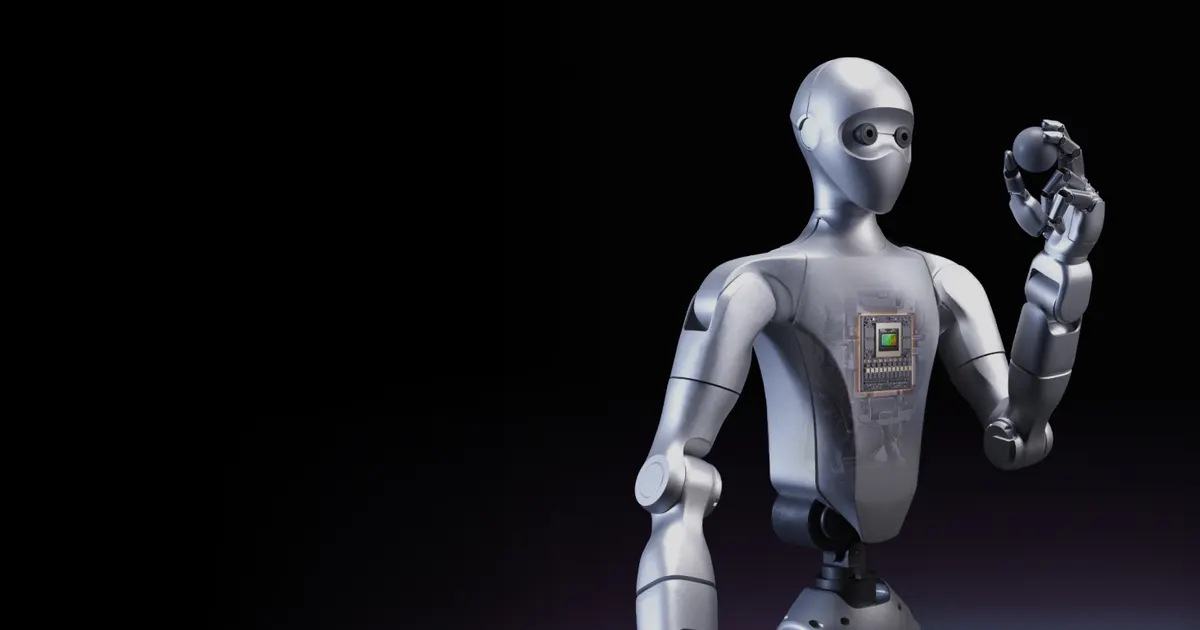
The fastest way to teach a robot a new skill used to be to drive it yourself — hours of teleoperation, one demonstration at a time. NVIDIA's GR00T 2, unveiled on November 9 at the Conference on Robot Learning (CoRL) in Austin, Texas, flips that: it learns by watching humans. The model completed 40 of 50 tasks it had never seen with no task-specific demonstrations at all, and reached 95% average success after just five.
Three ways to teach a robot#
GR00T 2 is the third generation of NVIDIA's robot foundation models, and the gap between generations is the story. Here is how the approaches compare:
| Approach | What it is | Learns from | A new skill costs… |
|---|---|---|---|
| GR00T 2 (Nov 9, 2026) | Open world action model built on NVIDIA Cosmos | Human video plus robot data — including 100,000 hours of open first-person video | Zero demos: 40 of 50 tasks; 1 demo: 71% success; 5 demos: 95% |
| GR00T N1 (Mar 2025) | Open-weight dual-system vision-language-action model, 2B parameters | Robot teleoperation data | Robot demonstrations for each new skill |
| Teleop-only imitation learning (the old way) | A narrow policy trained per task | Hours of teleoperated robot demonstrations | A fresh demo set for every skill — slow, expensive data collection |
GR00T 2: watch a human, do the job#
A world action model does two things at once: it predicts what the robot's camera will see next, and the actions to take. GR00T 2 reads recent video, a plain-language instruction and the robot's state, then generates a short chunk of future video and motor commands in a single diffusion transformer. The trick is the training diet — robot data plus human video, including 100,000 hours of NVIDIA's open-source first-person footage.
The numbers NVIDIA reported at CoRL are its own, and they are the reason the launch matters. On 50 tasks the model had never seen, it averaged 40% success with no demonstrations and completed 40 of them at least once. One demonstration per task lifted average success to 71%; five took it to 95%. Per NVIDIA's research page, the full pretraining mix ran to 402,730 hours of first-person human video, and adding all of it raised real-robot task progress from 50% to 70% across 72 tasks.
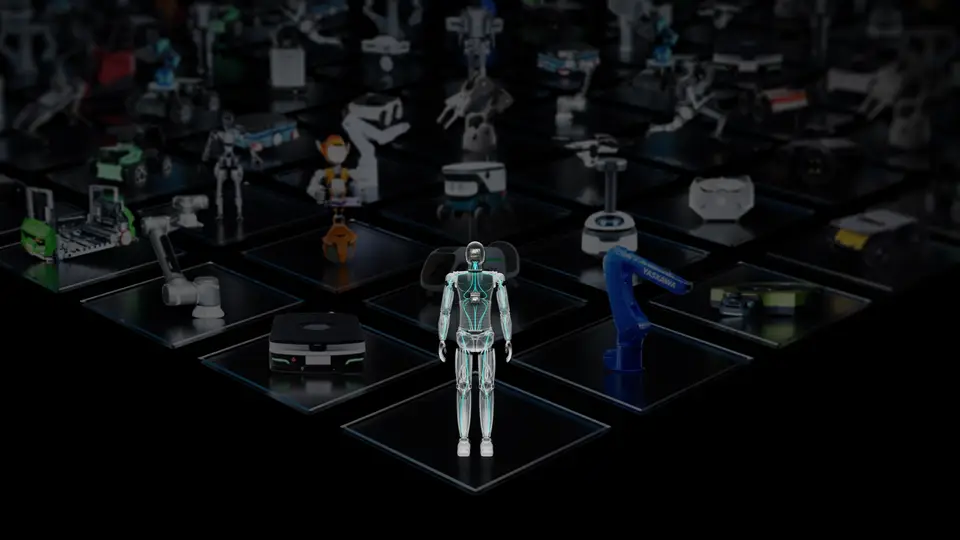
There is also a fast variant for real robots. GR00T 2 Turbo uses a 2-billion-parameter transformer and runs a prediction in 124 milliseconds on NVIDIA's Jetson Thor robot computer. And the model is built to be operated, not just admired: AI agents can use its API to chain skills into sequences and recover from errors when a step fails.
One caveat belongs in bold. NVIDIA calls GR00T 2 open, but its research page lists the code as "Available in December" and states no release date or license for the model weights. Until that code lands, the headline figures are company-reported results on company-chosen tasks.
GR00T N1: the teleop pioneer#
GR00T N1, released in March 2025, proved the basic bet: one foundation model could drive a humanoid instead of a separate policy per task. It was a 2-billion-parameter dual-system vision-language-action model, released as open weights, and follow-ups N1.5 and N1.6 added integration with NVIDIA's Cosmos Reason model.
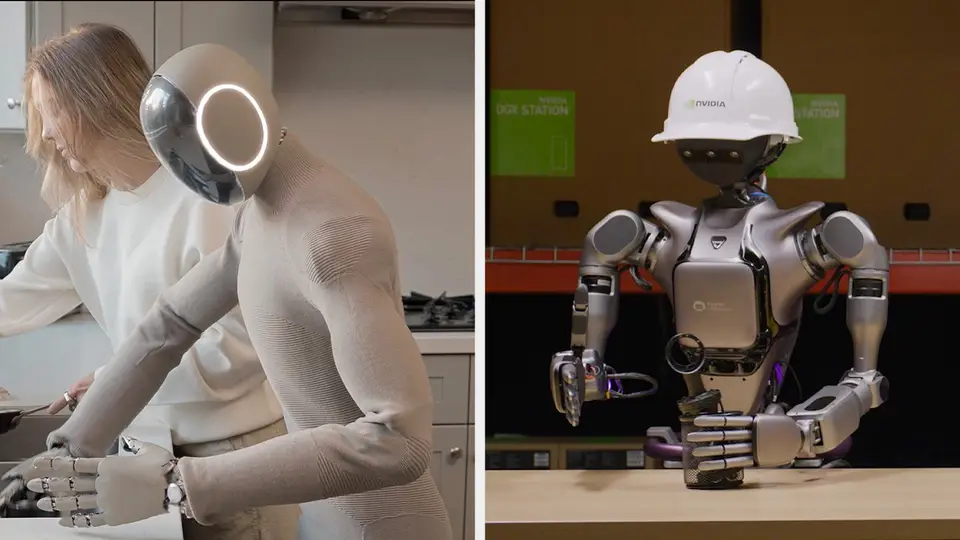
N1's limitation was its diet. It learned from robot demonstrations, which meant every new skill needed a robot, an operator and hours of teleoperation. GR00T 2 keeps the foundation-model idea and swaps the expensive ingredient — robot demos — for the cheap one: video of people doing the same jobs.
The old way: teach by remote control#
Teleoperation is the bottleneck the whole field has been working around. A human drives a robot through a task, the robot records it, and the policy imitates it — effective, but every new task restarts the clock. NVIDIA's own workaround has been simulation: its methods expand limited teleoperation data by more than 1,000x using synthetic data and world models.
GR00T 2 adds a second workaround that is arguably bigger. NVIDIA's new open Video to Data workflow turns human video into simulated robot demonstrations, and its EgoHand open model reconstructs 3D hand motion from video — it passed 40,000 Hugging Face downloads in the two weeks since launch. The message is consistent: the training data for dexterous robots no longer has to come from robots.
The training ground got faster too#
GR00T 2 did not arrive alone. Isaac Lab 3.0, NVIDIA's open-source robot-learning framework, went generally available on October 20, and at CoRL the company showed what it enables. Agents can now set up training environments, switch between the PhysX and Newton physics solvers, and apply a new reinforcement-learning post-training library to foundation models like GR00T. With Newton, Isaac Lab 3.0 reached up to 2.5 times the training throughput of Isaac Lab 2.3 on a vision-based dexterous manipulation benchmark — and Newton can now model deformable things like cables and cloth, plus multi-joint robot hands.
The measurement side got an upgrade as well. Isaac Lab-Arena 0.4, a developer preview, evaluates policies across thousands of variations in parallel. Two new open benchmarks use it: DexBench, from RLWRLD and NVIDIA, with 15 tasks across retail, logistics, manufacturing and hospitality; and VABAR, from UC Berkeley and NVIDIA, with six industrial tasks. GR00T 2 itself ranks among the top three models across the RoboCasa365, RoboLab, RoboDojo and MolmoSpaces benchmark categories, with multiple leaderboard wins, according to NVIDIA.
Early users are already testing the package in real work. Nexuni is trying GR00T 2 for robotic laundry handling, Foxconn is applying it to server-manufacturing automation, and Siemens is evaluating it across industrial use cases. MicroAGI post-trained it with reinforcement learning to swap Ethernet cables with a YAM robotic arm. UC Berkeley's Graph-as-Policy framework, meanwhile, uses agents to stitch individual skills into full robot programs and refine them on failures — "the most exciting technological development since the internet in 1995," in the words of Berkeley robotics professor Ken Goldberg.
The verdict#
GR00T 2 wins the head-to-head on the metric that matters most: the cost of teaching a robot something new. N1 proved a foundation model could drive a humanoid; teleop-only imitation proved it could learn a task if you paid for the demos. GR00T 2 is the first of the three that learns from the cheapest data on earth — people doing the job on camera.
Two things would turn a strong launch into a real shift. First, the December code release has to actually arrive, with weights and a license that let independent labs reproduce the results. Second, the factory trials — Foxconn's server lines, Siemens' industrial sites — have to move from evaluation to production. A model that scores 95% in NVIDIA's benchmark suite still has to survive a shift where one failure in twenty stops a line. If both happen, GR00T 2 is the robot brain the rest of the field will be measured against.
Sources#
- NVIDIA Blog: Practice Makes Precise — At CoRL, NVIDIA and Partners Reveal How Robots Rehearse Delicate Work in Simulation (November 9, 2026)
- The Robot Report: NVIDIA launches GR00T 2 and Isaac Lab 3.0 at CoRL (November 9, 2026)
- MLQ: Nvidia launches GR00T 2, a robot model that learns new skills from human video, and Isaac Lab 3 at CoRL (November 9, 2026)