OpenAI closes its standalone robotics team and hands the job to GPT-6 Astra
OpenAI has dissolved the team it built to give robots their own brains. Fortune reported on Friday that the company disbanded its standalone robotics team and scattered its people across the wider company — not, by OpenAI’s account, because it is giving up on robots, but because it no longer thinks robots need a team of their own.
- Reported November 13, 2026, by Fortune (Wen Shao, exclusive); OpenAI confirmed the reorganization when asked.
- Robotics researchers now report to Chief Research Officer Mark Chen; applied robotics and hardware moved to the Applied organization under President Greg Brockman.
- Stated reason: general frontier models, including GPT-6 Astra, can be applied directly to robotics.
- Nvidia study (October 14): an Astra-powered agent reached 74.8% success on the RoboLab-120 simulated manipulation benchmark, against 51.0% for the best specialized robot models.
- OpenAI’s own StationeryBench comparison on real dual-arm hardware: Astra completed 7 of 100 desk tasks, against 0 for Ai2’s MolmoAct2 — a directional gap at low absolute numbers.
- Second closure: OpenAI wound down its first robotics team in 2020, rebuilt one in 2024, and partnered with Figure until February 2025.
- A humanoid demo is still targeted for 2027, according to Fortune.
OpenAI has dissolved the team it built to give robots their own brains. Fortune reported on Friday that the company disbanded its standalone robotics team and scattered its people across the wider company — not, by OpenAI’s account, because it is giving up on robots, but because it no longer thinks robots need a team of their own.
The restructuring is a statement about where OpenAI believes the value now sits: a separate team signals a distinct problem with its own methods, and folding it into the main lab signals that robotics is now just another application of the frontier model, not a field apart.
What changed#
Under the new setup, the robotics research group sits inside OpenAI’s main research team, reporting to Chief Research Officer Mark Chen, while the applied robotics and hardware teams moved into the larger Applied organization under President Greg Brockman. A spokesperson told Fortune that robotics remains core to OpenAI’s long-term vision — the move as acceleration, not retreat — and the company has not said how many people were affected.
The timing showed. OpenAI had already registered a booth at CoRL, a leading academic robotics conference in Austin this week, and Fortune reported the conference app still listed it at booth #208 — but when its reporter visited, the space was empty, the logo nowhere to be seen, and a few former team members drew a crowd with no display or demo.
The bet: a general model can drive the robot#
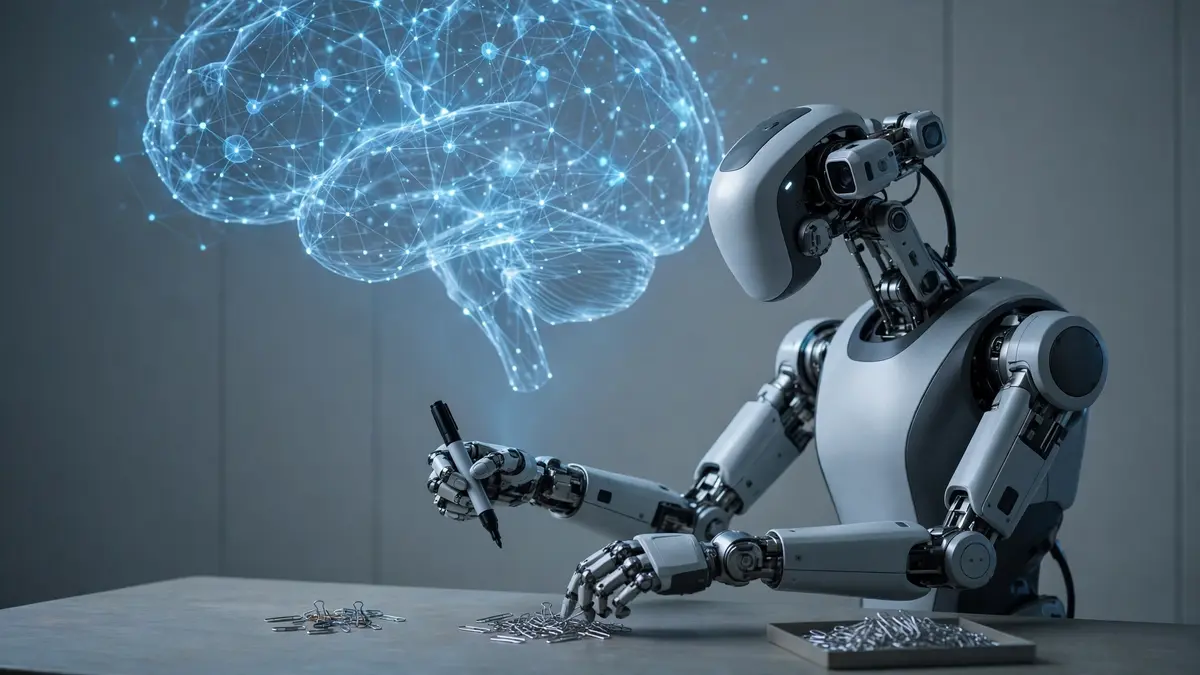
OpenAI told Fortune its researchers began the year assuming the best route to robotics ran through video models like Sora, which would have to hold some implicit picture of how the physical world behaves. Since then, the spokesperson said, general-purpose frontier models including GPT-6 Astra have shown they can be applied to robotics directly — the finding that prompted the fold.
The strongest data point comes from Nvidia. Researchers gave GPT-6 Astra camera images, robot state information and a control interface so it could command a robot; the Astra-powered agent reached a 74.8% success rate on a simulated manipulation benchmark, against 51.0% for the best specialized robot models on that leaderboard, according to Fortune. Two cautions: it was a simulation, not a physical robot, and one benchmark does not cover contact-rich real-world tasks. Coverage of the study also put the cost at roughly $36 per attempt, with each model call taking about 19 seconds — numbers that matter if a robot has to think before every move.
A second, more physical data point comes from OpenAI’s own StationeryBench comparison, which pits GPT-6 Astra against Ai2’s MolmoAct2 on five bimanual desk tasks with real dual-arm hardware — uncapping a marker, pouring paper clips, and the like. Across 200 trials, Astra completed 7 of 100 tasks against 0 for MolmoAct2. The report documents its own limits — operator-judged grading, MolmoAct2 run zero-shot, scenes outside that model’s training distribution — so the gap reads as directional. But it is a general model moving real arms on mundane tasks, which is the claim the reorganization rests on.
A long, uneven history#
This is not OpenAI’s first change of course on robots. Fortune recounted that the company wound down its early robotics team in 2020 — co-founder Wojciech Zaremba later pointed to limited robot data and a more efficient path to AGI through other methods — then rebuilt a standalone team in 2024 and partnered with the startup Figure to build AI models for humanoid robots. That partnership ended in February 2025, when Figure said it would develop its own robot AI.
OpenAI now says it is developing its own humanoid robot, with CEO Sam Altman targeting a first public demonstration in 2027, Fortune reported. That makes this the third structure in six years — and the throughline is not that OpenAI keeps changing its mind about robots, but about what kind of problem robots are.
Why the robot specialists are not conceding#
If general models can drive robots, that challenges the premise behind many robotics startups that have raised billions on the idea that robots need purpose-built brains. The researchers Fortune spoke with were not ready to declare that contest over.
Guanya Shi, an assistant professor at Carnegie Mellon’s Robotics Institute, told Fortune he reads the move as a sign OpenAI sees robotics as “no longer a special problem,” but a downstream application of general intelligence, much as the same frontier models now power coding and legal tools. He still sees a role for smaller specialized models running on the robot itself, because large models are slow and cloud-hosted.
Russ Tedrake, an MIT professor and CEO of Walden Robotics, told Fortune that robotics companies hold an advantage AI labs lack: robots already gaining work experience on factory floors and in other real places — and better foundation models make that site-specific data more valuable, because robots can learn from it faster. Pete Florence, co-founder of the robot-model startup Generalist, told Fortune it was unclear that any existing model would dominate robotics in the long run.
The specialized camp is still shipping. Two days before Fortune’s report, on November 11, Runway released open weights for Praxis-1, a 27-billion-parameter “world action model” for robots under the Apache 2.0 license. Runway says Praxis-1 reached 46.2% success across 1,200 episodes on Nvidia’s RoboLab-120 leaderboard and runs on Nvidia hardware down to the Jetson Thor computer mounted on a robot. In a company test Runway reported, GPT-6 Astra took 15.6 times longer than Praxis-1 to complete three tasks and cost 51 times more per completed task. The two approaches optimize for different things: the general model for capability, the specialist for speed and cost at the point of use.
Why it matters#
The move also lands as OpenAI narrows its focus. Fortune noted Altman told staff last year to abandon “side quests,” that the company dropped some efforts, including Sora, to free compute for core products, and that it reportedly posted a $10.9 billion operating loss in its most recent quarter while preparing for a possible IPO in early 2027. OpenAI did not tie the robotics move to costs in the statement quoted — the stated reason is capability, not budget — but a lab under cost pressure is unlikely to keep a separate team for a problem it believes the main model line can now solve.
For builders, the practical read is narrower: try the general model first — the Nvidia result suggests a frontier model with images and a command interface is a strong baseline — but measure latency and cost before committing, keep a small on-board model for reflexes, and collect your own deployment data, the asset general models do not have.
What to watch#
- Physical robots, not simulations. Do OpenAI’s general models control real hardware with the speed and reliability factories need, at a cost anyone will pay?
- The 2027 humanoid demo. Does it arrive on schedule, and does it run on a general model or a specialist stack?
- The economics. Does the per-call latency and token cost of a frontier model shrink fast enough for real-time control, or does the specialist camp keep the edge at the point of use?
- The followers. Do other labs fold their robotics teams into general research, or does OpenAI’s bet stay an outlier?
- The data moat. Does deployment data from robots already working in the world prove to be the durable advantage Tedrake describes, or do the big labs close the gap from the model side?
Sources#
- ExplainX — “OpenAI Disbands Robotics Team: GPT-6 Astra Bet (2026)” (November 14, 2026)
- DailyMech — “OpenAI Folds Its Stand-Alone Robotics Team Into Research and Applied, Betting General Models Can Run Robots” (November 13, 2026)
- Dev.to — “OpenAI Disbanded Its Robotics Team. GPT-6 Astra Is the Robot Now” (November 14, 2026)
- The Laborecon — “OpenAI disbands standalone robotics team, AI takes centre stage” (November 14, 2026)
All four reports draw on Fortune’s exclusive by Wen Shao, “OpenAI disbands its stand-alone robotics team as its general models start running robots” (November 13, 2026). OpenAI has published no announcement of its own.