Opus 4.6 vs Opus 5.5: the viral three.js before-and-after Reddit says is cherry-picked
A 27-second split-screen video claims to show seven months of progress in AI-written games — Opus 4.6 in April, Opus 5.5 in November. The clip is striking. The thread underneath says the comparison is cherry-picked, and the video itself never says which model made which half.
- The video: a Reddit-hosted 27-second split-screen clip, posted by u/stealthispost on r/accelerate on November 26, 2026 at 5:22 p.m. ET — 539 upvotes and 48 comments by Friday midday. The X original, from @RealFedeURU, has 152,600 views, 3,800 likes and 208 reposts.
- What it shows: top half, “25 Nov 2026” — a realistic 3D racing game with a black sports car on a wet, tree-lined course, a timer and minimap on screen. Bottom half, “25 April 2026” — a red box car on a sandy track with blocky cacti and a glowing cyan gate. No narration, music only.
- The gap in the claim: the video labels only dates. That the two halves are Opus 4.6 and Opus 5.5 comes from the title and the X post alone — no prompt, code or source material is shared.
- The thread’s verdict: the top comment (103 upvotes) says April “was not this bad”; others call it the worst April example against the best November one, and question whether the November game uses third-party assets while the April one was generated from scratch.
- The hot take underneath: the post’s body is a copied X reply arguing that ASI will one day write everything in raw binary and make tools like Blender unnecessary — a claim the replies push back on too.
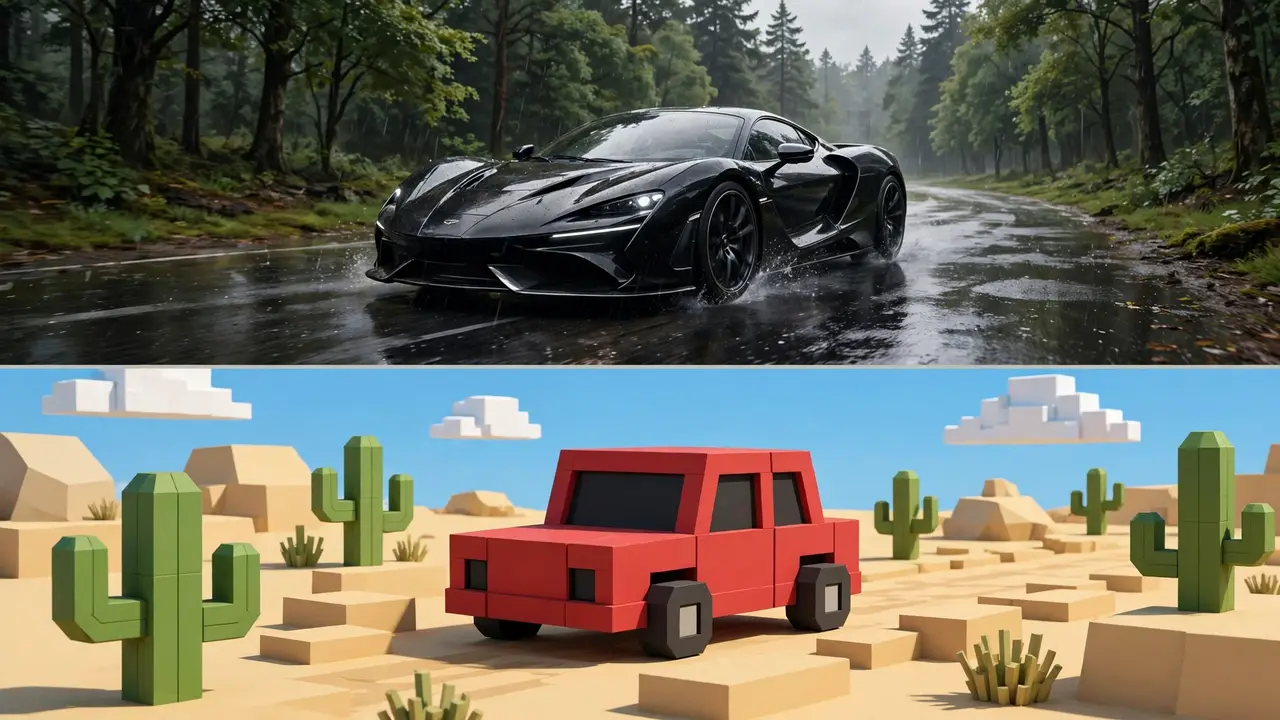
The clip is 27 seconds long, and the contrast does all the work. On the top half of the screen, labelled “25 Nov 2026,” a black sports car with a spoiler and red taillights drives a wet road through a green, tree-lined course, a light-blue car ahead of it, a timer reading 00:50.967 in the corner and a minimap and speedometer on screen. On the bottom half, labelled “25 April 2026,” a red box car with a dark-blue box on top putters around a sandy track past green blocky cacti, orange-and-white barriers and a glowing cyan gate, with the instructions “WASD drive — Space handbrake — Hit the glowing gate” floating on screen. The newer game is on top and the older one below, so the chronology runs backwards — a detail the replies noticed immediately.
The post, from u/stealthispost on r/accelerate, titles the pair as “Evolution of threejs and LLM models. Opus 4.6 vs Opus 5.5.” It credits an X post by Fede(URU) (@RealFedeURU), posted the same morning, which carries the same video and the same title and has passed 150,000 views. The framing is seductive: seven months of model progress, visible in a single frame, from toy blocks to something that could pass for a real racing game. That is the story the title tells. The thread underneath tells a different one.
What the video does not say#
Start with what is actually on screen. The video labels two dates and nothing else. It never says which model produced either game, what prompt was used, how many attempts each took, or whether the two halves were made under the same conditions at all. All of that comes from the title and the X post — and neither shares a prompt, a line of code, or any source material. The attribution to Opus 4.6 and Opus 5.5 is, for now, the poster’s word.
That matters because the comparison only means something if the two halves are comparable. A commenter in the thread puts the problem plainly: the November game may have been built with existing assets — car models, environments, textures — while the April game looks like it was generated from scratch, code and all. If so, the video is not measuring seven months of model progress; it is measuring the difference between two different workflows. Another commenter makes the same point from the other side: if you bring in assets, Claude can slot them into a three.js structure, and it could have done that in April too, “so it’s a little disingenuous.”
There is also a question about the dates themselves. One commenter challenges the April label outright, noting the model timeline does not line up as the title implies. Nobody in the thread resolves that either way, and we are not going to assert a release date we have not verified. What can be said is that the video’s own labels are the only dating evidence on offer, and the thread treats them as contested, not settled.
The thread’s verdict: cherry-picked#
The highest-voted comment in the thread, from u/decrement1 at 103 upvotes, is a flat rejection of the April half: “Top one is impressive, but there is no way April was this bad. I remember people were posting gta vice city clones with opus 4.7 that looked alright.” The reply beneath it, from u/ShortingBull, concedes the direction of travel while disputing the scale: “Yeah it looks like they took the worst example from April and the best from November… It is exaggerated for sure, and the truth lies somewhere between these two, but the comparison is not orders of magnitude off. Opus 5.5 and now Fable 5.2 are crazy good compared to previous kin.”
That middle position is where the thread mostly lands. The November half is genuinely impressive — nobody argues otherwise. What the commenters dispute is whether the gap between the halves is a measurement of anything. One calls it “not a fair comparison — one is from scratch the other one is a game recreation using existing assets.” Another asks whether the top version’s assets were generated or made with tools, and a reply guesses at third-party assets from Polyhaven and Blender, generation from Tripo, and Trellis.2 with MCPs, while the bottom half “looks fully generated from Claude itself.” The pushback is not that the video is fake. It is that a before-and-after only proves progress if the before and the after were made the same way — and there is no evidence here that they were.
The same scepticism followed the video to X, where replies call it “a complete exaggeration based on nothing” and ask how April’s quality could have been that bad. One reply asks the question the video’s layout invites: “Who the hell puts the ‘after’ before the ‘before’?”
The hot take underneath#
The Reddit post’s body text is not the poster’s own writing at all. It is copied from the replies on the X post — a “hot take” from a user called Mob, arguing that superintelligence will one day do everything in code, that 3D software like Blender will not be necessary, and that everything will be written raw in binary from the start, “better than anything humans have created.” Fede’s reply, “I hope so,” is the post’s other half, and the poster even attached a screenshot of it as a comment.
That claim drew its own pushback. One reply points out the practical problems: memory management, the inefficiency of abandoning abstraction, and the fact that higher-level languages exist for reasons beyond human convenience — compilers, error correction, leverage. It is the same argument the thread makes about the video, in a different key: the demo is impressive, but the conclusion drawn from it outruns the evidence.
What to watch#
First, whether anyone publishes the prompts and the process. The comparison becomes interesting the moment both halves are reproducible — same prompt, same constraints, same asset rules, one attempt each. Until then it is a striking clip, not a benchmark. Second, the pattern it belongs to: this blog has covered Opus 5.5 building a 3D movie in Blender, a one-shot playable game workflow, and a string of “AI made this” videos whose threads did the fact-checking in public. The before-and-after format is becoming its own genre, and the audience is getting faster at spotting the seams. Third, the underlying claim is not going away: even the sceptics in this thread agree the newer models are dramatically better at this kind of work. The argument is about how much better, and how honestly that can be shown in 27 seconds.
One note of proportion. The clip is short, the attribution is unverified, and the comparison is, on the thread’s own evidence, cherry-picked. What is verified is the appetite: 150,000 views on X, a fast-moving thread, and an audience that wants to believe the progress is real — and wants the proof to be real too.
Sources: r/accelerate, “Evolution of threejs and LLM models. Opus 4.6 vs Opus 5.5” (u/stealthispost, November 26, 2026); X, @RealFedeURU, “Evolution of threejs and LLM models. Opus 4.6 vs Opus 5.5” (November 26, 2026); AI Frontier Post, “Claude Opus 5.5 made a one-minute 3D movie by writing Blender code — in 8 hours on an RTX 5090” (October 27, 2026); AI Frontier Post, “One-shot a playable browser game with a frontier model: the workflow behind the Opus 5.5 demos” (September 30, 2026); AI Frontier Post, “A Reddit user built a working GTA-style game in a day with Gemini Neon — and the comments did the fact-checking” (November 22, 2026)