Replit launches Missions: give an agent swarm a goal and a budget, and it plans, builds, and tests
Replit’s new Missions product hands a whole project — not a prompt — to a swarm of AI agents working inside a budget and approval rules you set. Its headline proof, an internal monitoring platform built in two days for $3,000, comes with caveats worth reading first.
- Launched November 17, 2026 (blog updated November 19): Missions coordinates a swarm of agents around one goal, inside a Mission Agreement that sets success criteria, a spending limit, and which actions require human approval.
- An independent AI judge checks results against the agreed criteria and sends work back for another round when it falls short; a mission ends when the criteria are met, the budget runs out, or the user is needed.
- DataCat, the internal demo: a monitoring platform with dashboards, alerts, and application tracing, built in two days within a $3,000 budget; it caught a deliberately planted database bug in 38 seconds against a 60-second target and passed 51 of 51 data and alert checks.
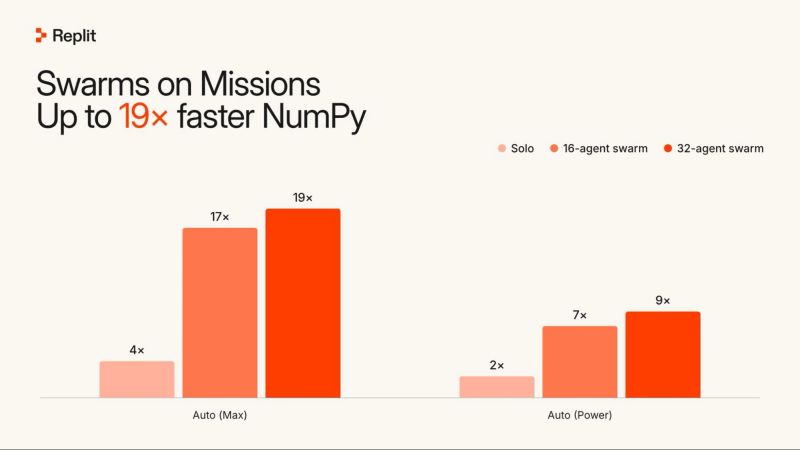
- On Replit’s own NumPy benchmark, a single agent reached a 4x speedup, a 16-agent swarm 17x, and a 32-agent swarm 19x — doubling the swarm from 16 to 32 bought only about 11% more.
- Pricing is unpublished; enterprise teams are directed to Replit’s sales team. Replit says it is open-sourcing a self-hostable version of DataCat.

Replit is no longer selling you a better prompt. Its new product, Missions, sells you an outcome: describe the goal, set a budget, name what needs your approval — and a swarm of AI agents plans the work, builds it, tests it, and revises it until the goal is met or the money runs out. Launched on November 17, 2026, it is the clearest version yet of an idea the whole industry arrived at the same week: the team of agents, governed by a contract, is the product.
The pitch is aimed at the work teams keep postponing: win the first ten paying enterprise customers, replace a piece of legacy software, build the internal tool nobody has bandwidth for. A single coding agent can do a version of each job if you sit with it. Missions is for the version where you do not — you close the laptop and hear about it on your schedule: immediately, in a daily digest, or weekly.
Write the contract, not the prompt#
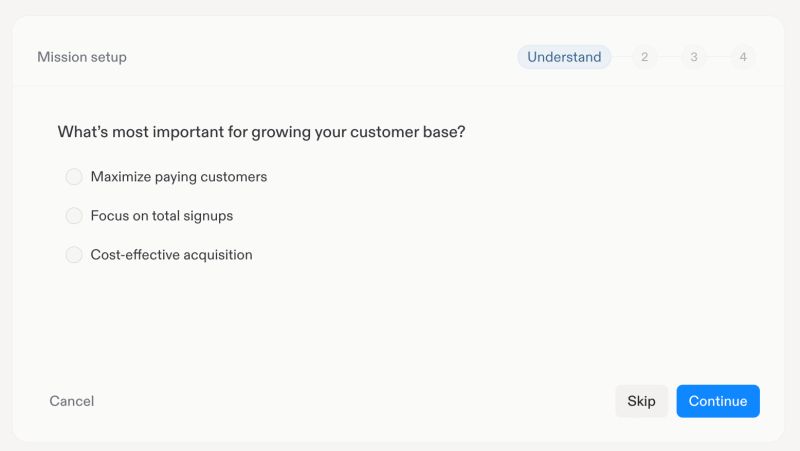
Everything runs through what Replit calls a Mission Agreement, settled before any agent starts. It fixes three things: the goal and how success will be measured, a spending limit, and which actions require a human’s sign-off. Setup asks questions to pin the goal down — what counts as an enterprise customer, or whether a paid pilot counts toward the first ten — because a vague goal is the easiest way to burn a budget on the wrong thing.
The controls are the interesting part. You can cap a mission at $1,000 and require approval before an agent contacts a prospect, shares a proposal, changes customer-facing sales material, or makes a product commitment. Replit checks spending at every step and blocks further paid services once the cap is hit. President Michele Catasta told The New Stack the limits matter because, in his words, “most autonomous or multi-agent products lead to runaway token costs.” The budget is the kill switch — and the feature. A swarm with no spending limit is a credit card with no owner.
An independent AI judge checks the work against the success criteria and sends it back when it falls short. A mission is complete when the criteria are met; if the budget runs out first, work stops with the outcome unresolved.
DataCat: the two-day, $3,000 receipt#
Replit’s headline evidence is its own dogfooding. The company wanted to bring application monitoring in-house, so it gave Missions the goal of building DataCat. According to Replit, a swarm built it in two days, inside a $3,000 budget: dashboards, alerts, and application tracing, plus DataCat’s own agent and tracing libraries.
The results are specific, and they deserve to be quoted with their limits attached: every number here comes from Replit’s own controlled tests, not an independent evaluation. Replit deliberately introduced a database bug; DataCat raised an alert in 38 seconds against a 60-second target. A three-hour load test stored 26 million activity records and 4.4 million log entries with no data lost, and all 51 data and alert checks passed. Against a monitoring platform built from the same prompt with Claude Code, DataCat took in traces five times faster — 49,000 per second against 9,800. Replit says it is open-sourcing a self-hostable version of DataCat, though The New Stack reports the public release still awaits a code audit.
More agents, diminishing returns#
The swarm itself got its own benchmark. Across 13 NumPy tasks, a single agent reached speedups of up to 4x; a 16-agent swarm reached 17x; a 32-agent swarm reached 19x. Doubling the swarm from 16 to 32 bought only about 11% more speed, because the extra agents mostly explore approaches the swarm has already tried. Catasta acknowledged the ceiling, telling The New Stack there is “a point of diminishing returns, both for time speedups and the benefit of specialization.” Replit also cites a simulated-trading result — ¥100,000 turned into ¥4.82 million on E-Commerce Bench — again from its own run, not an independent test.
Why it matters — and what to watch#
Missions did not launch into a vacuum. The same week, Vercel shipped Board, an experimental message board where humans and coding agents claim tasks and post updates, and Google’s Antigravity added a swarm command. Three vendors, one diagnosis: one thread of work has hit its limit, and the next product is the coordination layer — the contract, the budget, the judge, the shared board.
That framing is also where the honest questions sit. A $3,000 cap is a ceiling the user sets, not the price of an outcome, and Replit has published no pricing for Missions at all — no plan inclusion, no per-mission rate. The DataCat demo was run and graded by Replit, against criteria Replit wrote.
Three things to watch: what a mission actually costs when a paying customer runs one — the first real invoices will say more than any demo; whether the open-source DataCat release lands; and whether the contract model spreads. If budgets, approval lists, and independent judges become the standard way to buy agent work, Missions will look like the week the industry stopped selling prompts. If they do not, it will look like a very good demo of a very expensive way to build a dashboard.
Sources: Replit, “Introducing Replit Missions” (November 17, 2026, updated November 19); The Inference, “Replit’s agent swarm rebuilt its monitoring platform in two days for $3,000”; ExplainX, “Replit Missions: DataCat in 2 Days, 19x NumPy, Checked”.