South Korea’s education minister resigns as AI cheating upends the country’s biggest exam
South Korea’s education minister resigned on Sunday, November 22, after generative AI turned the country’s most important exam into a national security exercise. Choi Kyo-jin stepped down taking responsibility for a week of last-minute anti-cheating measures that, by his own admission, were improvised too late and changed too often — and President Lee Jae Myung accepted the resignation within about an hour.
- The resignation: Choi Kyo-jin, 72, offered to resign on Sunday, November 22; President Lee Jae Myung accepted within about an hour.
- The trigger: On November 15, Han Won-seok, 34, the top scorer on the certified tax accountant exam, admitted he used a miniature camera, generative AI, and a smartphone to cheat during the exam’s April and July rounds.
- The exam: The CSAT (Suneung) was held November 19, with more than 550,000 students registered. The ministry reported 111 suspected cases of cheating with electronic devices.
- The measures: Wi-Fi restricted, eyeglasses checked for smart glasses, clothing buttons covered with stickers, and nationwide emergency alerts sent three times during the test to catch undeclared phones.
- The fallout: Lee ordered a comprehensive review of national exam management and related laws, and a review of adding identification marks to question papers so a photographed or leaked paper can be traced to its source.
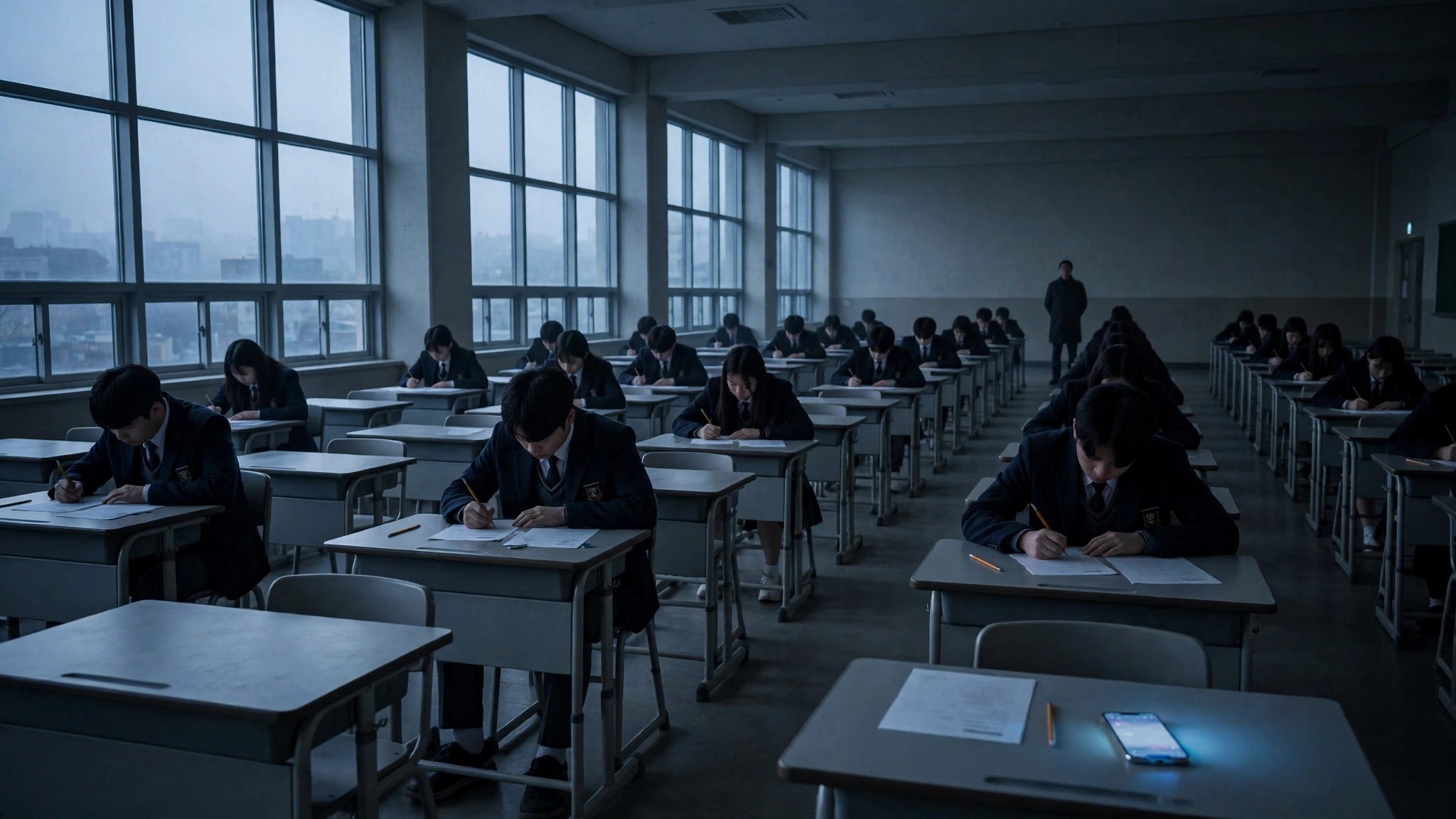
The week began with a confession and ended with a resignation. In between, South Korea discovered that the tools for cheating on its most consequential exam had outrun every system built to stop them — and that the government’s response, assembled in days, did as much damage as the cheating itself.
The College Scholastic Ability Test, or CSAT, is an eight-hour, once-a-year exam that largely decides which university a student can attend. This year it was held under precautions that would have been unthinkable a decade ago: Wi-Fi cut off, eyeglasses inspected, clothing buttons covered with stickers, and emergency alerts sent to every phone in the country three times during the test. The ministry says it caught 111 suspected cases of cheating with electronic devices. The minister lost his job anyway.
The confession that set the week in motion#
On November 15, four days before the CSAT, Han Won-seok — the top scorer on this year’s certified tax accountant exam — admitted in a video posted on his lawyer’s YouTube channel that he had cheated his way to the top. According to the Korea Herald’s account, Han photographed exam questions with a miniature camera, sent the images to a generative AI system, and read the answers on his phone, doing it across both rounds of the exam, in April and July.
The admission landed like a bomb. The CSAT is not just an exam; for hundreds of thousands of South Korean families it is the single day that shapes a young person’s university, career, and social standing. If a tax exam could be gamed with a camera the size of a button and a phone, the public question was immediate: what was stopping the same trick on Thursday? Police have since summoned Han repeatedly, and Yonhap reported on November 23 that officers had called him in for a fourth time for digital forensics on the devices he surrendered.

A week of improvisation#
The Education Ministry’s first plan had been narrow: watch for smart glasses. After Han’s confession it rushed out a much broader package — and kept changing it until days before the exam. Wi-Fi was restricted around test sites, proctors inspected glasses and covered clothing buttons with stickers to block hidden cameras, and emergency alerts went to phones nationwide three times during the exam to flush out devices students had not handed in.
The minister himself became part of the problem. On November 16, three days before the exam, opposition lawmaker Park Jeong-hun asked Choi at a National Assembly hearing whether he was confident the ministry could catch all AI-assisted cheating. “I don’t think that I can,” Choi replied. “Because of my age.” The remark — read as an admission that he could not keep up with the technology — drew sharp criticism, and Choi was largely absent from the ministry’s public events in the days that followed, with Vice Minister Choi Eun-ok attending in his place.
The exam itself passed without major incident, by the ministry’s account, but the human cost was already visible. Lee Jin-woo, a perfect scorer on the Legal Education Eligibility Test who had been publicly accused of using AI to cheat, was found dead at a Seoul motel on exam day. He had promised to answer the accusations by solving CSAT questions on a livestream that morning and did not appear. Police are investigating his death.
The resignation — and the review that follows#
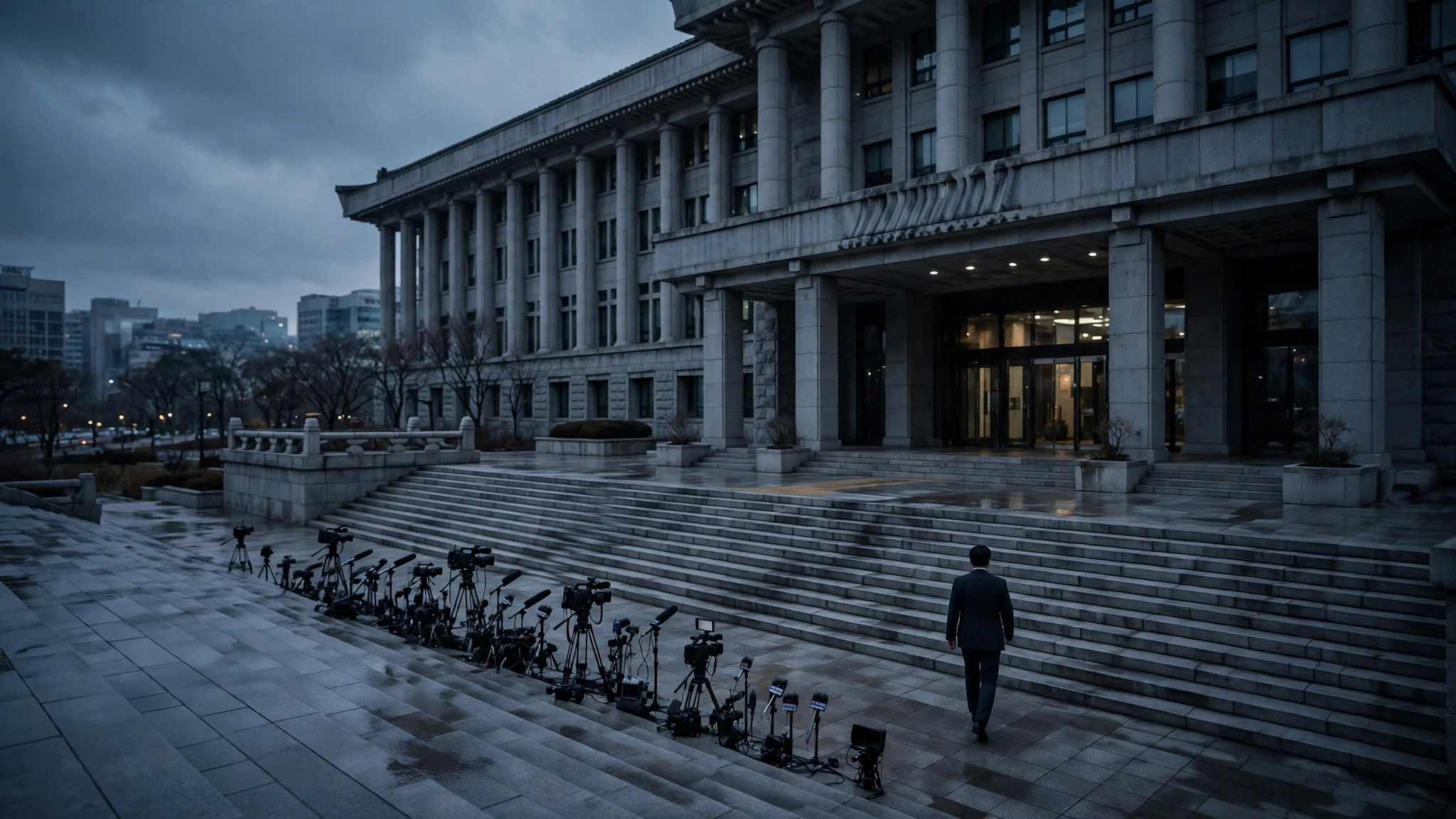
Choi offered his resignation on Sunday, once the exam was over. “Now that the CSAT is over, I keenly feel responsible and am offering my resignation,” he said in a statement, adding that the last-minute changes had caused inconvenience and that, as the minister in charge, he could not escape criticism for failing to prepare in advance.
Lee accepted within about an hour. In a post on X shortly afterward, the president said concerns about AI-assisted cheating were spreading “beyond the CSAT to essay-based admission exams and school tests,” and that “the fairness of exams is a principle that can never be compromised.” He ordered a comprehensive review of how the CSAT and other exams are managed, instructed Prime Minister Han Seong-sook to take charge of follow-up measures, and asked for a review of adding identification marks to question papers so that a photographed or leaked paper can be traced back to its source.
What to watch#
The CSAT is the canary. Every high-stakes exam in the world now faces the same problem: the cheating kit — a miniature camera, a phone, a generative model — is cheap, small, and improving faster than the detection kit. South Korea’s answer so far has been to tighten the room: more checks, more alerts, more restrictions. The review Lee ordered will test whether that approach can hold, or whether exams themselves have to change — from device-free rooms to papers that carry their own trace, to formats where a photographed question is worth less than the thinking behind it.
Three things to watch: what the comprehensive review actually recommends and how fast it moves; whether identification-marked question papers become standard for national exams; and whether other countries’ exam bodies — watching a minister lose his job over this — start their own reviews before their own confession arrives.
Sources: Reuters, via BusinessWorld, “South Korea’s education minister quits over exam cheating chaos,” November 23, 2026; Korea JoongAng Daily, “Lee accepts education minister’s resignation after CSAT anticheating measures trigger nationwide confusion,” November 22, 2026; TBS News, “South Korea education minister resigns after AI-assisted exam cheating scandal,” November 22, 2026; Explainx, “South Korea CSAT AI Cheating: Minister Out (Nov 2026),” November 23, 2026.