Stanford’s Flash ALOHA learns fast, precise robot manipulation from just 50 demos per task
A 74-second clip from Stanford shows a two-armed robot catching a ball, folding shorts, and bussing a table at near-human speed — learned from just 50 demonstrations per task, with the code now open source.
- 50 demonstrations per task: Flash ALOHA completes the named bimanual tasks at over 80% success rates, close to human speed.
- RGB input only: no wrist cameras, no proprioception, no force feedback — at 100 Hz control.
- Kinesthetic teaching: demonstrations are collected by moving the robot’s own arms through ergonomic scissor handles (the iPhUMI device), plus a smoothing step and masking the operator out of camera views.
- Open code, not open weights: the GitHub repository is MIT-licensed, but datasets, checkpoints, and logs are not included; the paper is not yet on arXiv.
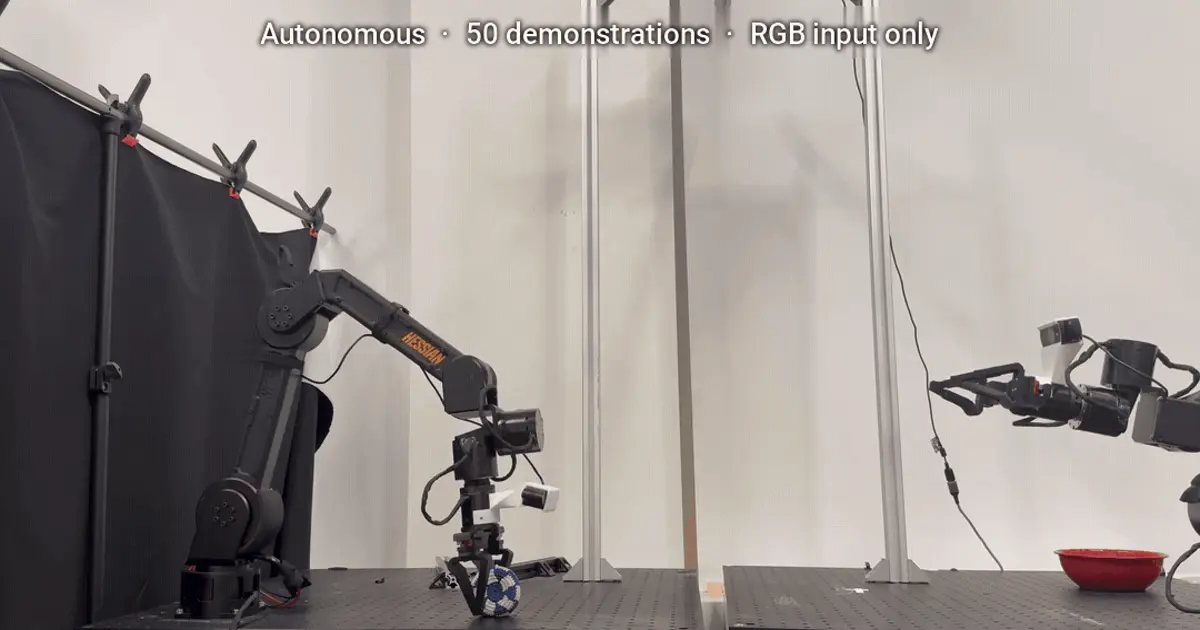
A two-armed robot catches a ball tossed across a workbench, folds a pair of shorts, and clears a table — all on its own, at something close to human speed. The clip is 74 seconds long, it comes from Stanford, and by Thursday afternoon it was doing the rounds on Reddit, where it picked up close to 200 upvotes and a comment section full of jokes about a robot whose job is to pass the butter.
The system is called Flash ALOHA, and the part that matters most isn’t any single trick. Given 50 demonstrations of a task, it completes two-handed jobs — ball tossing and catching, folding shorts, inserting a battery, bussing a table — with success rates above 80%, at close to human speed. And the code is open source, under the MIT licence.
What the video actually shows#
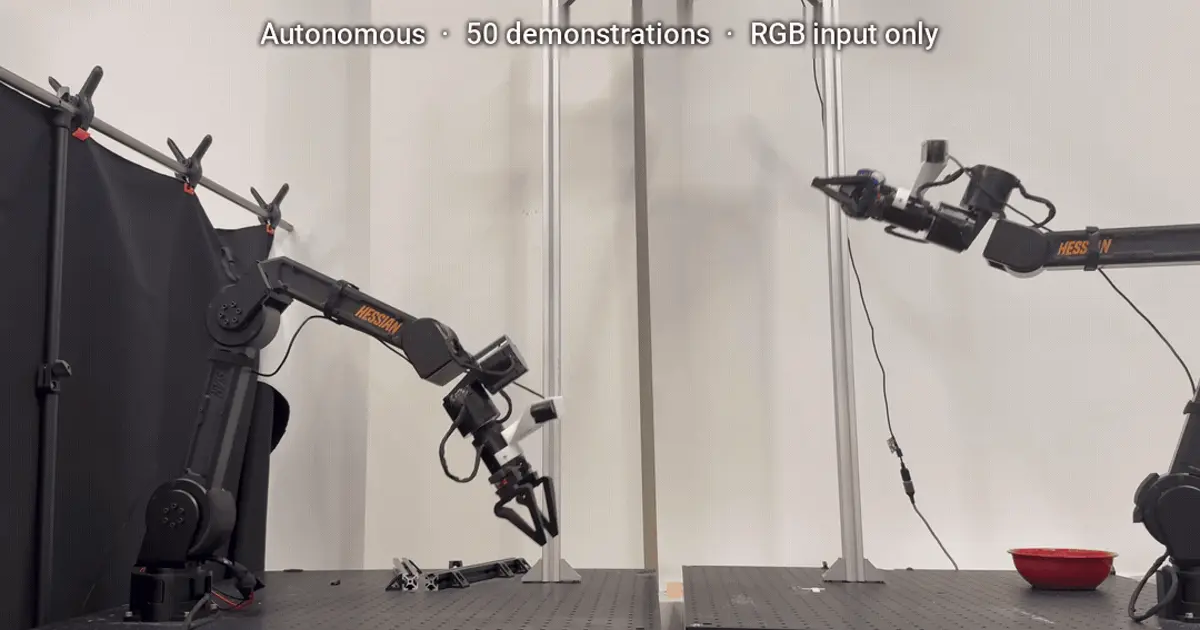
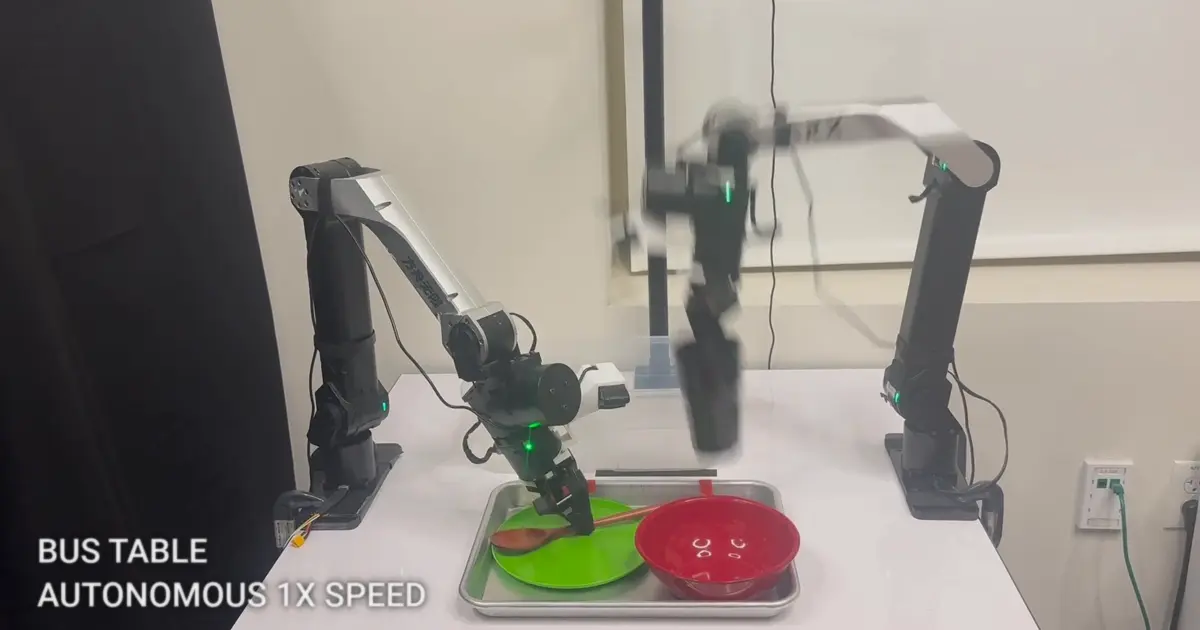
The clip landed on r/singularity on Thursday morning, posted by u/141_1337, and it is a montage of autonomous rollouts rather than a single continuous run. The project page lists the ten skills the montage draws from: folding shorts, unstacking cups, inserting a battery, bussing a table, loading a dishwasher, passing butter, helping put on a jacket, catching a towel, flipping a pancake, and tossing and catching a ball.
Two details in the footage are worth noting. The first is the on-screen label on the dishwasher shot: “LOAD DISHWASHER AUTONOMOUS 1X SPEED”. The “1X” is the point — the footage is not sped up, and the robot really is moving at that pace. The second is where the clip came from: a thread by first author John Hua Yao, a Stanford researcher, posted the night before. It had about 70,000 views by Thursday evening, and it singles out the ball and towel catching as the reactive, high-speed tasks — the ones where a slow robot would simply miss.
Reddit’s reaction was mostly delight. The top comment, with 46 upvotes, was “You pass butter.” — a Rick and Morty joke about the butter-passing shot — followed by “what is my purpose” at 21. Nobody in the thread disputed the claims. The scepticism was practical instead: one commenter pointed out that dishwashers don’t need plates rinsed first; another asked whether the system uses lidar (it doesn’t — it runs on RGB cameras alone); a third said they’d try it only if the hardware cost under $1,000 and the model ran on a gaming PC.
Why speed is the hard part#
Robot policies learned from human demonstrations can already do a lot of these jobs — the catch is that they usually do them far slower than a person would. Flash ALOHA exists to close that gap, and its project page names two reasons for it: there has been no good way to collect demonstration data precisely at high speed, and no good way to train a policy that robustly executes high-speed motion.
The collection problem is physical. Steering a robot by remote control gives the operator no sense of contact, and handheld tracking devices lose accuracy exactly when the motion gets fast — the project page shows a tracking-error comparison to make the point. Flash ALOHA’s answer is kinesthetic teaching: the operator moves the robot’s own arms directly, using ergonomic scissor handles mounted on friction-compensated, lightweight arms. The handheld device pictured in the thread is called iPhUMI, and the idea is that demonstrations collected this way are naturally fast, because the human is moving at human speed.
The training side has two fixes of its own. A lightweight smoothing algorithm steadies the jerky tracking that comes from action chunking, and the pipeline masks the operator out of the camera views, so the policy doesn’t learn to expect a human standing in frame. The result runs on RGB input only — no wrist cameras, no proprioception, no force feedback — at 100 Hz control.
What “open source” actually covers#
The code is public on GitHub under the MIT licence, and it covers data collection, training, and deployment on ARX robot arms, with two policy options: a decoder-only ACT policy by default, and a Flow policy built on LeRobot. At the time of writing, the repository had 43 stars and five commits.
What “open source” does not cover is everything else. The datasets, the trained checkpoints, and the training logs are not in the repository, and the hardware list lives in a separate document linked from the project page. So anyone who wants to reproduce the demos needs ARX arms, the parts list, and fifty demonstrations of their own per task. That is still a meaningful release — the recipe is public — but it is not a download-and-run robot.
The paper itself is also still on its way to the usual channels. The system was first presented as “ALOHA Lightning” at the ICRA robotics conference in Vienna in July 2026, the PDF is linked from the project page, and an arXiv posting is listed as “coming soon”. Until that lands, the abstract on the project page is the primary source for the numbers.
What to watch#
The first question is whether the 50-demo recipe holds up beyond the ten skills in the montage — and beyond the lab bench the demos were filmed on. The second is whether other groups reproduce the results on ARX hardware once the paper reaches arXiv and the inevitable questions about the training details get answered.
The third question is the one Reddit kept asking, in different words: what does the rig cost, and what does it take to run? If fast, precise manipulation can be taught in fifty demonstrations, the bottleneck for household robots moves from data collection to hardware cost and safety — which is a much more tractable problem, and a much more interesting one. One commenter already expects care homes to be full of robots like this within five to ten years. That is a prediction, not a fact — but it is a measure of how the demo landed.
Sources: the original post by u/141_1337 on r/singularity; the Flash ALOHA project page (Stanford); the code on GitHub (MIT licence); and John Yao’s thread on X. The paper is not yet on arXiv, and the above-80% figure applies to the tasks named in the project abstract. Commenter claims are reported as thread claims, not independently verified. The stills in this article are frames from Stanford’s demo videos, credited to the Flash ALOHA project page.