Apple’s HALO puts a locally run Qwen brain in a Unitree G1 — and Reddit is stress-testing the 91% success claim
A 46-second clip of Apple’s HALO system steering a Unitree G1 through a real home — sitting, sidestepping a box, ending up on the couch — topped r/singularity on Saturday. The paper behind it claims 91% success across 360 trials in homes the robot never saw in training. The thread believes the footage and doubts the framing.
- The clip: a Reddit-hosted video, 46 seconds, posted to r/singularity on November 8 by u/141_1337 — 443 upvotes and 86 comments by Sunday evening.
- The paper: “Perceptive Humanoid Motion from Simulation” (arXiv:2611.06908, submitted November 4, 2026) by Siyuan Hu and colleagues at Apple; the system is called HALO.
- The claim: 91% success across 360 trials in six unmapped real-world environments, after training only in procedurally generated simulated homes.
- The brain: a frozen Qwen3.5-2B encoder, running locally on the robot’s backpack compute unit — not in the cloud. The Reddit title’s “Mac mini” is unverified in Apple’s materials.
- The pushback: open rooms, a near-straight line, a person moving a box out of the robot’s path — and a 9% failure rate the thread says no homeowner would accept.
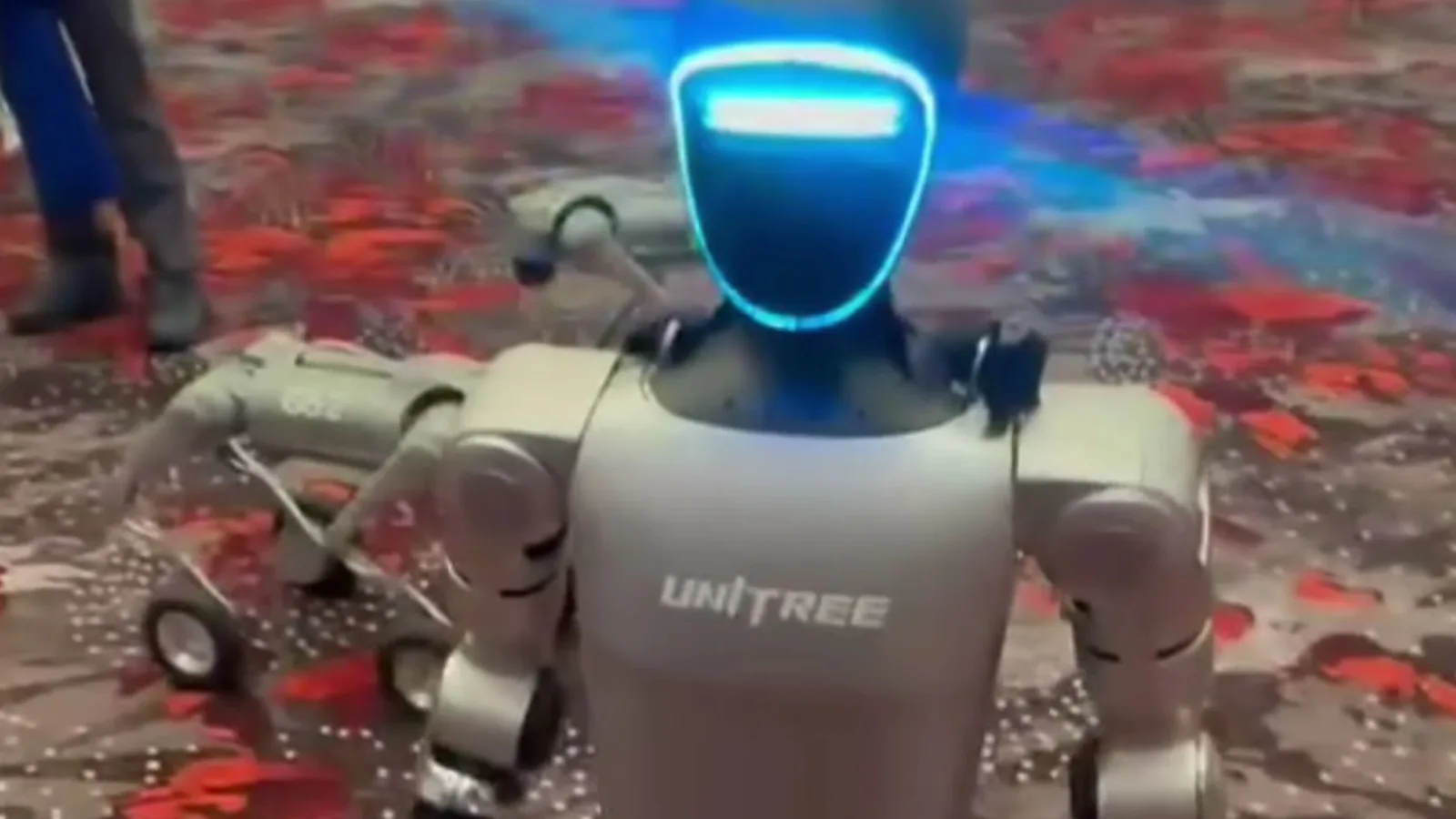
On Saturday afternoon, a white humanoid robot walked into a living room, stepped around a cardboard box, crossed a hallway and sat down on a couch — and r/singularity could not look away. The 46-second clip, posted by u/141_1337, passed 440 upvotes and 80 comments within hours, and the title did the heavy lifting: Apple researchers, a Mac mini, a Qwen model running locally, a Unitree G1, trained on a thousand simulated homes, 91% success across 360 real-world trials. Almost all of it checks out. The part that does not is worth naming first.
What the video actually shows#
The clip is a montage, not a single continuous take. A white Unitree G1 stands in a living room next to a table, a cardboard box on the floor in its path; a person moves — the thread’s word is kicks — the box out of the way. The robot walks down a wood-floor hallway with a person following behind, filming. It ends seated on a chair or couch in a bedroom or living area. The sitting and the room-to-room navigation are visible on camera. The crawling-under-a-table moment the title promises is not clearly visible in the frames sampled — the project page’s own description of the demo run is “crouch under the table, push the box, follow the person, go through the door, go to the chair, sit,” which suggests the table sequence exists in the fuller footage even if this cut does not linger on it.
The poster’s own source comment, posted three minutes after the video, links the project page and the paper, and both check out. The paper is “Perceptive Humanoid Motion from Simulation,” submitted to arXiv on November 4, 2026, by Siyuan Hu, Abulikemu Abuduweili, Yue Meng, Shipeng Liu, Quentin Leboutet, Chen Chen, Matthias Müller and Vladlen Koltun, with the project hosted on Apple’s machine-learning research pages under the name HALO. Its abstract matches the post’s numbers almost verbatim.
What HALO is#
HALO attacks the problem every humanoid lab is stuck on: there is no large dataset pairing what a robot sees and hears with the joint commands that move it, and collecting one by teleoperation costs at least an hour of human time per hour of data. Apple’s answer is to stop collecting and start synthesising. HALO generates vision-language-motion data across a thousand procedurally generated homes — the corpus scales with compute rather than human labour — and trains a system that turns pixels and free-form language into motion. The repertoire it acquires includes sitting on chairs, navigating to named objects, stepping sideways through half-open doors, crouching and crawling beneath tables, and pushing boxes, then chaining those skills into composite, long-horizon tasks.
The headline result is the transfer. Without ever seeing a real home during training, HALO moved zero-shot to the physical world and hit a 91% success rate across 360 trials in six unmapped real-world environments, according to the paper. That is the number the post’s title leads with, and it is a real claim from a real paper — not a forum invention. It is also, as the thread immediately noticed, a number that says nothing about which trials failed, or what failing looked like.
The local brain — and the Mac mini footnote#
The detail that made the post travel is the local compute. Per Apple’s project page, HALO’s motion generator uses a frozen Qwen3.5-2B encoder running on the robot’s backpack compute unit — the model lives on the machine, not in a data centre. That is a genuinely interesting design choice: a 2-billion-parameter open model from Alibaba steering an Apple research system on a Chinese-built robot, all of it running on the robot itself. One commenter summed up the supply chain with a raised eyebrow; another asked whether the Apple researchers were, as the title implies, “in the room with us right now.”
One word in the title, though, does not survive contact with the sources. The post says the robot is controlled by a Mac mini. Neither the paper’s abstract nor Apple’s project page mentions a Mac mini anywhere — the compute is described as the robot’s backpack unit. That does not make the Mac mini claim false; a Mac mini could be involved somewhere in the setup without being named in the paper. But it is unverified, and this article does not repeat it as fact. It is a useful reminder that a viral title can be 90% paper-accurate and still smuggle in one detail nobody checked.
What Reddit pushed back on#
The top comments do not dispute that the footage is real. They dispute what it proves. The most pointed, with 21 upvotes, calls the test rigged: the robot walked through an open living room, an open hallway and an open bedroom and sat on a couch at the end, a route close enough to a straight line that it would have made it either way — and a person had to move the box. “They invented a robot that can sit down and relax while I move the box,” another commenter wrote. A third noted that the phrase “crawls under tables” is doing a lot of heavy lifting from a video that does not clearly show it.
Then there is the 9%. “Alternatively, the robot fails a tenth of the time,” one commenter wrote. “That’s completely untrustable in a home.” Another: “91%? Call me when it gets to 100%. That other 9% could be accidental house fires or leaving the front door open.” The scepticism is fair as far as it goes — a research success rate is not a product reliability figure, and a home robot that fails one time in ten is a liability, not an appliance. But it also misses what the paper is actually claiming: not that a home robot is ready, but that simulation-only training can transfer to unseen real homes at all, at 91%. The interesting question is whether that number climbs with more simulated homes, not whether 91% is already good enough for your living room.
A smaller thread argued about how much AI is even involved. One commenter suggested the tasks are simple enough that the G1’s sensors building a 3D map plus preprogrammed actions could cover them. Another asked how “locally controlled” squares with “autonomous” — answered, correctly, that local means the model is hosted on the robot rather than in a cloud data centre. The poster, for his part, spent the afternoon in the replies arguing that mass-market cleaning robots arrive around 2032 to 2035, and that the constraint is the supply chain for hardware that can run local 100-billion-parameter models.
Why it matters#
HALO matters for two reasons that have little to do with sitting on a couch. The first is the data bottleneck. If procedurally generated simulation can produce the training corpus for generalist humanoid motion, the field stops being gated by how many hours of teleoperation a lab can afford — and Apple, which has never shipped a humanoid, can iterate on home robotics without owning a fleet of robots in real homes. The second is the local-model angle: a frozen 2B encoder running on the robot is a bet that household robots will be private by architecture, not by policy. No video leaves the house, because nothing needs to.
It also lands in a week when humanoid demos are piling up faster than anyone can verify them. Theo, the wheeled humanoid restocking a Zurich supermarket at night, drew the same treatment from the same community days earlier — believed footage, contested rate claim. And the G1 itself is becoming a familiar face: a GPT-6 Astra demo had the same robot tidying an unseen room in September. The pattern is now legible: the robot is the stage, and the argument is always about the claim stapled to it.
What to watch#
Three things. First, the code and videos Apple promises on the HALO project page — independent replication is what turns a 91% claim into a result. Second, whether the success rate holds as the tasks get harder: sitting and walking are the easy end of the repertoire, and the paper’s own skill list points toward manipulation next. Third, whether Apple says anything at all about humanoids beyond the paper — HALO is a research publication, not a product announcement, and the gap between the two is where most humanoid hype goes to die.
Until then, the fair description stands: a real paper, a real robot, a real 46-second clip, a 91% figure that is real and narrow at the same time — and a Mac mini that may or may not have been in the room.
Sources: the original post by u/141_1337 on r/singularity; “Perceptive Humanoid Motion from Simulation” on arXiv; the HALO project page at Apple Machine Learning Research. Commenter claims are reported as thread claims, not independently verified. The photographs are CC0 / CC BY 4.0 via Wikimedia Commons.