Nvidia releases Nemotron 3.5 Transcribe, an open speech model that covers 40 languages in a single pass
Transcription used to mean chaining tools: one model to turn speech into text, another to say who spoke when, a third to translate, a fourth to answer questions about what was said. Nvidia’s Nemotron 3.5 Transcribe, released on October 28, collapses that chain into a single open-weight checkpoint — and it is aimed squarely at the meeting room and the clinic, the two places where recorded speech already pays the bills.
- What it is: Nemotron 3.5 Transcribe, a free open-weight speech model released by Nvidia on October 28, 2026, alongside version 2 of its Granary open speech dataset.
- What it does: transcribes 40 languages, translates 31 to and from English, attributes speakers in 13 languages, labels up to eight speakers, and handles recordings up to an hour long — in a single model pass.
- How it is built: a 30-billion-parameter mixture-of-experts model with about 4 billion active parameters, pairing a speech encoder with a hybrid Mamba-Transformer language model.
- Where it runs: a single Nvidia GPU, from the Jetson AGX Thor edge controller and DGX Spark desktop system to Blackwell data-centre chips; Nvidia says a Blackwell Server Edition GPU at NVFP4 precision processes 100 hours of audio in under three minutes.
- The catch: it works on recorded audio, not livestreams — so live captioning and real-time agents are not its job.
Nvidia announced the model on Wednesday alongside version 2 of its Granary speech dataset. The model is free and open-weight, and the company says it beats rivals on public transcription leaderboards.
The release matters less for any single capability than for the packaging. Each of these jobs already has good tools. What is new is one freely available model doing all of them, steered by plain-language instructions, on hardware as small as one GPU — so any team willing to download weights and fine-tune them for its own jargon can build a transcription product without renting a commercial speech API.
One model instead of a pipeline#
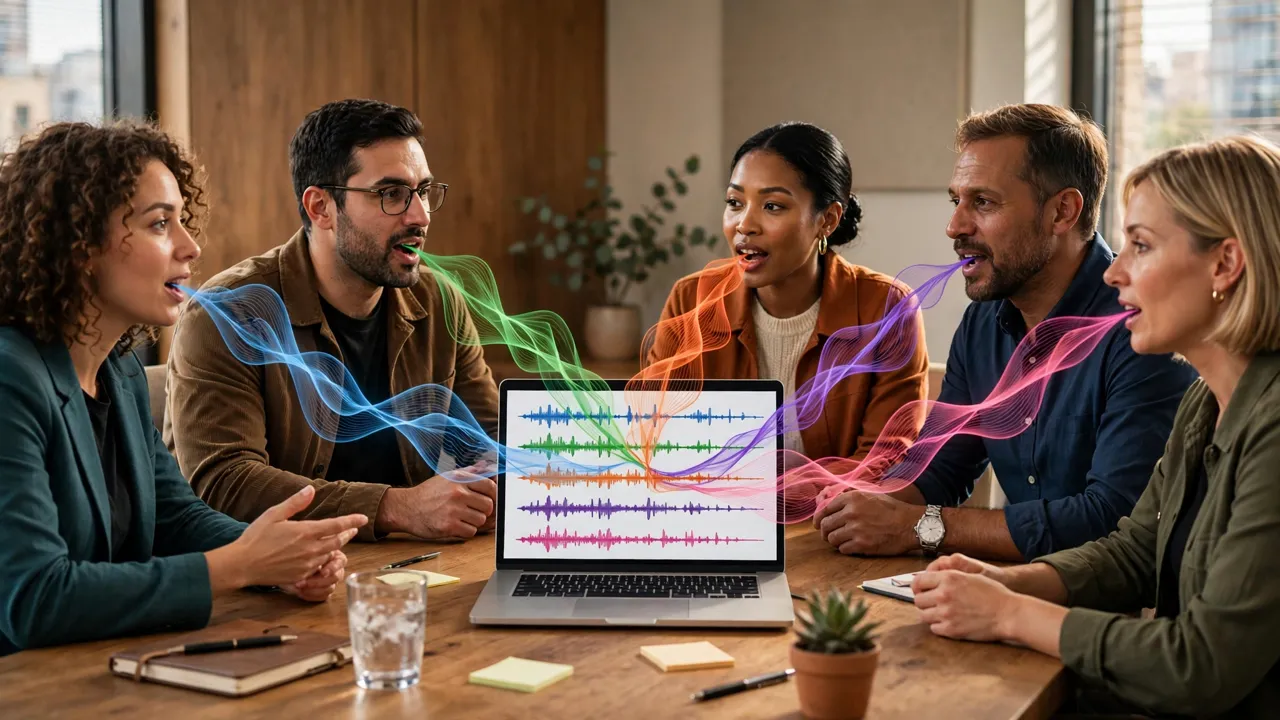
The traditional transcription workflow is a relay: speech is detected, transcribed, passed to a diarization step that labels speakers, then to translation or question-answering. Every handoff is a place for errors to compound. Transcribe does the whole job in one pass: audio goes in, and a text instruction decides what comes out.
The numbers Nvidia puts on it are broad. The model transcribes 40 languages and translates 31 of them to and from English. It attributes speakers in 13 languages and can label up to eight speakers in a recording. It handles files up to an hour long. And because the output is promptable, the same checkpoint can produce a verbatim transcript with every “um” intact, a cleaned-up version, a speaker-labelled version, a translation, or answers to questions such as what decisions a meeting reached.
Prompts can also carry product names or medical terms, so the model hears specialized vocabulary the way its users do — and Nvidia positions it as a transcription specialist rather than a general assistant, since the right transcript depends on who will read it.
Small where it counts#
Transcribe is a 30-billion-parameter mixture-of-experts model, but only about 4 billion parameters are active for any given token. The architecture pairs a speech encoder with a hybrid Mamba-Transformer language model, and that sparsity is the point: accuracy close to much larger systems at a fraction of the compute per token.
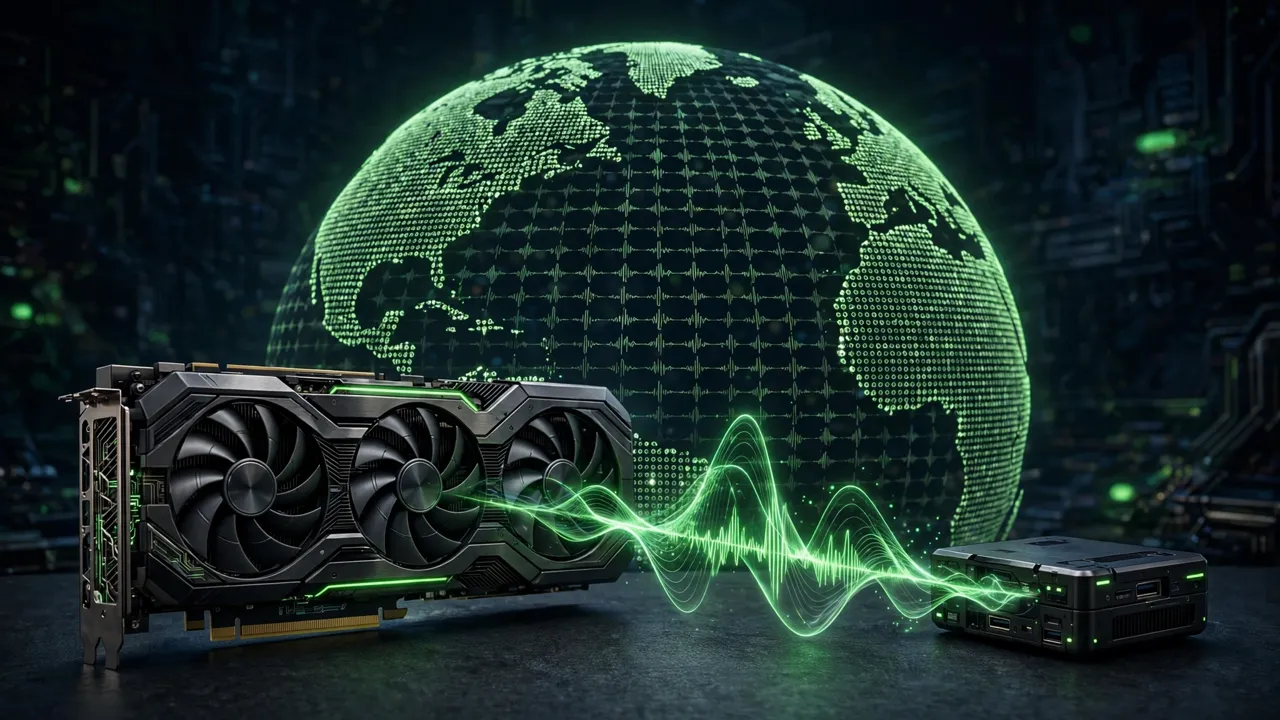
In practice, Nvidia says the model runs on one GPU across its whole range — from the Jetson AGX Thor robotics controller and the DGX Spark desktop system up to Blackwell data-centre chips. With NVFP4 precision and quarter-size compression, the company says a Blackwell Server Edition GPU chews through 100 hours of audio in under three minutes. The weights are released under the OpenMDW-1.1 licence, which permits commercial use, and the model is available on Hugging Face with an interactive demo.
On benchmarks, Nvidia says Transcribe ranks first among open-weight models on Hugging Face’s English Open ASR Leaderboard, and reports a 2.8% score on Artificial Analysis’ speech-to-text index, tied with Mistral’s Voxtral Small — a model with roughly six times as many active parameters. Those are company-reported figures, not independent audits, and commercial APIs still lead on the multilingual board overall. The honest reading: the open field has a new front-runner, and the gap to paid services is now about specific languages and settings rather than a different league.
The dataset behind it#
The quieter half of the release is Granary v2, the open speech dataset and curation pipeline behind the model. Built with Nvidia’s NeMo Curator, its public manifest covers 463,062 hours of audio across 48 languages and 16 source corpora — nearly double the 25 languages of the first Granary. Developers get the audio from its original sources, under each source’s licence, rather than as one redistributed blob.
Granary v2 also explains the model’s flexibility. It generates three transcripts for each recording: one with everything, fillers included; one that normalizes wording into written form, turning spoken numbers into figures; and one that strips filler words. Those three styles are exactly what Transcribe can be prompted to produce, and they give fine-tuners a ready-made way to teach the model a house style.
Nvidia’s own fine-tuning example shows why that matters. Trained on medical speech from Indian doctors, the model cut errors sharply on held-out test clips for that domain — the kind of result that turns a general transcription model into a product for hospitals, law firms, or call centres with their own vocabularies.
A crowded voice month#
Transcribe lands in the middle of a busy stretch for voice AI. Mistral shipped Voxtral 3 earlier in October, ElevenLabs launched a real-time speech product for voice agents, and Salesforce released its Launa-Omni voice model. Nvidia itself already had a foothold with Parakeet, its tiny 1.1-billion-parameter transcription model; Transcribe is the bigger sibling for jobs where accuracy and speaker handling matter more than latency. One boundary: it handles recorded audio, not livestreams, so live captioning still needs streaming models. Business meetings and medical transcription — two of the most established commercial uses of speech AI — both run on recordings, which is where this model aims.
What to watch#
Three things will tell whether this release matters beyond launch week. First, the fine-tunes: if hospitals, legal teams, and multilingual support desks publish domain-tuned versions, Transcribe becomes infrastructure rather than a demo. Second, the leaderboard gap: whether independent testing confirms the open-weight lead. Third, Granary v2 itself: a 463,000-hour open corpus with three transcript styles could become standard training material for the next wave of speech models.
The broader shift is worth naming. Transcription was one of the first AI capabilities to go from research curiosity to boring utility, and utilities get judged on cost, control, and coverage — not on demo magic. An open model that runs on one GPU, covers 40 languages, and can be taught a company’s vocabulary is a bid to own that utility layer. Whether developers take it up depends on the least glamorous question in AI: how accurate it is on their audio, in their language, with their jargon. The weights are out. Now the audits begin.
Sources: Nvidia’s October 28, 2026 release as reported by TechCrunch and SiliconANGLE, with additional details from Unite.AI. Benchmark figures are as reported by Nvidia. Cover and inline images are AI-generated editorial illustrations.